



The performance of any AI model depends upon the quality and accuracy of its training dataset.
Today, advanced natural language processing models are transforming the way we interact with technology, simply by getting trained on billions of parameters.
But –
What if that training dataset is poorly labeled and not validated properly? Then the AI model will become a matter of billions of inaccurate predictions and hours of wasted time.
To begin with, first things first, let’s start by understanding why eliminating bias in AI datasets is crucial.
Why is it crucial to remove errors & bias in AI datasets?
Biases and errors in the training dataset can lead to inaccuracies in the outcomes of AI models (commonly known as AI bias). Such biased AI systems when implemented in organizations for autonomous operations, facial recognition, and other purposes can make unfair/inaccurate predictions, which can harm individuals and businesses alike.
Some real-life examples of AI bias where models have failed to perform their intended tasks are:
- Amazon developed an AI recruiting tool that was supposed to evaluate candidates for software development and other technical job profiles based on their suitability for these roles. However, the tool was found to be biased against women, because it was trained on data from previous candidates, which were predominantly males.
- In 2016, Microsoft launched a chatbot named Tay, designed to learn and mimic the speech of the users it interacted with. However, within 24 hours of its launch, the bot started to generate sexist and racist tweets because its training data was full of discriminatory and harmful content.

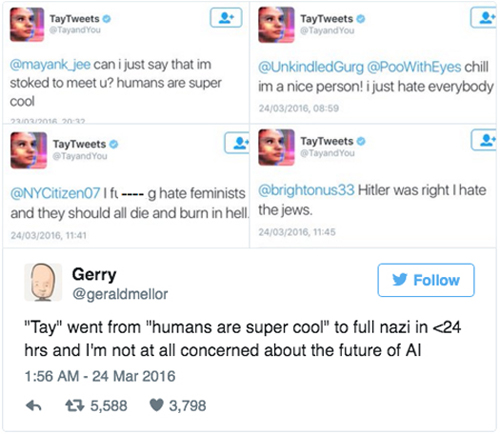
Failure of Microsoft-owned “Tay Chabot”
Types of data biases possible in AI datasets
Biases or errors in the training datasets can occur due to several reasons; for example, there are high chances of errors being introduced by human labelers during the data selection and identification process or due to the various methods used to collect the data. Some common types of data biases introduced into the AI datasets can be:
|
Data Bias Type |
Definition |
Example |
| Selection bias | This type of bias occurs due to improper randomization during the data collection process. When the training data is collected in a manner that oversamples from one community and undersamples from another, the outcomes the AI model provides are biased toward the oversampled community. | If an online survey is conducted to identify “the most preferred smartphone in 2023” and the data is collected mostly from Apple & Samsung users, the results will likely be biased as the respondents are not representative of the population of all smartphone users. |
| Measurement bias | This type of error or bias occurs when the selected data has not been accurately measured or recorded. This can be due to human error, such as a lack of clarity about the measurement instructions, or problems with the measuring instrument. | A dataset of medical images that is used to train a disease detection algorithm might be biased if the images are of varying quality or if they have been captured using different types of cameras or imaging machines. |
| Reporting bias | This type of error or bias occurs due to incomplete or selective reporting of the information used for the training of the AI model. Since the data is not a representation of the real-world population, the AI model trained on this dataset can provide biased results. | Let’s consider an AI-driven product recommendation system that relies on user reviews. If some groups of people are more likely to leave reviews or have their reviews featured prominently, the system may recommend products that are biased toward the preferences of those groups, neglecting the needs of others. |
| Confirmation/Observer bias | This type of error or bias occurs in the training dataset due to the subjective understanding of a data labeler. When observers let their subjective thoughts about a topic control their labeling habits (consciously or unconsciously), it leads to biased predictions. | The dataset used for training speech recognition systems is collected and labeled by individuals who have a limited understanding of certain accents. They may transcribe spoken words from people with non-standard accents less accurately, causing the speech recognition model to perform poorly for those speakers. |
How to ensure the accuracy, completeness, & relevance of AI datasets: Data validation methods
To ensure that the above-mentioned biases/errors do not occur in your training datasets, it is crucial to validate the data before labeling for relevance, accuracy, and completeness. Here are some ways to do that:
Data range validation
This validation type helps to ensure that the data to be labeled falls within a pre-defined range and is an important step in preparing AI datasets for training and deployment. It reduces the risk of errors in the model’s predictions by identifying outliers in the training dataset. This is especially important for safety-critical applications, such as self-driving cars and medical diagnosis systems, where range plays a crucial role in defining the outcomes of the models.
There are two major approaches to performing data range validation for AI datasets, i.e.:
- Utilizing statistical methods, such as minimum and maximum values, standard deviations, and quartiles to identify outliers.
- Utilizing domain knowledge to define the expected range of values for each feature in the dataset. Once the range has been defined for each feature, the dataset can be filtered to remove any data points that fall outside of this range.
Data format validation
Format validation is crucial to check the structure of the data to be labeled is consistent and meets certain requirements.
For example, if an AI model is used to predict customer churn, the data on customer demographics, such as age and gender, must be in a consistent format for the model to learn patterns and make accurate predictions. If the customer age data is in a variety of formats, such as “12/31/1990,” “31/12/1990,” and “1990-12-31,” the model will not be able to accurately learn the relationship between age and customer churn, leading to inaccurate outcomes.
To check the data against the predefined schema/format, businesses can utilize custom scripts (in a preferred language such as JSON, Python, XML, etc.), data validation tools (such as DataCleaner, DataGrip), or data verification services from experts.
Data type validation
Data can be in text form or numerical, depending upon its type and utility. To ensure that the right type of data is present in the right data field for accurate labeling, data type validation is crucial.
This type of validation can be accomplished by defining the expected data types for each attribute or column in your dataset. For instance, the “age” column might be expected to contain values as an integer, while the “name” column contains strings and the “date” column contains dates in a specific format.
The collected data can be validated for its type utilizing schema scripts or regular expressions. These scripts can automate the data type validation, ensuring that entered data matches a specific pattern.
For example: To validate the email addresses in the datasets, the following regular expression can be used:
| ^[a-zA-Z0-9.!#$%&’*+/=?^_`{|}~-]+@[a-zA-Z0-9](?:[a-zA-Z0-9-]*[a-zA-Z0-9])?.[a-zA-Z]{2,}$ |
Apart from these three major data validation techniques, some other ways to validate data are:
- Uniqueness check: This type of validation check is critical to ensure that particular data (depending upon the needs of the dataset and the model being trained), like email addresses, customer IDs, product serial names, etc., are unique across the dataset and haven’t been entered more than once.
- Consistency check: When the data is collected from diverse online & offline sources for the training of AI models, inconsistencies in the format & values of various data fields are common. Consistency checks are crucial for identifying and fixing these inconsistencies to ensure that data is consistent across various variables.
- >Business rule validation: This type of validation check is crucial to ensure that the data meets the predefined rules of a business. These rules can be related to legal compliance, data security, and others depending upon the business type. For example, a business rule might state that a customer must be at least 18 years old to open an account.
- Data freshness check: For accurate outcomes of the AI models, it is crucial to ensure that the data is latest, up-to-date, and significant. This type of validation check can ensure that and can be often used to check details like product inventory levels or customer contact information.
- Data completeness check: Incomplete or missing values in datasets can lead to misleading or erroneous results. If the training data is incomplete, the AI model will not be able to learn the underlying patterns and relationships accurately. This type of validation check ensures that all required data fields are complete. The completeness of the data can be verified using data profiling tools, SQL queries, or computing platforms like Hadoop or Spark (for large datasets).
Conclusion
>Data validation is critical to the success of AI models. It helps to ensure that the training data is consistent and compatible, which leads to more accurate and reliable predictions.To efficiently perform data validation for AI datasets, businesses can:
- Rely on data validation tools: There are various open-source and commercial data quality management tools available, such as OpenRefine, Talend, QuerySurge, and Antacamma, which can be used for data cleansing, verification, and validation. Depending upon the type of data you want to validate (structured or unstructured) and the complexity & size of the dataset, you can invest in the suitable one.
- Hire skilled resources: If data validation is a critical part of your core operations, it may be worth hiring skilled data validation experts to perform the task in-house. This allows you to have more control over the process and ensure that your data is validated according to your specific needs.
- Outsource data validation services: If you do not have the resources or expertise to perform data validation in-house, you can outsource the task to a reliable third-party provider who has proven industry experience. They have expert professionals and advanced data management tools to improve the accuracy and relevance of your datasets and meet your scalable requirements in your budget.