



Research reveals that businesses waste around 80% of the data they generate. This equates to wasted insights, knowledge, and potential. However, this is not surprising given that some companies still handle data manually, which is a tedious and time-consuming task.
Automated data collection tools will help you capture all the data lingering within your company, as well as data coming from relevant external sources. And you can contract a data analytics services provider to make sense of all this data and derive insights that will transform your business.
So, what is automated data collection?
Automated data collection is the process of harvesting data automatically from various sources without human intervention and storing it at the corresponding location in your company’s database/system.
It’s common to use AI algorithms to capture different types of data. For instance, speech recognition models can collect data from audios and optical character recognition models can analyze text. Some of these tools can also categorize information and produce useful insights.
Which types of data can these tools process?
- Structured data is highly organized data that can be “read” by both humans and machines, such as Excel spreadsheets, tabular CSV worksheets, and SQL databases.
- Unstructured data isn’t arranged according to a predefined data model, making it harder for software tools to read, collect, and analyze. Free text is a common type of unstructured data, but it also includes images, web pages, and video content. Research suggests that around 80-90% of data that is accessible to you is unstructured.
- Semi-structured data is a middle ground between the two types mentioned above. It doesn’t conform to a specific semantic data model and yet has some structure. One example is XML files that are structured but don’t necessarily carry semantic meaning.
To put things into perspective, let’s take Rossum as one example of a credible automated data collection vendor. The company’s solution deploys self-learning AI algorithms to extract unstructured data without relying on a predefined template. Rossum’s tool has two phases – extraction and validation. During validation, the algorithm assigns confidence scores and prompts human experts to review data with scores falling below the threshold.
Automated vs. manual data capturing
Some businesses still rely on manual data entry, overloading their staff. This process includes typing or copy-pasting information from one source to another, transcribing audio files, etc. Capturing data manually is time-consuming. And since employees are busy with trivial tasks, they can’t perform duties that require their qualifications and expertise.
Additionally, statistics show that manual data entry is prone to error. Take healthcare as an example. Any mistake in this field can potentially be life-threatening. Manual data capture is still common there even though it’s proven to have an error rate of 3-4%.
If your error tolerance is low, it’s time to consider automated data collection.
Benefits of automated data collection
- Reducing errors and ensuring higher data quality. Errors are common in manual data entries despite people’s diligence and expertise. Such mistakes include mistyped data, missing entries, duplicated entries, and more. Unlike humans, AI and robotics process automation (RPA)-powered tools don’t make mistakes because they are tired or emotional. Also, you can include validation as a part of the automated data collection process to ensure accuracy.
- Saving time on manual tasks. Collecting data is a tedious task if done manually, and automated tools are simply faster in retrieving information from large datasets than people.
- Improving scalability. As your operations expand and the amount of collected data grows, you will be forced to hire additional staff members to cope with the increasing workload. When you rely on automated data collection methods, your system can scale accordingly. Unlike human employees, bots can work 24/7 if needed without asking for a raise.
- Decreasing costs. Even though implementing an automated data collection solution seems like an expensive option at first glance, it will free you from manual labor expenses in the long run. Not to mention that manual data collection is ridden with errors, which can also result in hefty fines and reputational damage.
Automated data collection methods
After learning about the benefits of automation, let’s see how to automate data collection.
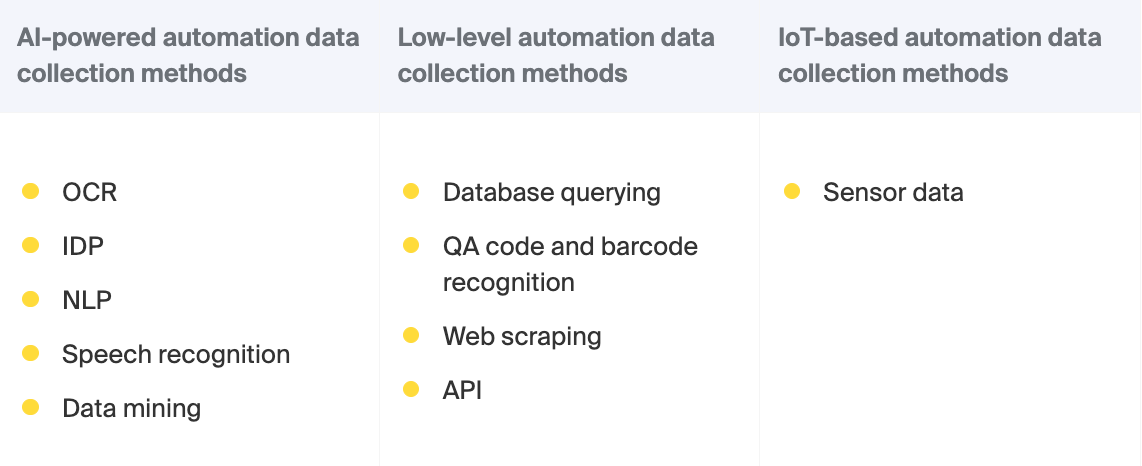

OCR, OMR, ICR
Optical character recognition (OCR) is an AI-powered technology that can “understand” typed and scanned documents, PDF files, and text in images. The technology can work with financial documents, legal reports, and patient information, to mention a few examples.
Intelligent character recognition (ICR) is a more advanced form of OCR specializing in handwritten text. Identifying handwritten characters is complicated because every person has their own unique writing style.
Optical mark recognition (OMR) can capture human-marked information, such as answers to multiple-choice questions and poll results.
Intelligent document processing (IDP)
IDP is an advanced AI-powered technology that can read and understand documents, categorize them, and search for specific information within one file. For example, it can read an invoice, extract an account number, and connect it to the account holder’s address. IDP is particularly useful for document-heavy sectors, such as insurance, law, and banking.
Natural language processing (NLP)
NLP is a field of artificial intelligence that interprets and generates written human language. You can combine it with speech recognition to handle audio. One application of NLP solutions is to perform sentiment analysis and gauge customer perception of their brand based on data from different sources.
Speech recognition
Speech recognition tools can decipher human voice and extract and classify data from human speech. Businesses can deploy voice recognition to automatically collect data from verbal customer surveys, while hospitals can use it to capture data from doctors’ speech and enter it in the corresponding patient’s EHRs.
Data mining
Data mining techniques aim to discover trends, patterns, and other valuable information in large datasets. In other words, it helps make sense of vast amounts of data that can’t be processed manually. For instance, financial institutions can use data mining to analyze financial transactions and detect signs of fraud. And retailers can apply this technique to detect customer sentiment on web pages with client reviews.
Low-level automated data collection methods
Database querying
Database querying refers to automatically retrieving specific data from a database through systematic queries that are executed at predefined time periods or in response to a trigger. For example, a bank can use this automated data collection method to systematically query its transactions database and aggregate information from different branches to compose profit-and-loss statements.
QR code and barcode recognition
This automated data collection method involves processing coded images that contain encrypted data, such as barcodes and QR codes.
The retail sector uses this technique to track stock levels, display additional information about products, and enable customers to make payments. For instance, Starbucks lets clients scan QR codes to learn about their favorite beverages. And Amazon Go relies on QR codes to enable its checkout-free stores.
Web scraping
A scraping bot crawls the web to extract data from websites. It can retrieve useful information, such as company contacts, industry statistics, product information, etc., and export the gathered data into a spreadsheet or any other format. More advanced tools can work with JSON files.
As websites come in different forms, scraping tools also vary in functionality. Some can even bypass CAPTCHA. One application of web scraping tools is gathering relevant information from business directories and social media profiles to help companies with lead generation.
Application programming interface (API)
Many online platforms offer an API that others can use to access structured data through API calls. For instance, a social media platform can provide an API that allows different software bots to perform social media monitoring.
Keep in mind that not every online resource offers an API; in other cases, an API may not be well-documented, making it hard to access.
IoT-based automated data collection
Sensor data collection
In the context of the Internet of Things (IoT) applications, sensors can help automatically capture different types of data. For example, in predictive maintenance use cases, sensors attached to a device can gather its temperature, vibration, and other parameters to look for anomalies in the device’s condition. In healthcare, IoT devices can capture patients’ vital signs to help monitor chronic diseases and other disorders.
Key business applications of automated data collection
Below are five examples of how you can use automated data collection methods combined with data analytics solutions and machine learning to strengthen your position among the competition.
You can find an insightful guide on how to prepare your data for machine learning on our blog.
Use case #1: Empowering you with the right information to make sound decisions
The more data you have, the deeper your understanding of upcoming trends and your own processes. Here is how automated data collection can support you in decision making:
- Speeding up market research. You can rely on web scraping bots to crawl social media and other online platforms to capture the newest market trends and competitor activities. Having all this information at your disposal will help management prioritize production and other processes.
- Tracking employee performance. An automated data collection process can also support internal HR decisions. The tools can gather data on employee attendance, performance, and levels of engagement and volunteering at the company, which helps decide on promotions and identify training and education opportunities.
Real-life examples:
- Starwood hotels pull data on the economic situation, local events, and weather conditions from a variety of sources to adjust their dynamic pricing. For instance, if a famous performance takes place at the local theater, they modify room pricing at nearby hotels accordingly.
- Netflix analyzed over 30 million shows and 4 million customer ratings to bet on movies and series that later became big hits.
Use case #2: Shedding light on productivity hurdles
You can use automatically gathered data to:
- Streamline internal operations. Automated tools can aggregate data on different tasks associated with the production process, or any other process at your organization. Analyzing this data will give you an idea of any inefficiency or blockers in your flow. Not to mention that gathering data automatically is already more productive than doing it manually.
- Facilitate predictive maintenance. Unplanned equipment downtime can lead to as much as 20% loss in productivity. Companies can avoid this by automatically aggregating sensor data on equipment parameters to pinpoint devices that are showing early signs of malfunctioning and fix them at the right time without hindering the rest of the process.
Real-life example:
A study published in the Journal of Nursing Administration shows how automatically collecting patients’ vital signs measurements and transferring them to the corresponding EHR fields reduced errors by 20% compared to manual entries, and the measurement time by up to two hours per measurement in some cases, thereby increasing nurses’ productivity.
Use case #3: Steering your marketing campaigns in the right direction
Aggregating data from different sources, such as product review sites and social media platforms, will help you segment the target audience and understand customer behavior. With this knowledge, marketers can craft personalized campaigns and advertise products and services to people who will be the most receptive to it, instead of sending annoying generic messages to everybody.
Automated data capture can improve lead generation as it can assign scores to prospects to understand their interaction with your products and determine potential buyers/partners/collaborators.
Real-life examples:
- American Express aggregated data on 115 variables, including customers’ historical transactions, to foresee and mitigate customer churn. The company was successful in predicting 24% of the accounts that actually closed within a few months.
- Amazon relies on enormous volumes of customer data, such as purchases, engagements, wish lists, etc., and analyzes this information to come up with targeted ad placements to user subgroups.
Use case #4: Ensuring optimal inventory levels
If you are using sensors to monitor products in stock, automated data collection tools can aggregate inventory data together with sales stats, demand patterns, and general market trends. With this combination, you will know when to restock products to match the increasing demand and when you can avoid expensive replenishment of a product that is not trending anymore.
Real-life example:
A large manufacturing and distribution company, Aliaxis, combines its own data on production schedules and sales records with external data, such as supplier information, customer reviews, and more to manage its inventory. With the help of data analytics, the company managed to:
- Predict demand and maintain optimal stock levels
- Identify outdated inventory practices
- Evaluate supplier performance based on delivery times, product quality, and pricing. Aliaxis used these insights to renew/terminate partnerships and negotiate supplier contracts.
Use case #5: Maintaining top-notch product quality
Here is how analyzing data collected automatically can help monitor product quality at different stages of the production process:
- Aggregating data from production lines in real time looking for defective equipment or an intermediate product that doesn’t match quality standards in its weight, material composition, etc.
- Evaluating the characteristics of raw materials to be used in production
- Inspecting the final product for color variation, shape irregularities, etc. to spot non-conforming pieces
Also, companies can use all this quality evaluation data to automatically generate comprehensive quality documentation, get insights on how to improve production, and make sure products remain compliant with the industry standards.
Real-life example:
Intel employed big data to find a way to shorten the chip quality assurance process. These chips traditionally undergo around 19,000 tests on the production line. By analyzing large amounts of historical data, the company decided to concentrate on specific tests at the wafer level, decreasing quality control time by 25% and saving $3 million on one production line.
Obstacles to automated data collection
Even though automated data capturing has proven benefits, there are challenges in the way that you will need to consider.
- Data management and verification. Who is responsible for verifying and maintaining the collected data? How long will this data remain in your system? Can individuals access their personal data and delete it if they want to? It’s imperative that your company establishes strong data governance practices, and benefits from external data management services if needed, to address all concerns related to maintaining large data volumes.
- Data quality can suffer. Automated techniques can accumulate large amounts of data which is impossible to verify manually. So, unless you have a strong validation system, automated data collection tools can start adding inferior quality, inconsistent data. This is a dangerous practice as it can cause other applications depending on this data to malfunction. It can influence the decisions you make and result in missed opportunities.
- Data ownership and privacy violations. Every location has its requirements when it comes to data privacy. When you capture large data volumes daily, it can become challenging to ensure proper anonymization, obtain consent, and give people control over their personal information. However, failure to comply can lead to financial losses and reputational damage.
- Data security. When you store more data, you can become a more appealing target for cybercriminals. So, it makes sense to strengthen your security protocols to protect the data against unauthorized access. To put things in perspective, Statista reported 6,4 million data branches worldwide in the first quarter of 2023 alone.
- Integration issues. Automated data collection tools capture data from different sources, such as databases, website APIs, etc., resulting in a heap of information that is inconsistent, duplicated, and lacking unified formatting. However, for this data to be useful, it needs to be stored in a coherent and usable view.
- Implementation costs. As we established previously, automating the data collection process reduces labor costs, but may introduce a cost of its own. There is the initial investment to acquire and integrate the system. Then, the system needs to be updated, maintained, and protected. And the company will still train human employees to properly use this system.
So, where do you go from here?
If you operate a small business that needs to have access to a modest amount of data and has a high tolerance for data handling errors, then you are fine with manual data collection and processing. Otherwise, it’s best to consider exploring automated data gathering.
However, switching to automated data collection is just the beginning. To handle all the data in your possession, it’s advisable to install strong data management practices. And to further transform your operations, you can benefit from artificial intelligence software solutions, predictive analytics, and other powerful big data services. Here at ITRex, we have a proven track record with AI-powered technologies and will be happy to support you on your journey.
Want to transform into a data-driven organization? Drop us a line! We will help you automate data collection, implement data management practices, and build strong analytical AI-powered tools.