


The #COVID-19 #coronavirus has impacted countries, communities and individuals in countless ways, from school closures to health-care insurance issues not to undermined loss of lives. As governments scramble to address these problems, different solutions based on blockchain technologies have sprung up to help deal with the worldwide health crisis [2]
A blockchain is an essential tool for establishing an efficient and transparent healthcare business model based on higher degrees of accuracy and trust because technology is a tamper-proof public ledger. Blockchain will surely not prevent the emergence of new viruses itself, but what it can do is create the first line of rapid protection through a network of connected devices whose primary goal is to remain alert about disease outbreaks. Therefore, the use of blockchain-enabled platforms can help prevent these pandemics by enabling early detection of epidemics, fast-tracking drug trials, and impact management of outbreaks and treatment. [9]
But before we explore in detail the possible ways of using Blockchain to help in fighting this invisible enemy, we need to understand some of the challenges defining this deadly virus.
Major Challenges of COVID-19
- One major issue is how prepared the world’s health systems are to respond to this outbreak.
- Tracking a huge population of infectious patients to stop epidemics.
- Another is the immediate requirement for developing better diagnostics, vaccines, and targeted therapeutics.
- Misinformation and conspiracy theories spread through social media platforms.
- Various limitations while accessing the tools when required.
- No adequate measures to adopt in a crisis situation. [4][7]
Can Blockchain help in preventing pandemics?
With Blockchain we can share any transaction / information, real time, between relevant parties present as nodes in the chain, in a secure and immutable fashion. In this case, had there been a blockchain where WHO, Health Ministry of each country and may be even relevant nodal hospitals of each country, were connected, sharing real time information, about any new communicable disease, then the world might have woken up much earlier. We might have seen travel restrictions given sooner, quarantining policies set sooner and social distancing implemented faster. And may be fewer countries would have got impacted.
What every country is doing now fighting this pandemic, would have been restricted to fewer countries and in a much smaller scale. The usage of a Blockchain to share the information early on, might have saved the world a lot of pain.
The world had not seen anything like COVID-19 pandemic before in the recent history. Today we need to take a hard look at the reporting infrastructure available for communicable diseases, both technology and regulations and improve upon that, such that we do not need to face another pandemic like this in the future. [9]
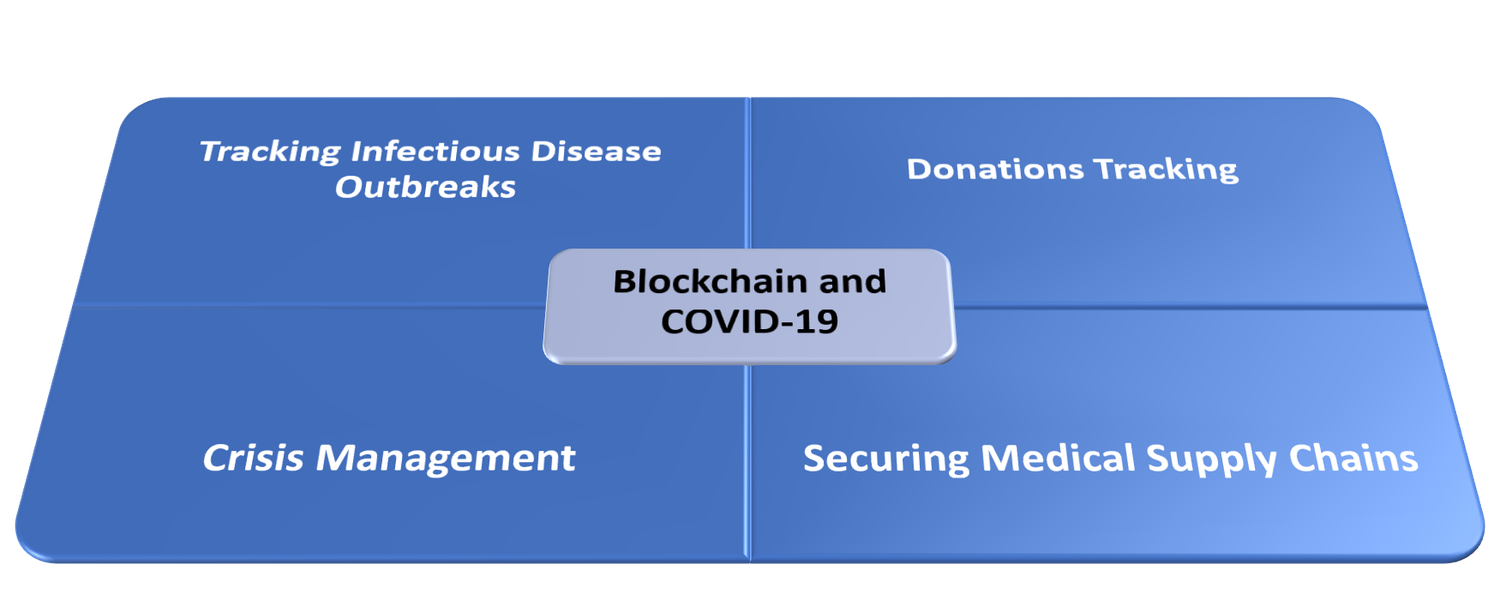
Blockchain Applications in fighting COVID-19
Tracking Infectious Disease Outbreaks
Blockchain can be used for tracking public health data surveillance, particularly for infectious disease outbreaks such as COVID-19. With increased blockchain transparency, it will result in more accurate reporting and efficient responses. Blockchain can help develop treatments swiftly as they would allow for rapid processing of data, thus enabling early detection of symptoms before they spread to the level of epidemics.
Additionally, this will enable government agencies to keep track of the virus activity, of patients, suspected new cases, and more. [9]
Donations Tracking
As trust is one of the major issues in donations, Blockchain has a solution for this issue.
There has been a concern that the millions of dollars being donated for the public are not being put to use where needed.
With the help of blockchain capabilities, donors can see where funds are most urgently required and can track their donations until they are provided with a verification that their contributions have been received to the victims. Blockchain would enable transparency for the general public to understand how their donations have been used and its progress. [9]
Crisis Management
Blockchain could also manage crisis situation. It could instantly alert the public about the Coronavirus by global institutes like the World Health Organization (WHO) using smart contracts concept.
Not only it can alert, but Blockchain could also enable to provide governments with recommendations about how to contain the virus. It could offer a secure platform where all the concerning authorities such as governments, medical professionals, media, health organizations, media, and others can update each other about the situation and prevent it from worsening further. [9]
Securing Medical Supply Chains
Blockchain has already proven its success stories as a supply chain management tool in various industries; similarly, #Blockchain could also be beneficial in tracking and tracing medical supply chains.
Blockchain-based platforms can be useful in reviewing, recording, and tracking of demand, supplies, and logistics of epidemic prevention materials. As supply chains involve multiple parties, the entire process of record and verification is tamper-proof by every party, while also allowing anyone to track the process.
This technology could help streamline medical supply-chains, ensuring that doctors and patients have access to the tools whenever they need them, and restraining contaminated items from reaching stores. [9]
WHO and Blockchain Technology
The World Health Organization (WHO) is working with blockchain and other tech companies on a program to help convey data about the ongoing COVID-19 pandemic, named #MiPasa.
The program is a distributed ledger technology (DLT) that will hopefully help with early detection of the virus and identifying carriers and hotspots.
MiPasa is built on top of Hyperledger Fabric in partnership with IBM, computer firm Oracle, enterprise blockchain platform HACERA and IT corporation Microsoft. It purports to be fully private and share information between need-to-know organizations like state authorities and health officials.
Described by creators as an information highway, MiPasa cross-references siloed location data with health information. It promises to protect patient privacy and to help monitor local and global trends such as the virus that has now sent the world spiraling into chaos and uncertainty in recent weeks.
The U.S., European, and Chinese Centers for Disease Control and Prevention, the Hong Kong Department of Health, the Government of Canada and China’s National Health Commission have all worked with the project. [4][5][9]
Ahmed Banafa, Author the Books :
Secure and Smart Internet of Things (IoT) Using Blockchain and AI
Blockchain Technology and Applications
Read more articles at : https://medium.com/@banafa
References
- https://btcmanager.com/us-authorities-blockchain-covid-19-critical-services/?q=/us-authorities-blockchain-covid-19-critical-services/&
- https://www.govtech.com/products/Blockchain-Emerges-as-Useful-Tool-in-Fight-Against-Coronavirus.html
- https://www.expresscomputer.in/blockchain/could-blockchain-be-the-solution-for-surveillance-and-reporting-of-the-covid-19-pandemic/51670/
- https://www.ibm.com/blogs/blockchain/2020/03/mipasa-project-and-ibm-blockchain-team-on-open-data-platform-to-support-covid-19-response/
- https://mipasa.org/about/
- https://www.ledgerinsights.com/us-homeland-security-lists-blockchain-as-covid-19-critical-service/
- https://www.pymnts.com/blockchain/bitcoin/2020/bitcoin-daily-who-debuts-mipasa-blockchain-to-share-covid-19-data-coinbases-retail-payments-portal-passes-200m-transactions-processed/
- https://www.rollcall.com/2020/03/31/blockchain-could-transform-supply-chains-aid-in-covid-19-fight/
- https://www.blockchain-council.org/blockchain/how-blockchain-can-solve-major-challenges-of-covid-19-faced-by-healthcare-sectors/
