


Big Data and IoT are influencing many industries today. Businesses are adopting Big Data technologies to improve themselves and to provide better value to customers. With the adoption of Big Data and (IoT) Internet of things, the manufacturing industry which is a highly automated industry, can rapidly reduce machine downtime and improve efficiencies with predictive maintenance. Better control can be gained over machine operations through real-time monitoring of assets across the globe.
Challenges
- Machines produce a lot of data but most of the time, this data does not go out of the system. That is because these machines rarely communicate with the external world.
- Companies that do collect data, usually use this data only for tracking purposes.
- Handling large amounts of high velocity data requires skilled resources.
- Data collection has to be done from shop floors across geographically distributed locations.
Case for use of Big Data
- Improves efficiency Data collected during machine operation can be used to identify running patterns, correlate different events across the organization, and use predictive models to identify patterns that lead to machine downtime.
- Operational performance Efficient use of Big Data can enhance operational performance by real-time monitoring of data collected across geographically distributed locations. Data collected across different dimensions can be sliced and diced to understand performance better.
Approach
With existing services available from major cloud service providers, we can build IoT solutions with small investments. This section details the building of a solution using Microsoft Azure stack. Here is a list of PaaS offerings that can be leveraged from Azure cloud:
- Azure Event Hub: This is a scalable and managed service for ingesting millions of events per second from websites, applications and devices.
- Azure Stream Analytics: This is a fully managed, distributed real time stream computation service, that enables running of low throughput streaming workloads at very low costs.
- Azure HDInsight: HDInsight Hadoop distribution on Azure cloud, which can handle any amount of data.
- Azure ML: A fully-managed cloud service that enables data scientists and developers to efficiently embed predictive analytics into their applications, helping organizations use massive data sets and bring all the benefits of the cloud to machine learning.
- Power BI dashboards: Power BI is a cloud-based service that works with Excel to provide a complete self-service business intelligence (BI) solution.
The following diagram represents reference architecture:
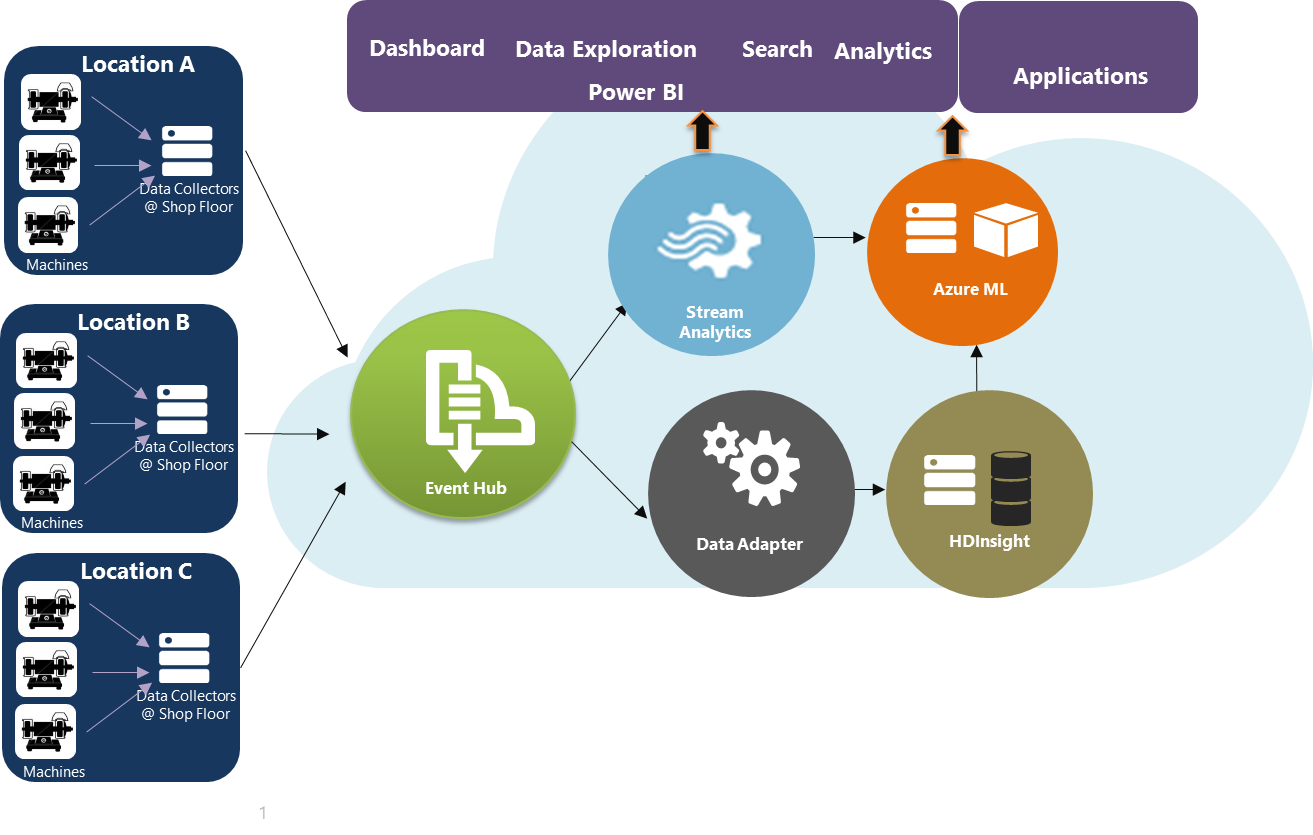 Data generated from machines is collected using a collector and securely streamed into the Azure Event Hub over http. The data collector is a custom code which reads data from machines and simply makes .net APIs of Azure Event Hub to push events.
Azure Stream Analytics pulls events from the event Hub, processes it and generates meaningful information, such as trends of machine usage over a time window. This information can then be consumed by the dashboard to show real-time operational details.
Using Azure ML libraries and collected data, various hypotheses can be tested and verified. Once appropriate models are identified, real data can be used to derive patterns and predictions.
Events from the Event hub can be pulled into HDInsight for persisting events. HDInsight persists all events. Tools like Hive or HBase can be used to store data in a structured format so that it can be used for further analysis.
Have you found any interesting use cases for IoT and Big Data in manufacturing? Wed love to hear them. Write to us in the comments section below.
