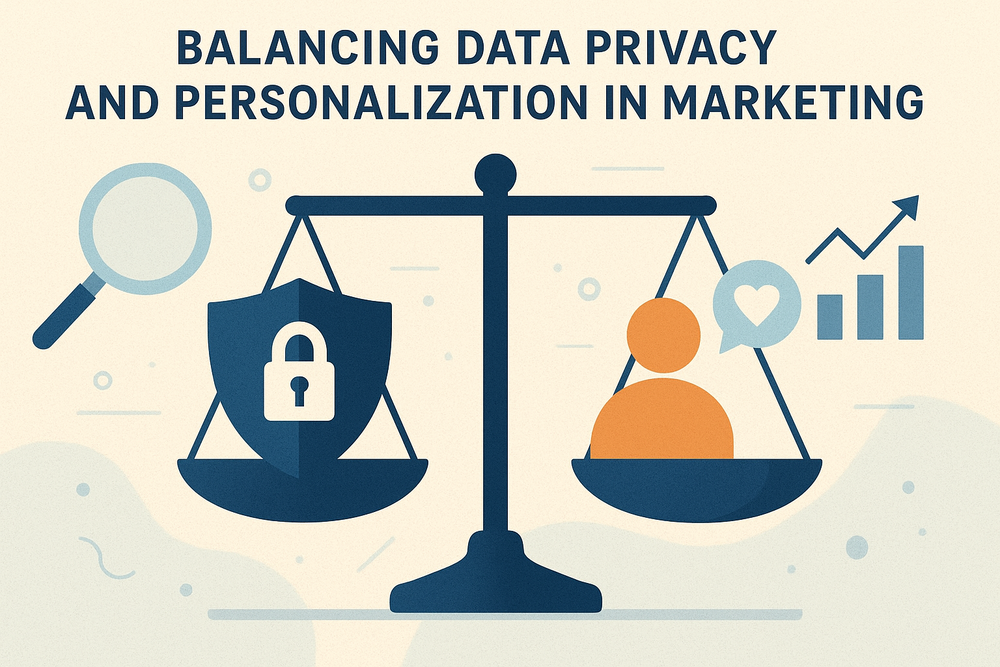
Balancing Data Privacy and Personalization in Marketing
Personalization has emerged as a defining characteristic of effective marketing in today’s connected world. Consumers expect brands to understand their needs, likes, and activities-even before they say anything about them. But with the expectation of personalization comes an equally powerful expectation of privacy. As regulations tighten and the public becomes more sophisticated about privacy, finding the appropriate balance of personalization and privacy has emerged as one of the great business challenges today.
This article will address how organizations can ethically harness technology to create personalized experiences, while remaining transparent, trustworthy, and appropriately managing privacy obligations.
The Rise of Personalization in the Digital Age
The idea of personalization is not a new trend. It has been a concept since the time customer service was invented. Over the past 20 years, the digital world has brought personalization from an “enhancement” to a “must-have.” At the same time, marketers have been able to distil mountains of customer data into relevant messaging, dynamic website experiences and predictive recommendations to engage customers and drive conversions.
Marketers can now leverage technology to process large amounts of historical data in real time, obtaining insights with the customer’s browsing history and purchasing behaviors, as well as their location and social interactions. With data, marketers can ultimately curate personalized experiences that feel seamless and intentional for the consumer.
However, as there is an increasingly data-driven aspect to personalization, this can also push consumers away. As more data is collected, there are more opportunities for a breach of privacy. Data breaches and data mismanagement have forced consumers to begin to ask the question, “how much is too much personalization?”
The Growing Importance of Data Privacy
Data privacy has changed from being a niche issue to one of global concern. Regulations such as the General Data Protection Regulation (GDPR) in Europe and the California Consumer Privacy Act (CCPA) in the United States have changed the rules for companies regarding the collection, storage, and processing of user data.
Consumers are looking for transparency in how their data is being used. They want to have choice-about what data they share, who has access to it, and what value it provides for them. This has put pressure on organizations to evolve, from collecting data for the sake of data, to collecting data with intention and ethicality.
In order to allow companies to balance these priorities, companies need to use technology as an enabler of trust, not as a surveillance device. When utilized in the correct manner, technology can facilitate automating compliance, enhance data protection, and even enhance the process of personalization itself.
The Trust Equation: Why It Matters
Trust is the core of every strong customer relationship. In its absence, even the most sophisticated personalization plans will fail. A 2024 global survey conducted by Deloitte found over 70% of consumers stated they would share data if they trusted the brand to use the information responsibly.
Here’s an important point: consumers are not against data collection; they just need assurance that their data is secure and will be used in an ethical way.
Consequently, brands must take three cornerstone principles into account:
- Transparency – Clearly explain what data is collected and the reasons for collecting it.
- Control – Logic dictates that users find it easy to interact with their preferences and consent.
- Security – Invest in security technology to protect any underlying sensitive information that might be vulnerable to misuse or theft.
By respecting these principles, a personalization process becomes a win-win for the brand and consumer alike: the brand has information to personalize experiences, and consumers receive timely, relevant, valuable interactions.
How Technology Enables Ethical Personalization
Modern technology offers powerful tools that can help marketers maintain privacy while delivering personalization. Here are several ways this balance can be achieved:
1. Data Anonymization and Pseudonymization
When organizations eliminate personally identifiable information (PII), it becomes possible to analyze user activity without sacrificing privacy. Data anonymization guarantees that if data is breached, it cannot be attributed back to the individuals to whom it can be traced.
2. Privacy-First Data Platforms
Customer Data Platforms (CDPs) designed with privacy in mind permit organizations to bring data “together in compliance” with data privacy laws. These types of systems help marketers track consent and manage data usage policies and audit trails.
3. Consent Management Systems
Consent management systems allow companies to easily collect, store, and update customer consent preferences. They allow customers to opt-in, or out, with just a few clicks and enable customer to build trust with their data through transparency.
4. Artificial Intelligence with Guardrails
AI-driven personalization can be incredibly effective, but it needs to be designed in a responsible way. Ethical AI frameworks can keep algorithms from exceeding privacy expectations. For instance, AI can use behavioral trends, yet not identify an individual user.
5. Blockchain for Transparency
Blockchain offers decentralized, tamper-proof systems for managing consent and authenticity of data. Blockchain builds consumer trust through providing immutable records of data exchanges.
6. Differential Privacy
Differential privacy allows organizations to analyze large datasets while adding “noise” to protect individual identities. This means insights can be drawn at scale without exposing personal information-a promising direction for privacy-preserving analytics.
Challenges in Achieving the Balance
While the benefits of personalization are evident, achieving balance is not without obstacles. Some of the main challenges include:
Reliance on Third-Party Data
Historically, organizations have operated on the use of third-party cookies and external data brokers. However, as cookies are phased out and stricter privacy regulation are established, marketers must shift to first-party and zero-party data collection.
Complex Privacy Regulations
Because digital business is by its nature global, organizations must contend with a multitude of differing privacy laws and regulations in different jurisdictions. Compliance means frequent changes to policies and their monitoring.
Data Silos
Businesses often have disconnected lines or fragmented data systems, and consistency of data management often becomes more difficult. Integrating systems securely and within privacy requirements can generate additional tech difficulties and required operationalization.
Accuracy vs Privacy
As more privacy protections are integrated (anonymization, etc.), data specificity often suffers, which can be problematic for personalization accuracy, etc. Properly balancing privacy analytics issues will often start with technology and additional modelling.
Consumer Skepticism
While brands engage with ethical approaches to dealing with data, changing consumer perception can be extremely difficult. Providing clear and consistent communications about ethics and policies is an important part of curating changes in perception.
The Role of Ethical Frameworks in Marketing
Every technological and strategic option in marketing should be informed by ethics. An ethical framework assists marketers in determining whether their personalization strategies respect and protect consumer rights, as well as social norms. These frameworks typically stress the following areas:
- Transparency and accountability in all processes involving data.
- Respecting user autonomy with unambiguous opt-in processes.
- Fairness in AI-based decision-making, ensuring that personalization does not unintentionally reproduce bias or exclusion.
By systematically rooting ethics into a company’s culture, brands can create a situation where privacy and personalization are not opposites, but co-existing values.
From Data Collection to Data Stewardship
Marketers are more frequently evolving from a perspective of data collection to one of data stewardship. Stewardship requires an understanding of responsibility, care, and purpose. It requires collection only what is necessary, wise use of the information, and disposing of the information securely when it has outlived its useful life.
The shift in perspective changes the nature of the relationship between brands and consumers. Customers ought to view their data as something that is shared versus simply viewing the data as a commodity. Data is entrusted by the customer to the brand to steward responsively.
Brands that embrace this view often find that consumer trust leads to a more meaningful exchange of data. As a result, personalization efforts become more meaningful because they are based on high quality, willingly exchanged data.
Building Consumer Trust Through Communication
Obtaining trust through fine print-in a policy-is not what it looks like to be ‘transparent’; gaining user trust is achieved through honesty and clear messaging regarding the brand’s data practices. Readers are far more likely to trust a brand that shares its data practices in clear language.
It could be as simple as a message on an e-commerce site:
“Your browsing data makes it easier for us to recommend products you might love; feel free to manage or delete that data any time.”
This kind of messaging demonstrates respect and control, both of which create a favorable brand impression. Correspondingly, if a brand is communicating to build trust, it should be presented as writing across some messaging- emails, website text, customer support communication, etc.
Future of Personalization and Privacy
The trajectory of marketing will largely depend on an organization’s ability to leverage new technologies to resolve the tension between personalization and privacy. New technologies are making that work feasible in new ways.
- Federated Learning allows machine learning models to train on distributed data, all while not moving sensitive data.
- Edge computing allows processing on devices rather than central servers, eliminating the need to ship data back to a central server.
- Privacy-enhancing technologies (PETs) are becoming mainstream. With PETs, data is analyzed with the knowledge that data cannot be reverse-engineered, even if the analyzing algorithm is not owned by the user.
As the technologies continue to grow, so too will the possibilities for responsible personalization. The intent isn’t to curb innovation; rather, curbing innovation means leaning toward ethical, transparent, and user-centric solutions.
Conclusion
Striking a balance between data privacy and personalization is not something done once and put aside; it’s a daily commitment to ethics, transparency, and innovation. As privacy legislation shifts, and technology continues to change, marketers will have to stay nimble, and continually adjust their strategies in accordance with shifting expectations.
When done properly, that same balance protects customers while simultaneously empowering customers. It turns marketing from a transactional activity to a relationship based on trust, respect and value.
In the end, brands that behave in accordance with values, will not only do so from a regulatory standpoint, but will earn something far more important: lifelong customer loyalty.