

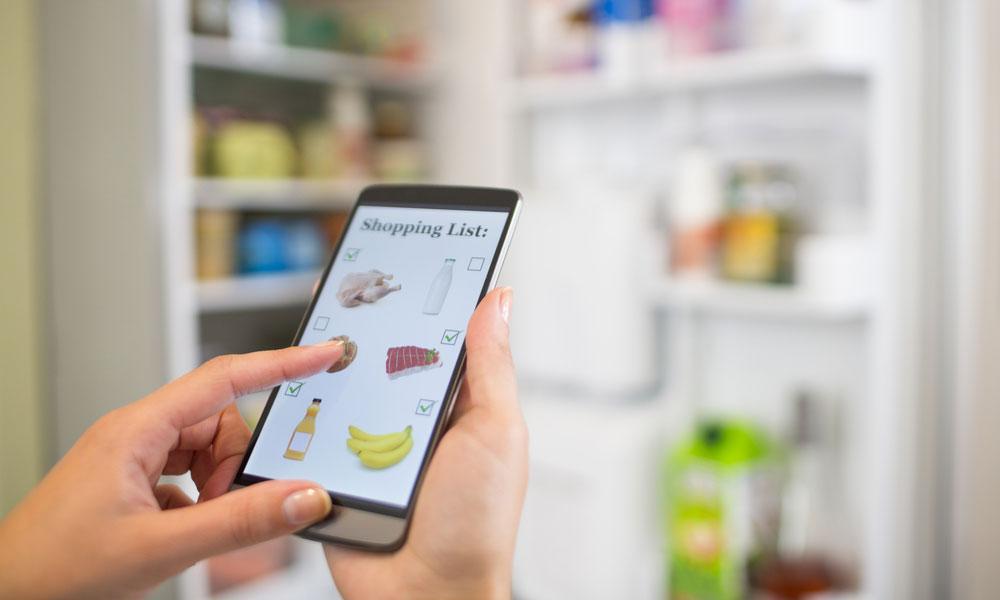
Smart replenishment solutions have been retailers’ poster child for a few years now; being part of elaborate inventory management systems, the technology helps businesses reduce out-of-stocks by up to 30%, achieve supply chain transparency and create a consistent customer experience.
When it comes to Smart Homes, however, Amazon Dash buttons remain the best-known (and somewhat lackluster!) attempt to automate routine grocery shopping, and thus introduce a new level of convenience to modern connected home products which often require complex setup and management on a user’s part.
What changes have taken place since Dash buttons were launched three years ago? Is there a future for automatic replenishment solutions within the Home Automation domain? Does the current level of Smart Home software development allow for complete household replenishment automation and how could users and eCommerce brands benefit from taking the smart approach to online shopping? These are just a few issues I’ll cover in my new article.
Introduction to Household Replenishment Solutions
In a nutshell, a home replenishment system is a combination of hardware and software components that allows users to create shopping lists and place orders on an eCommerce website. For example, via voice assistants like Alexa, by scanning QR codes on product packages with Augmented Reality apps or hitting a single Internet-connected button attached in close proximity to groceries, cleaning products and other household items that have to be purchased frequently.
The Dash buttons I’ve mentioned above are in fact a far cry from what smart inventory management systems do, as they’re pre-programmed to order one particular product ” for example, washing powder.
According to Gartner, however, by 2020 up to 50% of essential household products will be shipped with some form of connectivity and replenished via Smart Home systems.
Examples of Today’s Automated Replenishment Solutions
Amazon Dash Button: First Glimpse of Automatic Reordering
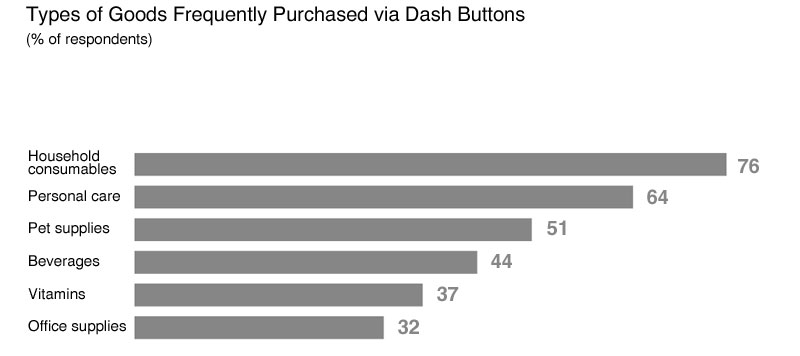
Launched on the verge of April Fools’ Day in 2015, Amazon Dash buttons were designed to facilitate reordering of groceries and household supplies produced by certain brands including Procter & Gamble, Glad and Hershey.
By 2017, the Dash service expanded to over 250 products, while the amount of Dash-generated transactions reached four orders per minute. Some of the companies that had joined the initiative early on reported that half of their Amazon orders came through the Wi-Fi connected devices.
 Amazon went on to introduce virtual Dash buttons that enable one-click purchasing from the Amazon homepage and app home screen and made the Dash Replenishment Service (DRS) available to third-party providers to allow Smart Home devices track household supply levels and trigger the reordering process.
This “ alongside Amazon’s recently announced partnership with Jabil, a technology company that creates smart packages with baked-in BLE connectivity, ” is expected to encourage more eСommerce brands to join the DRS program and leverage the power of the world’s leading platform for continuous revenue growth and time to market (TTM) optimization.
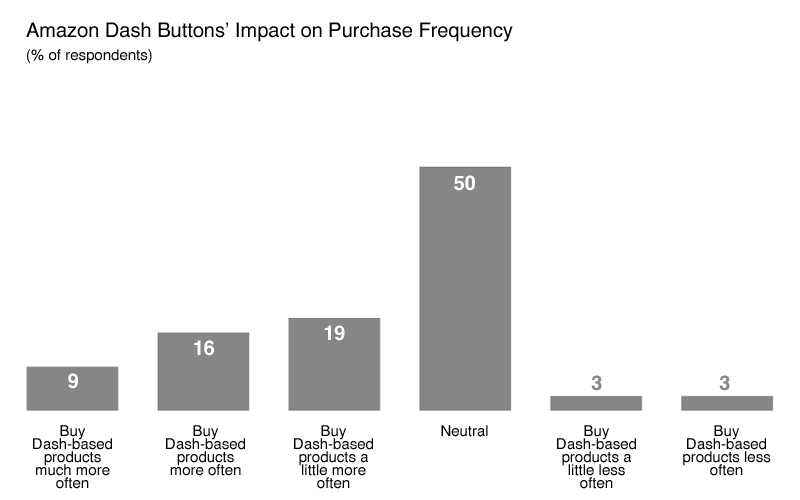
Recent studies show consumers are not at all indifferent to automated replenishment solutions, too: at least 16% of homeowners who make use of the service admit to buying Dash-based products more often.
Smart Refrigerators: from Touchscreens to Voice Purchasing
In 2016 Samsung unveiled its Family Hub ” a Tizen-powered smart refrigerator with a giant touchscreen mounted into its door. The thing that made the fridge intelligent was actually a shopping application installed on the device which allowed homeowners to shop at ShopRite and FreshDirect right from the display. Furthermore, there were three cameras installed inside the Family Hub that took pictures of the fridge contents so that users could check supply levels remotely via the dedicated iOS or Android app.
LG developed the concept a bit further and integrated their LG Smart InstaView Door-to-Door refrigerators with Amazon Alexa to enable voice purchasing.
Similarly to Dash, Family Hub and InstaView do facilitate household replenishment and ” thanks to publicly available APIs ” can be seamlessly merged into the Smart Home ecosystem.
How do Automated Replenishment Solutions Work under the Hood?
Technology-wise, hardware is not the crucial component of an auto-replenishment system.
Inside a Dash button, for instance, there’s only a circuit board featuring an STM32F205 microcontroller, a flash Read-only Memory (ROM) chip, a Wi-Fi chip and an AA battery. As simple as it is, Dash has enough computing power to establish a Wi-Fi connection and generate messages. Dash buttons are orchestrated via Amazon iOS and Android mobile apps. After the initial setup which is carried out with the help of a built-in microphone, Amazon registers the unique number of a button, and the gadget then waits for orders in the deep sleep mode. When a customer presses the button to purchase laundry detergent, the device sends a message to Amazon and places an order the same way users do it on the company’s website.
Thus, it is software which lives behind the portable gadgets that enables replenishment automation.
Besides BLE mobile applications, the software components of the DRS service include a powerful cloud-based infrastructure (AWS Retail) which supports the business logic of the smart solution and Amazon APIs facilitating user authentication and secure payments.
Smart replenishment solutions can also feature QR code or barcode reader software and ” as in the case with smart refrigerators ” video analysis applications and voice assistants. The latter are widely considered the future of Smart Home systems ” at least until more advanced Machine Learning algorithms trained on vast amounts of purchasing data are introduced to the market.
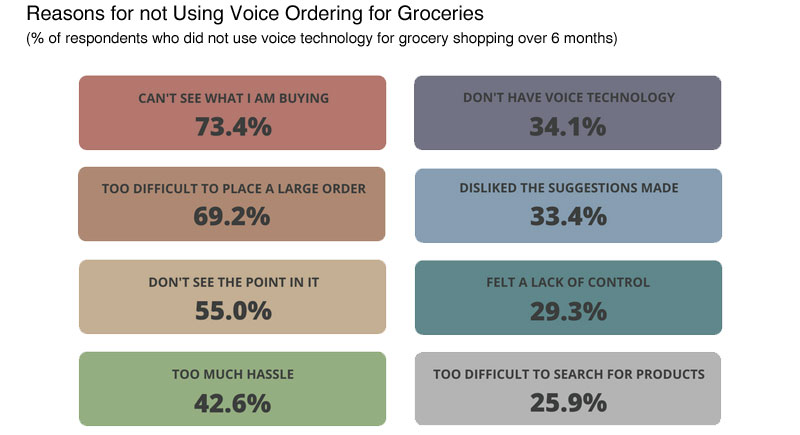
The current implementations of the voice recognition technology, however, do have their limits: the lack of control (users often have to double-check orders placed via smart assistants) and situational awareness (i.e., irrelevant product suggestions) prevent homeowners from leveraging voice-based Smart Home products’ shopping potential to the fullest.
Challenges to Automated Replenishment Solutions’ Wider Adoption
-
Button-based replenishment systems are hardly applicable to the entire range of household goods (as with Amazon Dash, it’s one button for each product).
-
Modern home replenishment solutions “ pretty much like Smart Home devices “ do not make reordering decisions autonomously and require manual configuration. To enhance the systems’ cognitive capabilities, we need Machine Learning algorithms implemented on the back-end and device level, as well as sensor-based or video analysis programs capable of tracking household supplies’ levels in real time.
-
By fueling mass consumption, auto-replenishment arguably undermines the concept of green living and could have a disastrous ecological footprint.
Furthermore, there are security concerns, as devices and computer programs dealing with auto-replenishment will be granted access to a homeowner’s financial routing.
Automated Household Replenishment: eCommerce & IoT Intertwined
Automated reordering is intended to simplify buying decisions and minimize friction through the digital customer journey. As connectivity becomes universally available, more shoppers are expected to use IoT solutions while making purchases online; for eCommerce brands, the Internet of Things creates stellar opportunities to reach out to new customers and increase conversion rate.
The existing replenishment solutions are by no means perfect: products like Dash, for instance, require a complex (up to 15 steps!) setup, align with just one product and are too reliant on mobile applications.
Companies eyeing the promising market should bear in mind that Artificial Intelligence ” even the pre-trained models offered by cloud managed services providers ” can significantly minimize human involvement in the household replenishment process.
Although we’re not likely to see any Nest-like self-learning replenishment solutions released to the market in the foreseeable future, it’s true to say the novel concept offers a lot of untapped opportunities for online retailers: over 31% of home appliances manufactured in 2020 will be IoT-compatible (as opposed to just 0.2% in 2014).
