


At one point in time, Augmented and Virtual Reality was largely conceived in science fiction. Through the rapid advancement of technology, the application of both AR and VR have become available for sale.
For a while, both technologies have been reserved for gamers. Since AR uses real-time information like text, graphics, audio and other virtual enhancements and renders them onto real-world objects; prospects for interactive gaming were at the forefront of AR technology.
VR technology takes things a step further by opening the doors to a computer-generated simulation in which a user can interact within an artificial 3D space, using electronic devices such as headsets and sensor gloves. A clear direction for a more immersive gaming experience.
Whilst the gaming and entertainment industries have dominated the application of Augmented Reality, it’s vital to take notice of the considerable potential for AR and VR across a broader variety of industries. Of which in some cases, are forecast to surpass the application of these mixed reality technologies in gaming.

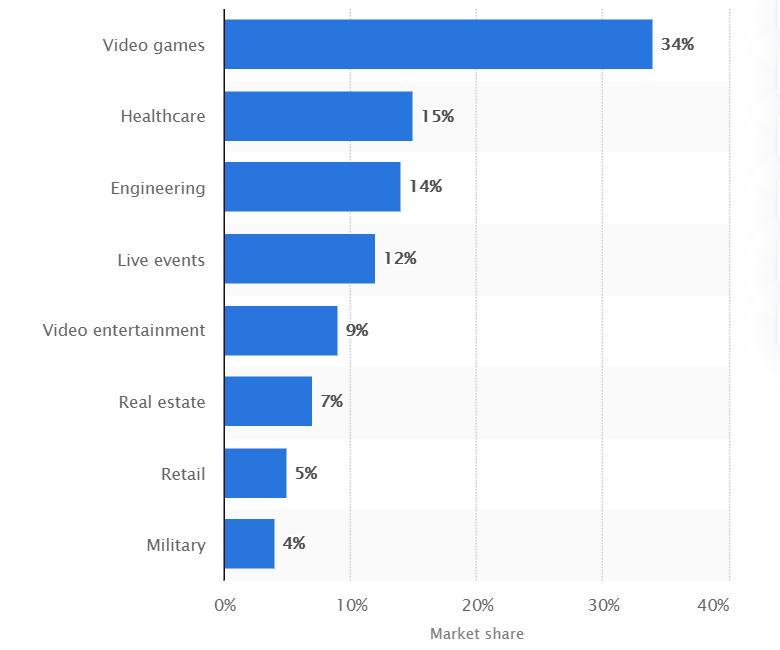
Forecast distribution of the augmented and mixed reality market worldwide in 2022: (Statista)
The stats depict the forecast of the AR and MR technology market in 2022. In just two years from now, it’s predicted that the video gaming segment will constitute 34% of the market– forecast to reach 80 billion U.S. dollars in 2022.
From marketing to healthcare, construction and space exploration, the application of AR and VR across sectors has taken off at such a speed, it’s plausible to expect it to soon catch up to the gaming industry. When it comes to meaningful applications of these technologies, alternative industries have found efficiencies, best-practices and revolutionary possibilities of connecting people and places from afar.
Alternative Markets Using Mixed Reality
For a better appreciation of the applications of augmented and virtual reality away from the gaming industry, let’s examine AR and VR at play in growing and promising markets.
Healthcare
Visualising smokers lungs or runners knees through VRs application of virtual symptoms can be helpful to help educate patients in the medical setting. Many technology companies are working towards developing AR Apps for visualising internal symptoms to assist in treatment and recovery plans.
AccuVein has used AR to develop a scan that projects over skin to show nurses and doctors where different veins and valves are in a patients body. This particular technology has reportedly made finding a vein on the first attempt over 3 times more likely. Such small developments make us realise the potential of highly technological and automated healthcare processes for the future.
Endless application for Virtual Reality exists within the healthcare industry. From VR-powered telemedicine to transportive elder care. For example, elderly home residents can use VR headsets to see the world without leaving their seats- including making virtual hospital visits. Further, companies like Psious are offering Virtual Reality Immersion Therapy for behavioural and mental health issues.
Sure, you can catch Pokemon’s using AR, but you can also boost efficiencies in hospitals and medical centres.
Engineering
Mixed reality gives engineers access to early-stage product designs before they exist in real life. Getting hands-on with early developments allows engineers to visualise, tweak and change parts of their designs- which can affect the overall project.
Seeing the results on a virtual reality display can be a helpful way to connect engineers and designers for better collaboration. Engineers can rotate images, see final designs from all angles and understand how each change could affect the final project.
The Ford Immersive Vehicle Environment lets designers and engineers at Ford see vehicle models virtually to ensure that all parts of the design can work together. This also helps early prototypes and designs to meet the required specifications.
Exciting developments in early 2020 from SolidWorks saw the software company creating a way for engineers to view designs with AR technology using a Meta Development Kit headset.
Retail
As stores struggle to reopen under the pressures of the COVID-19 pandemic, Mixed Reality has proven valuable in producing sound e-commerce solutions. Using AR and VR, retailers can now offer customers customisable products, virtual fitting rooms and more. Customers can continue to shop effectively without entering physical stores.
VR technology has created virtual maps, of shoppers bodies, allowing them to virtually try on clothes. Startup Bold Metric has used this application to help customers access products in more immersive ways.
Military and Defence
The furthest sector away from gaming as possible, multiple branches of the military are using AR and VR to create multiple large-scale simulation environments for immersive training to optimise operations.
Efficient maintenance and repairs of machinery, equipment and weapons are of vital importance. ScopeAR uses AR to generate computer vision technology to help with maintenance and repairs.
Communication is key in the military. VR could potentially help government officials to digitally track and capture landscapes during crises- and share those environments virtually with remote personnel for better crisis management and personnel-deployment.
Of critical importance, maximising efficiencies in military training can be dome with MR. Software simulation company Bohemia Interactive Simulations is working to create a virtual training environment for tactical training, mission rehearsal and experimentation on land, sea and air.
There is no doubt that Mixed Reality has and will continue to transform gaming and entertainment. But as such developments occur, so too will they happen in alternative markets. The healthcare, engineering, construction, retail industries and others can learn a lot from the AR and VR applications in gaming and entertainment.
It’s reasonable to expect that as time progresses and technologies evolve, the application of AR and VR across all industries will overtake that of gaming. From HR and training to remote work on the operating tables and in laboratories; Mixed Reality has a transformative future in our digitalised world.