

Artificial intelligence (AI) is taking the world by storm and has recently attracted significant media attention.
For instance, Jasper, the AI content platform, recently raised $125 million in a series A funding round that values the startup at a valuation of $1.5 billion.
And the My First Million podcast, where successful entrepreneurs Sam Parr and Shaan Puri share new business ideas based on trends and opportunities in the market, recently covered an entire episode on everything artificial intelligence.
With at least 89% of companies worldwide adopting a digital-first business plan to streamline their business processes, it’s safe to say AI content creation is here to stay.
In this post, we’ll share six ways AI will transform content creation for your business in 2023 and beyond.
Are you ready to learn more?
Let’s dive in.
1. Enhance topical relevance
Ah, the internet. It’s a beautiful place to find everything you’re looking for.
But sometimes, it can feel like a black hole. And before you know it, you just wasted six hours researching for a 1,500-word blog post. It’s maddening.
The power of AI helps you create better content briefs faster.
A content brief is the foundation of every impactful SEO-driven article. Typically, writers spend hours (or even days) manually researching and scouring SERPs to build a robust content brief.
And then it’s almost impossible to tell if the outline is optimized correctly for reader intent until it’s too late (i.e., once the blog is live and producing lackluster results).
Unlike humans, AI tools can quickly analyze existing search engine result pages (SERPs) and pull in crucial information to understand search intent, topical relevance, and topic depth that performs best.
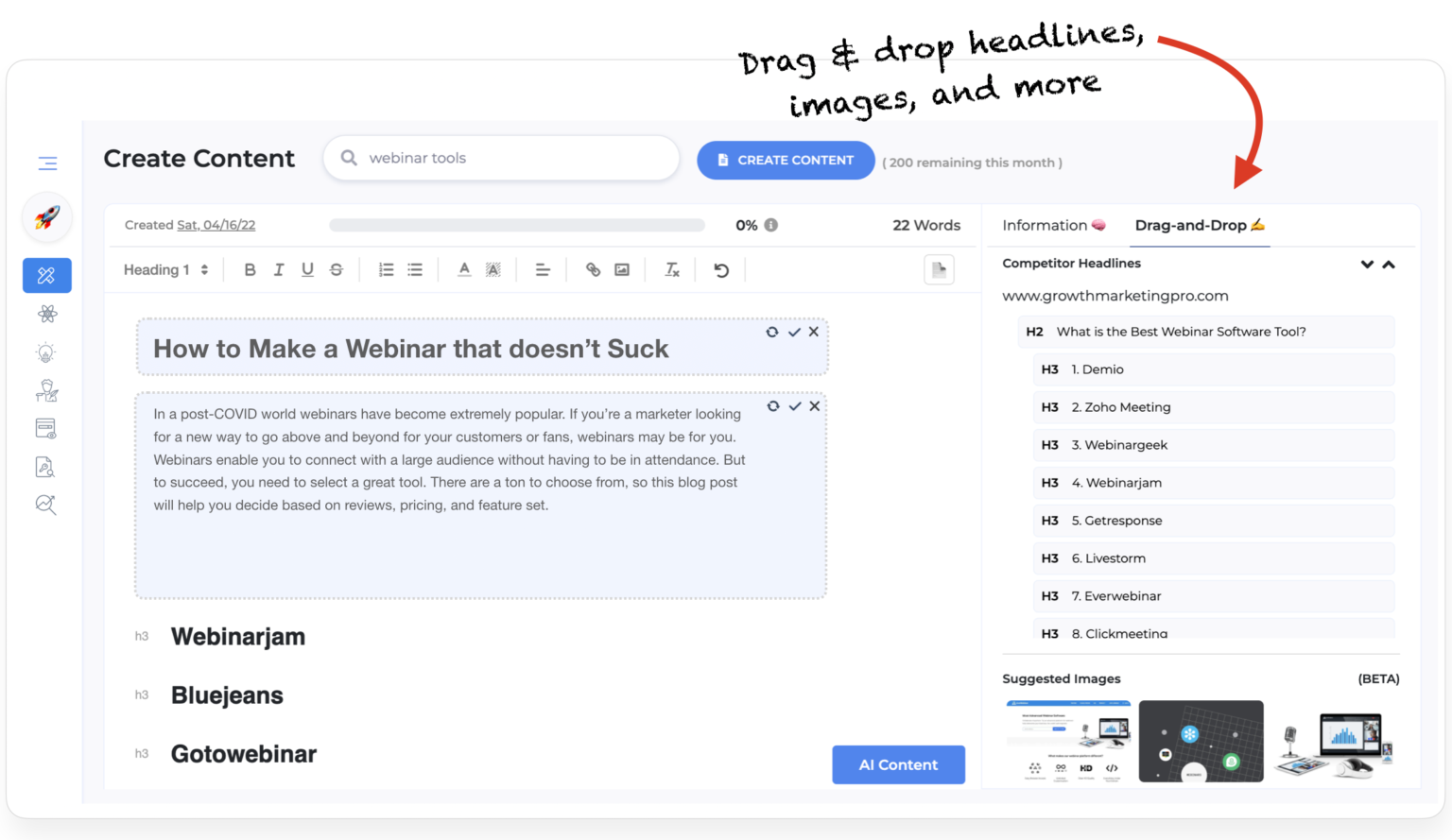
AI can create a blog outline in minutes, churn out new ideas, and uncover related topics and ideas to expand upon, all with one click.
And when writing the meat and potatoes of the content, it can help guide your focus on what real readers care about most – the winning recipe for creating excellent content that converts.
In short, AI is the perfect tool for an agency or marketing department – regardless if their target audience is a virtual receptionist service or a luxury traveler – creating content with a greater focus on niche audiences is just that much easier.
2. Improve rankings on SERPs
Search engine optimization (SEO) is a long-term play that includes quite a few arduous tasks.
From keyword research to content creation, image optimization, and internal linking, there’s no shortage of items to pay attention to. And if you want your SEO to pay off, everything needs to work in tandem.
For example, if you are a realtor, you can’t rely only on strong niche content to convert leads into sales. Visitors will bounce immediately from your site if you let your real estate web design fall to the wayside (i.e., it’s not mobile-friendly or takes more than three seconds to load).
The action of people quickly bouncing from your site sends a signal to Google that your website is spammy and untrustworthy and can ultimately hurt your rankings.
Internal linking is another underused SEO strategy. And let’s face it, it’s incredibly time-consuming and the last thing you want to do after writing a long blog post.
But when you use internal links to connect to other site pages, it helps Google understand that your pages are related. Plus, it passes along link authority.
Now Google can crawl your website and index your pages accordingly. If your pages aren’t interconnected, it can take longer for Google to index them or, worse, not index them at all.
Internal links aren’t just for Google. They also help increase navigability for your users, which can increase engagement and conversion rates by helping people find what they’re looking for more quickly and easily.
Are your eyes starting to roll into the back of your head? Don’t worry.
Link Whisper, a revolutionary WordPress plugin powered by AI, can seamlessly add internal links directly into your content in seconds.

But there are other AI tools that can help boost your rankings on SERPs.
Get real-time feedback on how well your content covers a topic with the help of MarketMuse. The tool scours the top 20 search results and identifies content gaps to help you rank above the competition.

What’s the key takeaway? Work smarter, not harder, by adding AI tools to your tech stack and start outranking your competition.
3. Speed up the content creation process
Let’s set the record straight. AI isn’t meant to replace human writers.
No matter how far AI advances, there’ll always be a desire for creative writing and content creation with a human touch.
Rather than replacing humans altogether, AI will help speed up the content creation process, doing so with greater efficiency and accuracy than we’ve ever seen before.
Imagine creating thousands of engaging, informative, and accurate content within minutes – without a single ounce of writer’s block.
It may sound too good to be true. But with an Ai writer, you can create the first draft of a blog in under five minutes.
For reference, some freelance writers can take 5-7 business days to write one 1,500-word blog post. That’s an incredible amount of time saved.
Thanks to AI content creation tools, you can finally establish a content calendar and stick to it. Soon, you’ll publish new content regularly, build brand authority in your niche, and drive organic traffic to your website.
Can you already hear the sales rolling in?
4. Create personalized content
Using AI to create personalized content is a massive opportunity for brands. And it looks like CMOs have already caught on.
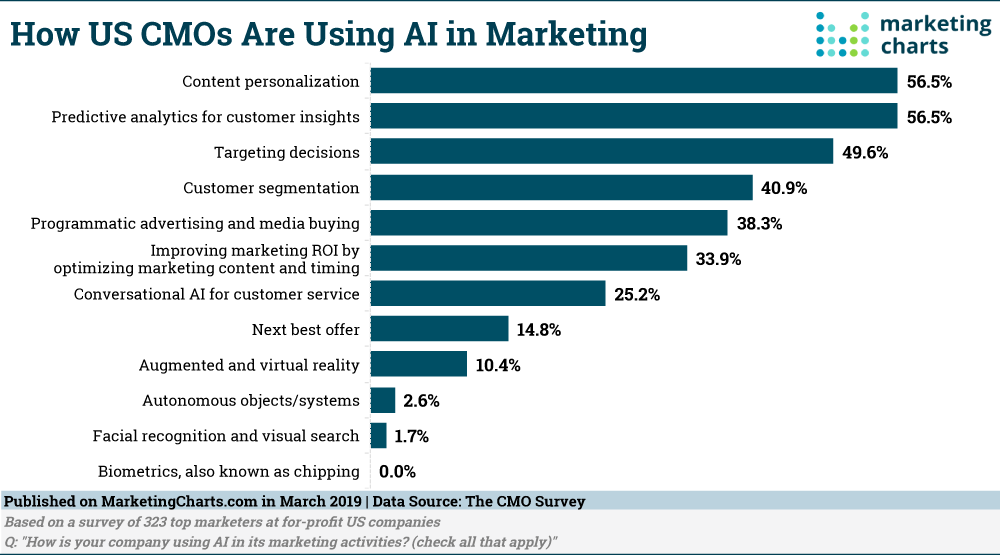
According to The CMO Survey, the top use cases for AI in marketing are content personalization and predictive analytics for customer insights.
Consumers are increasingly expectant of a personalized experience from brands, and they’re not afraid to let brands know when they’re not getting one.
Personalization helps build trust and boosts engagement by giving consumers a tailored experience that feels more human and relatable.
Plus, it improves the overall user experience by sharing the right message at the right time.
For example, AI can analyze the movies, shows, or TV channels a user is watching within a TV package and generate curated content based on user behavior.
Let’s say that an AI algorithm picks up on the pattern that a customer is watching more football than comedy shows. If you are a TV provider, you now have valuable insight into targeting them with the appropriate TV package add-ons.
So you send them a tailored email marketing campaign offering them a $100 prepaid card to upgrade to the multi-sport pack with NFL RedZone.

Since they are already nose-deep in the NFL season (rooting for the Patriots), there’s no way they can pass on this offer. And they’re stoked with your new service because they can now watch pre-game shows and other interviews with their favorite players. It’s a win-win.
With 80% of consumers more likely to make a purchase after a personalized experience, consider the importance of AI to streamline and automate this process for you.
5. Build high-quality custom images
A picture is worth a thousand words.
Images are one of the most important elements in the content creation process. They help you attract attention and add pizzazz to your blog posts, website, and social media content.
An upscale API uses AI to help you enhance small or blurry images into ready-to-share, optimized content for your website, maintaining the highest photo quality that’ll indeed transform your online presence.
Or if you’re still stuck on the hamster wheel of adding stock images to every blog post, it’s time to jump ship.
Why? Because a 2021 study by Venngage confirmed that stock photos were the visuals that performed the worst. And the best performer was the original graphics.

Before AI, creating custom graphics for every blog post was extremely tedious. And if you don’t have graphic design experience, you probably resort to stock images more than you would like to admit.
Thankfully, new AI tools are emerging left and right that can create custom images in seconds. All you need is a one-sentence descriptive input, and voila. An AI generated image appears.
6. Reduce human errors
Humans make mistakes all the time. That’s why the power of computers is so appealing.
One of the significant benefits of AI is its ability to analyze a large set of data more quickly and accurately than humans can.
For instance, change data capture integrates, analyzes, and uses data faster than ever to make accurate data-driven decisions. So not only are you saving time, but you are making decisions based on real-time data to enhance your marketing campaigns.
Change data capture helps you understand the results of your landing page A/B testing and make the necessary changes to boost conversions. There’s no point in throwing money at something that isn’t working.
So say goodbye to failed marketing campaigns, poorly written product descriptions, or blog posts filled with grammar errors.
AI is here to save the day, make your life easier, and reduce errors that could be costly to your business.
Wrapping up
AI has a bright future in content creation.
Many freelancers, marketing agencies, and startups are already using the technology. And it’ll only continue to establish a stronger foothold in the industry as time goes on.
AI tools are a fantastic addition to your content creation process. And just like Yoast didn’t hurt the demand for SEO specialists and Canva for graphic designers, AI content creation isn’t going to hurt the demand for expert writers.
It’s just another great tool to step up your game. And you won’t regret it once you try it.
