



Descriptive, diagnostic, predictive and prescriptive analytics can each provide insights into the business and as such improve and optimise your performance and increase your competitive advantage. Descriptive and diagnostic analytics enable organisations to learn, sense, filter, shape and calibrate opportunities by providing insights as to what has happened in their environment. This will allow your organisation to better sense opportunities than the competition. Predictive analytics can improve your decision-making across your organisation to help you understand which opportunities are best to be seized depending on their future outcome.
As an example, predictive analytics can predict future customer demand based on detailed customer profiles, which will build loyalty and commitment if carried out correctly. When predictive analytics is successfully incorporated into your organisation, you can start to predict a lot more, including:
- Customer churn; when is your customer about to leave you for what reason. Knowing this information will enable you to take proactive action to prevent your customer from eventually leaving you.
- Sentiment; what do your customers think of your new product, service, campaign or commercial. Knowing this information enables you to change it before or shortly after launch to ensure that they match your customers‘ needs.
- Customer support; when can you expect an increase in customer support and what will the customers be looking for? Knowing how your customers use your product, would enable you to predict customer service request if you notice a fault in your product. This information will certainly improve your customer service.
- Customer Lifetime Value; when you have a detailed understanding of your customers, you can better predict their Customer Lifetime Value. Having a better understanding of the CLV will allow you to invest more, or less, in the right customers.
Finally, prescriptive analytics transforms an organisation and can be seen as the final stage in understanding your business. It enables a continuous and in real time alignment and realignment of tangible and intangible assets based on foresight achieved from continuously analysing a wide variety of structured and unstructured data sources, exactly what is necessary to understand a changing context.
9 Analytics Use Cases
There are many different use cases with analytics to improve your organisation. This may seem daunting, but in general, the opportunities can be divided into nine use cases across three different pillars: your customers, your product and your organisation:
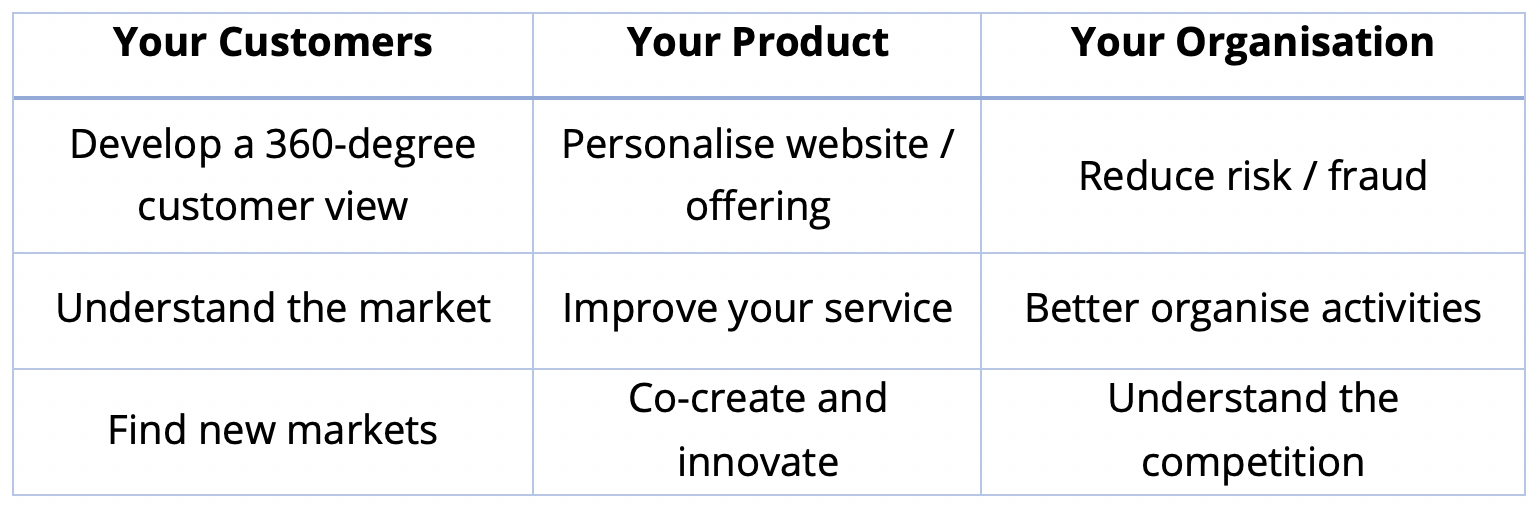

- Develop a 360-degree customer view: Developing a complete view of your customer is important for every organisation, as it helps to understand what your customer wants, what the needs and preferences are and how the customer has to be approached. When you combine and analyse internal data sources, such as your CRM data, sales data or call centre data, with external sources, such as social media data or news data, you are capable of creating segments of 1.
- Understand the market: when you mix different data sets such as sales data, market news data and social media data, you can get real-time insights what the market thinks of your product and when you launch for example a new commercial, you can get insights in real-time how it is perceived.
- Find new markets: analysing various data sources such as web statistics, and social media can help you find new markets or customers with latent needs that you were not aware of. Using techniques such as Natural Language Processing (NLP) or machine learning you will be able to anticipate better what (potential) customers are looking for, which could result in finding completely new markets.
- Personalise website/offering: today it is all about relevancy and offering the right product/service to the right person for the right price via the right channel at the right moment in time. Google personalises its search results based on your profile and Amazon offers different homepages, with different products on offer, to almost every visitor. It comes back to completely knowing your customer by combining different data sources to really know what they are looking for.
- Improve your service: using analytics, you can optimize your customer service, resulting in happier customers. A great example of this practice is Southwest Airlines; they use speech analytics to extract in real-time deep and meaningful information out of live-recorded interactions between staff and customers. This data, combined with other sources such as customer profiles, flight information and social media data enables them to offer a consistently high-quality service.
- Co-create and innovate: analytics not only provides you with insights about your customers but can also give you information regarding the products and how these are being used. When you are capable of monitoring how the product is being used via sensors and telematics, you gain a deep understanding of how you can improve the product. In addition, simulation analysis using massive amounts of data and supercomputers will enable you to drastically speed-up the innovation of your products.
- Reduce risk/fraud: analytics can help you with detecting anomalies and outliers. These anomalies and outliers could indicate fraudulent actions. It can also reduce the risk you are facing. When you have a better understanding of your customer, you can better determine their risk profile (whether it is a customer or a business looking for a credit, mortgage or insurance).
- Better organise activities: employees can generate massive amounts of data at the office. Sensors installed on office furniture and throughout the office can provide insights into how employees behave at work. These insights can be used to organise the workplace better. You can also monitor all unstructured data such as emails, documents and meetings to know which employee is knowledgeable about what topic and which employees interact with each other (of course taking privacy into account). This should not be seen as spying on your employees but will help employees to find the information they need faster and more efficient.
- Understand the competition: what you can do for your own organisation, can also be done, more or less, for your competitors. When you monitor the pricing strategy of your competitor, analytics can inform you in real-time when they adjust pricing, allowing you to respond faster. Of course, this strategy is not completely without risks as when two algorithms start interacting, strange things can happen; such as a book about flies for sale for over $ 23 million.
Analytics has become a prerequisite for competitive advantage. Only when you have access to insights created using descriptive, predictive or prescriptive analytics will you be able to understand the fast-changing environment your organisation operates in. When applying analytics, it will allow you to understand your customers better, improve your products and service and better run your organisations. Without these insights, you will simply be left behind by organisations with a better understanding. Don’t wait, start analysing today.