


Did you know that 84% of marketing databases are barely functional? NetProspex analyzed hundreds of companies, thousands of files, and over 61 million records for their Annual Marketing Data Benchmark Report. The findings were an eye-opener:
- 64% of records did not include a phone number.
- Only 35% of emails were classified as functional.
- 88% of business records analyzed were lacking basic firmographic data (industry, company revenue, number of employees).
Additional Findings at a Glance:
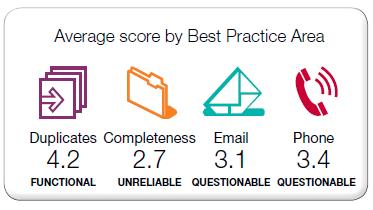
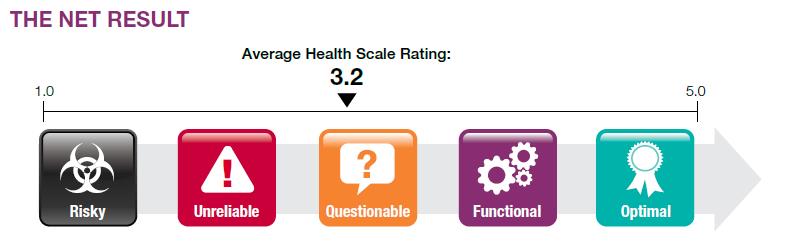
The net result? The average database scored a 3.2 out of 5 according to the NetProspex scale:
Marketers who establish good techniques to get their data in shape will see huge benefits. According to a report by SiriusDecisions, companies who have implemented on-going data management techniques experience 66% higher conversions to revenue than those who do not have a solution in place.
Here are 4 Tips to Whip Your Marketing Data into Shape:
1. Begin with a Data Assessment
If you arent sure where the quality of your data ranks, many vendors offer free data assessments. An assessment will identify areas where data quality can be improved, what types of data may be missing, and other problems that may be affecting optimal data performance.
2. Establish Business Processes to Ensure Data Quality
Business processes should be established to ensure data manually entered into systems is of the highest quality possible. Many organizations experience data errors when information is manually entered, at a rate of 2% and 8%. Even one wrong number entered incorrectly can cause a payment to fail or a wrong part number to be shipped.
Data validation controls can also be integrated into on-line forms, using rules to check the validity of data sets. For example, an on-line website form may require a visitor to enter data in specified formats. Or an IRS form may utilize controls to check that positive numbers are being entered into fields.Training employees to be more aware of the importance of data quality is also a crucial step to achieve a company-wide awareness of maintaining high quality information.
3. Establish an ROI to Fund New Marketing Database Initiatives
Data must be maintained on an ongoing basis. Data decays at an average rate of 2 percent per month, which means 25 to 30 percent of an organizations contact data will go bad each year under normal circumstances (NetProspex). Customers move, names are misspelled, and households split.
Establishing a strong return on investment (ROI) will help get new data projects off the ground. Begin by outlining problems caused by dirty data, documenting the costs, and showing the benefits that can be achieved by improving data. By directly aligning data improvement projects with business goals, data management solutions can more quickly be justified.
In the following two examples, each company establishes a strong ROI by documenting costs caused by dirty data, as well as the benefits gained by improving data quality.
A. Mid-Sized Retailer – Increase revenue by improving operational efficiency.
Numerous errors in billing and shipping are causing frequent product returns, inaccurate deliveries and queried invoices. The problem is tied back to inaccurate customer addresses. If the customer database for the retailer contains 100,000 customers, and addresses were improved by 5% or 5,000 customers, costs and benefits of improving data can be quantified. Product redelivery costs are reduced, cash flow is increased when invoices are paid in a timely manner, and customer service representatives become more productive when they no longer need to spend time resolving customer invoicing issues.
B. National Financial Institution – Increase revenue by identifying up-sell and cross-sell opportunities.
Customer data silos are hindering the marketing departments ability to identify new revenue opportunities. By integrating disparate data sources, unified household views can be established and analyzed to make informed marketing offers. For example, using common identifiers, the Smith household is linked together. By discovering that the Smiths have a college-age son, an offer can be made for a student savings account.
4. Implement a Data Management Solution
Once you are ready to move forward with a marketing database project, a data solutions provider will get your data into tip-top condition by performing the following functions:
- Perform a business needs analysis to help you determine what data should be integrated, how you prefer to access the data, and other strategic goals you are trying to accomplish.
- Use a software solution to integrate multiple data sources and types, eliminate duplicate data, and consolidate customer data into a single record.
- Append missing customer information, such as household income, age, occupation, hobbies, and other key demographic and psychographic attributes for a more complete view of the customer.
- Implement controls to ensure data quality remains accurate over time.
Getting your data into shape is a very attainable goal for those companies who are willing to invest the time and resources. And for those companies that do? Companies that put data at the center of the marketing decisions improve their marketing return on investment (MROI) by 20%. (McKinsey)
