
One of the distinguishing characteristics of modern healthcare is the massive volumes of data generated by a range of interwoven operations. Medical images create the most data of all the several types of healthcare. And it‘s growing at an exponential rate as the instruments get better at acquiring data.
Deep inside the data are significant insights on the patient’s state, the progression of the disease/anomaly, and the treatment’s progress. Each component adds to the overall picture, therefore it’s vital to put it all together as precisely as possible.
The extent of data, on the other hand, frequently exceeds the capabilities of traditional analysis. Doctors are limited in their ability to consider so much information.
Given that data interpretation is one of the most important components in disciplines like medical image analysis, this is a big issue. Human interpretation also has limitations and is prone to mistakes owing to a variety of causes (including stress, lack of context, and lack of expertise).
As a result, deep learning is a logical fit for the problem.
Deep learning programs can analyze data faster and with more accuracy, allowing them to extract useful insights. This can aid doctors in more completely processing data and analyzing test results.
The truth is, with so much data available, training deep learning models isn’t difficult. Deep learning, on the other hand, is an excellent approach to boost the efficiency of operations and the accuracy of findings in healthcare proceedings.
A convolutional neural network is the most common deep learning application for medical image processing (you can read more about them here). To detect and extract diverse characteristics from input data, CNN employs many filters and pooling.
Medical imaging in radiology with deep learning
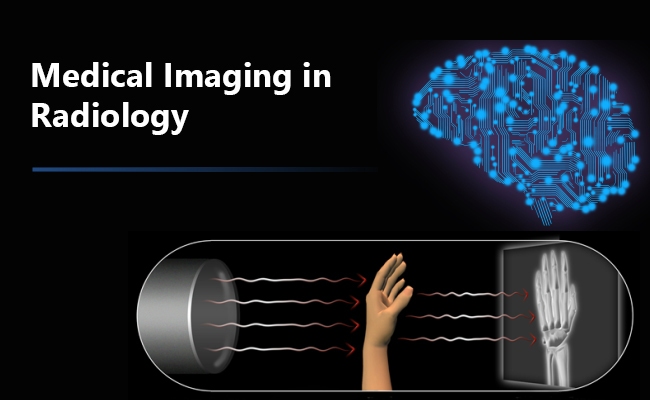
The field of radiology stands to gain a lot from deep learning’s potential.
Deep learning has made significant progress in radiology solutions, giving the capabilities needed to simplify and speed extensive data processing and enhance diagnosis. It has the ability to be taught and trained. It can also help physicians so well that it may be able to cut down on reporting delays and indicate instances that are either urgent or important. It is, nevertheless, a tool. It will not be able to replace radiologists as a profession; rather, it will be able to enhance their function and improve the way they operate.
Deep learning medical imaging can only benefit from a lot of collaboration and innovation with the industry. In order to learn and enhance its dependability and results, it requires ongoing modification, adaptability, and agility.
Examples of deep learning for medical image analysis
1. Cancer diagnosis with deep learning
Cancer detection is one of the most common uses of deep learning CNNs at the time of writing. In terms of accuracy and speed of operation, this use case makes the most of deep learning implementation.
This is significant because some cancers, such as melanoma and breast cancer, have a better chance of being cured if detected early.
2. Monitoring the progression of a tumour
Convolutional neural networks are known for their capacity to analyze images using several filters in order to extract as many important aspects as possible. When it comes to tracking the tumour’s progression, this tool comes in helpful.
Furthermore, a CNN of this type can:
-
Follow the tumour’s progress over time;
-
Connect this information to the elements that influence it (for example, treatment or lack thereof).
3. MRI image processing speedup through using deep learning
One of the most difficult methods of medical imaging is magnetic resonance imaging (MRI). The operation is both time-consuming and resource-intensive (which is why it benefits so much from cloud computing). For correct interpretation, the data has various levels and aspects that must be contextualized.
This is where deep learning comes in. With a wide selection of classification and segmentation algorithms that sift through data and extract as many objects of note as necessary, the convolutional neural network can automate and expedite the picture segmentation process.
4. Abnormality Detection in Musculoskeletal Radiographs
The most prevalent medical causes of severe, long-term pain and impairment are bone disorders and traumas. As a result, they’re a great place to try out different picture classification and segmentation CNN application cases.
End Note
Medical image analysis is one of the largest healthcare sectors in terms of data volume. This alone makes using machine learning technologies a sensible choice.
In medical imaging, AI and Machine Learning play a significant role in the study and diagnosis of a variety of disorders. Annotated images such as X-Rays, CT scans, Ultrasound, and MRI reports are used to teach Artificial Intelligence in medical diagnosis. These medical imaging data are used to train an AI or machine learning model that performs deep learning for medical image analysis using an automated diagnosis system in the medical and healthcare industries. Cogito has carved out a place for itself by providing medical imaging data and healthcare training data for deep learning for medical image analysis using visual perception-based AI or machine learning models.