
Christmas is the time to give presents and according to Google this years top present will be wearables such as the Fitbit or Jawbone. Google analysed the trending gift searches for 2014 and the research revealed that wearable technology is gaining serious attention this month. Also Staples expects that wearables will be hot this year. According to them, mainstream adopters will look for health trackers such as the Jawbone or the Fitbit, while early tech adopters will likely move to smartwatches. Another survey by Currys PC World states that wearables are featured in 1-in-3 Christmas present wish lists. Clearly wearable technology appeals to the consumer market, so a lot of people will probably find some sort of wearable gift underneath the Christmas tree.
Wearables are of course fun to get and fun to use. According to Rohit Yadav, there are four ways that wearables will improve our lives:
- They will keep us fit and healthy; when we receive information on how we behave during the day, we become aware of whats going on. If we see that we only walk 500 steps a day, this might be a trigger to walk more often and walk further. By making us aware of our, positive or negative, behaviour, wearables have the power to change our lifestyles.
- They will save lives: we see more and more wearables that are primarily focused on monitoring how our body performs such as our heart rate, blood pressure or your blood oxygen levels. When this information is collected over time, a doctor will get a much better picture of your overall health. In addition, when something does goes wrong, caregivers can be alerted in real-time.
- They will keep us save: average smartphone users check their phone 221 day, according to a study by Tecmark. Taking into account that on average we sleep 8 hours, this means that we check our phone every four minutes when we are awake, also when we are on the road. New wearables such as smartwatches or smartlenses from Google, could reduce this amount considerably, giving us more time to pay attention where we are going when we are underway.
- They make things fun: knowing how fast you have run and how many calories you have burned can be a fun way to start the competition with your friends and can make running a lot more fun for many people.
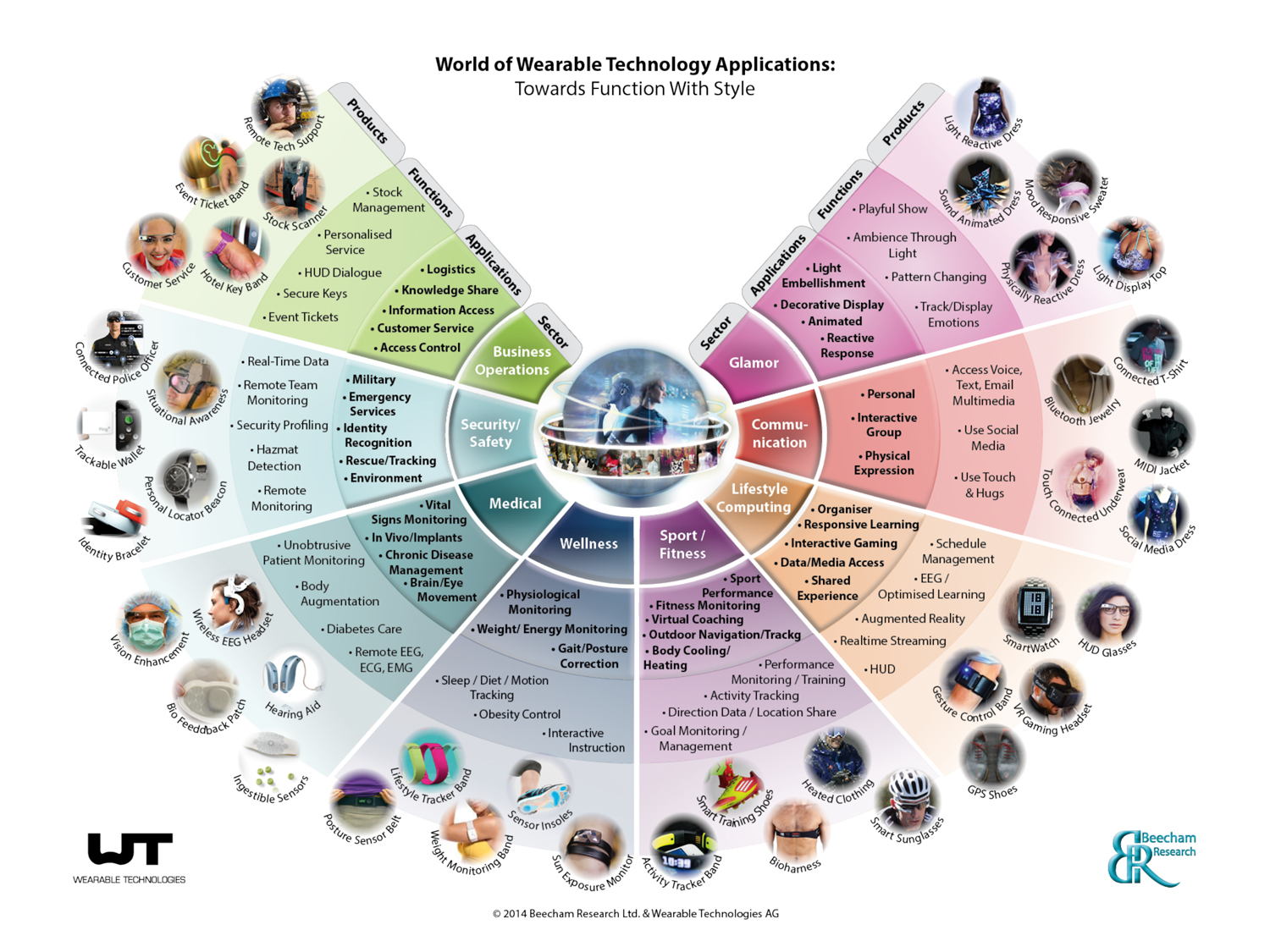
The biggest market in wearables is still health and fitness, but also wearables for the office are becoming popular. And of course there are multiple options for wearables in the communication industry, glamor industry or security industry. Below image offers a great overview of the world of wearable technology:
But what does these wearable devices mean from a Big Data perspective? Of course, these wearables devices are collecting all kinds of data, which is not just for your personal information and to keep you healthy, but will also be used by the producer to improve the product over time. In addition to that, the producers of these products, but also apps that can be used to track yourself, can extract all kinds of trends out of the data that says something about the users.
As the below video shows, trends such as sleeping patterns or walking patterns based on geography are quite easily to extract out of the data. The same video predicts that 485 million wearables will be sold annually by 2018, so a lot more data is coming our way that will contribute to global insights in human behaviour. That massive data set is of course a gold mine for healthcare providers, insurers and researchers.
Wearables are therefore all about Big Data, contributing massively to the data flood that is coming our way in the coming years. Of course, the data can be used by consumers to better understand their lives, but it is also very interesting to aggregate the, anonymous, data and obtain a helicopter overview of human behaviour around the world.