

Kubernetes has become the world’s most popular open source container management platform and is fast becoming the operating system for running modern, containerized applications. With the proliferation in the use of Kubernetes, it became the prime accelerator and broadcaster for cloud-native technologies.
In this blog post, we will discuss in detail the top 6 futuristic cloud-native technologies to watch out for.
Cloud-Native in conjunction with Kubernetes: Current State of Affairs & Precognitive Insights
According to Gartner’s predictive analytics, the end-user expenses on public cloud services will surge to $482 billion in 2022 from $396 billion in 2021 at an exponential growth rate of 21.7%.
In recent years, cloud-native technologies have gone mainstream and a report from the Cloud Native Computing Foundation (CNCF) substantiates the same. The report reveals that containers are being used in production by as many as 84% of the developers. The technologies that graduated from CNCF, in totality, have witnessed a substantial increase in production. The projects from the foundation are deployed more than ever and 50% have already been deployed in a production environment.
The State of Cloud Native Development Report 2022 by CNCF reveals that out of a total of 6.8 million cloud-native developers, 4.6 million use container orchestration tools such as Kubernetes, 4 million use serverless platforms, and 1.8 million use an amalgamation of the two.
Clearly, Kubernetes deserves a special mention amongst the cloud-native technologies for helping proliferate many other technologies under the over-arching umbrella of Kubernetes and for being the ultimate enabler in the containerization space.
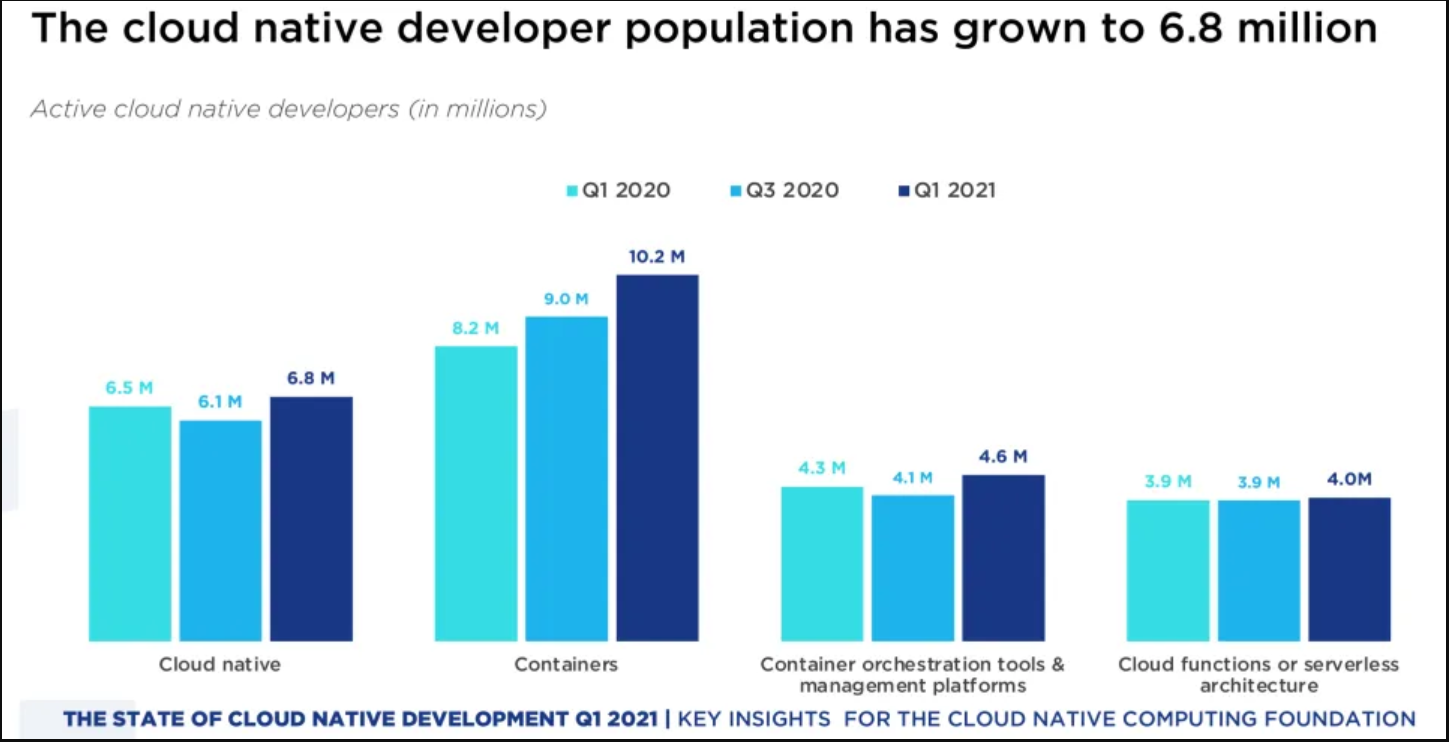
Image Source: CNCF
Also, the report revealed that edge computing has the highest adoption rates of Kubernetes and containers with 63% of edge developers adopting Kubernetes and a substantial 76% opting for containers.
How Kubernetes Is Parented by Both Google & CNCF?
It was created by Google to manage its internal infrastructure, but in 2014 it was donated to CNCF as a seed technology and the foundation now owns Kubernetes. The foundation receives an annual grant worth $9 million credits from Google Cloud to fund Kubernetes development. The CNCF is an open-source community and since the time it got in charge of Kubernetes, the container orchestration tool received inputs from new contributors and broad partnerships from numerous cloud-providers organizations and new users.
Until now, Kubernetes has been adopted by many other companies who use this popular tool to run applications in a highly scalable way.
What’s Beyond Kubernetes in Cloud-Native Space?
Kubernetes is not a loner when it comes to futuristic cloud-native technologies. There are some other open source projects worth mentioning that have additional competencies to complement Kubernetes. These projects make Kubernetes the rock-solid container orchestration platform that it is and help it function in a scalable way, allowing it to better scale several web platforms and enterprise solutions.
So, without further ado let’s just delve into these six futuristic cloud-native technologies, starting with the one that’s not a secret anymore viz.K8s aka Kubernetes.
1. Kubernetes
We have discussed a lot about Kubernetes and its role in evolving the cloud native applications already in the sections above.
Kubernetes is a platform as a service (PaaS), enabling container-based application development in the cloud. The increasingly diverse ecosystem surrounding Kubernetes has resulted in the creation of a brand-new ecosystem for cloud-native applications.
The advent of Kubernetes has resulted in the creation of a brand-new ecosystem for cloud-native applications. Through this rise, there has been a diverse set of ISVs and SaaS providers building tools for the cloud-native environment. The overarching ecosystem of Kubernetes is analogous to that of Microsoft or VMware during the halcyon days of Windows and vSphere. The major difference though is that the cloud-native products are mostly open source, and their commercially hosted enterprise versions are available in the cloud.
2. Istio
Istio is a service mesh to connect multiple microservices of an application with utmost safety and security. It is based on several open-source projects, including Linkerd and Envoy. The reason why Istio is so popular among developers and operators is that it provides seamless integration with Kubernetes without explicit code or configuration changes. Furthermore, it offers reliable high performance, persistent IP-based endpoints, intelligent routing capabilities, and comprehensive metrics. Enterprises are already actively using this technology on GCP today, as a managed service. Besides, the Istio project is also receiving profoundly humble support from companies such as Red Hat, IBM, Weaveworks, Tigera, and Pivotal.
Kubernetes and Istio, together form the best ecosystem for enterprises to adopt cloud-native architectures.
3. Prometheus
Prometheus is a project that aims to provide monitoring solutions for Kubernetes and other cloud-native technologies. It provides comprehensive metrics, discovery, and graphing capabilities. Prometheus complements Istio by aggregating the metrics that can be visualized through centralized dashboards. It’s designed to complement Kubernetes by enabling users to monitor their apps and infrastructure, so they make informed decisions in an automated fashion.
Along with alluring dashboards and insightful metrics you also get a community of users who share their monitoring experience to make getting started quick and painless. Just like Kubernetes, Prometheus is a CNCF project deployed into production, so you can be assured that it’s fit for purpose in any production environment.
Not only Prometheus is free and open source, but it also acts as a distributed monitoring system and time series database with an emphasis on horizontal scalability and superior performance. Prometheus collects metrics from different Prometheus endpoints (nodes) around a Kubernetes cluster and disseminates the collected data to external systems or services.
4. Helm
Kubernetes is the new OS for containerized applications. But what about installing your own cloud native application? Helm is the answer.
Helm is a unified package manager and installer that helps you quickly set up your Kubernetes application. Helm manages your application lifecycle, e.g. creating, updating, and destroying different components such as deployments, services, Ingress controllers, and persistent volumes. Helm manages ‘Charts’ that are pushed down to the nodes of a cluster.
Helm makes it easier to produce, maintain, and deploy cloud-native applications, and may soon get the status of arguably the most popular cloud-native application installation platform. Helm is a CNCF project benefitting from active collaboration with many top companies like Bitnami, Ticketmaster, Codefresh, Microsoft, and Google.
5. Spinnaker
Spinnaker is an open source release management tool from Netflix that targets traditional IaaS environments such as Amazon EC2 and modern CaaS platforms running on Kubernetes. Its multi-cloud capabilities make it an ideal platform for deploying applications across different cloud platforms.
It’s a release management tool that allows you to deploy cloud native applications rapidly and easily, by simply leveraging your existing infrastructure in AWS, GCP, and Azure. The tool helps you build, test, and distribute your applications with the speed of a CI pipeline. It handles the complexities of multi-cloud deployments by enabling easy transitions between operating systems, clouds, and containers. There are multiple ways to get started with Spinnaker, including a fully hosted open source version.
It delivers rapid, repeatable, and predictable cloud delivery. With Spinnaker at your side, you can automate cloud-native deployments across multiple environments in minutes. Spinnaker has multi-cloud capabilities. Available on all major public clouds, Spinnaker offers enterprise coverage, including support for Kubernetes and HCI.
6. Kubeless
Serverless computing has taken the cloud-native ecosystem by storm, with popular projects including AWS Lambda, Google Functions, and Microsoft Azure Functions.
Kubeless is a serverless, open source, compute platform service that makes deployment, management, and scaling of event-driven applications simple. The computing framework runs on the top of Kubernetes. It has been designed to work seamlessly with AWS Lambda and supports a wide range of languages including JavaScript, Python, PHP, Node.js, and Java. Using Kubeless, application logic is packaged as a container, and functions run inside of the same process. Kubeless provides easy-to-use SDKs for all major programming languages offering support for event-driven computing and mainstream languages.
Kubeless includes features such as event-based invocation and scalability to make running serverless functions easier than ever.
Final Words
The adoption of these 6 futuristic cloud-native technologies for enterprises has made tremendous progress and is expected to continue at an accelerated pace as they go mainstream. The most recent World Economic Forum’s (WEF) report on the state of the internet of things (IoT) has revealed that there is a huge gap in this market between manufacturing giants and start-ups. One way to offset this gap is by using some of these emerging cloud native technologies to revolutionize manufacturing processes.
Clearly, the stage is set for these 6 technology trends that are slated to impact enterprise IT and guide you through how you can develop a strategy for leveraging their effectiveness.
