


Quantum computing is a new, but futuristic technology, in terms of bettering the existing computing speeds. However, it’s still in the development phase, but in the next few years to come, it is going to overtake classical computing. Quantum computing, in the simplest of terms, is an area of computing that concentrates on enhancing computer technology, basis the fundamentals of quantum theory, which pertains to analyzing the behavior of material and energy on the subatomic & atomic levels. While classic computing encodes information in the form of 0 & 1 (bits), quantum computing uses qubits that could be a 0 or 1, or both together.
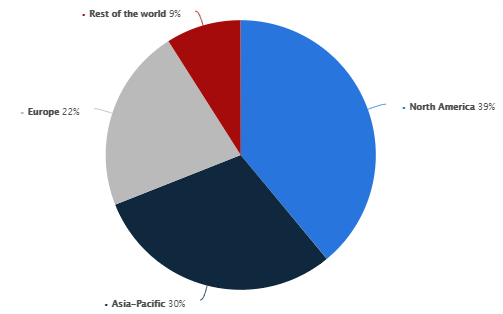
Quantum computing global market share forecast by region (2024)
Source: Statista
Quantum computers exploit intertwined quantum states that help overlap information bits to execute calculations. This makes them incomparably faster than the classical computers at performing data-crunching and mathematical calculations. Neuromorphic computing is another big technology invention that has emerged off late, which involves designing computer hardware and software in a manner that imitates the working of a human brain, thereby improving the computing power.
What is Silq?
Silq is a newly found high-level quantum programming language comprising strong static-type system. It’s in fact, the first programming language in quantum computing that has not been specifically designed in conformance to the construction and architecture of the hardware. Instead, it’s developed keeping in mind, the ease to programmers while they solve a problem using quantum computing.
Silq allows programmers to leverage the unparalleled capabilities of quantum computing much better than with the currently existing programming languages because the Silq code is fast, compact, intuitive, and away easier to understand and familiarize, for coders. As a matter of fact, Silq is the only quantum language that automatically recognizes and eliminates values that are not deemed to be important in the overall scheme of things.
Unparalleled Benefits with Silq as a Quantum Computing Language
- Here are a few big advantages with Silq as a programming language for quantum computers:
- A level of separation from the programming language C‘.
- Better capabilities of exploiting the full potential of quantum computers, compared to existing programming languages.
- Silq code is much intuitive, fast, compact, and understandable to programmers.
- Silq is compatible with supporting subexpressions like (a+b)+c, that other existing languages lack.
- Programming in Silq is less pivoted to the low-level details, which makes it easier to analyze Silq programs compared to programs written in other quantum languages.
- Silq fosters the development of analysis tools that in return, help developers.
What is QUA?
It is a pulse-level programming language meant specifically for quantum computers, and it’s the first coding language that combines classical operations with the universal quantum operations at a pulse level. From a commercial and technological viewpoint, QUA was designed to be a highly intuitive language that relies on XQP to optimize a variety of classical and quantum operations. XQP collates quantum programs to QM’s Pulse Processor assembly language that allows for the quantum programs to run at low latencies. Additionally, QUA utilizes qubit agnostic and therefore, is compatible with all sorts of quantum processors.
Vital Elements Associated with QUA, and Associated Benefits
QUA allows programmers to draft a quantum program and have it collated the way down to the coding pulses by leveraging a proprietary compiler from XQP Machines. The aspect of the QUA that makes it different from other coding languages is its capability to systematize down to the pulse level. A majority of the other quantum programming compilers systematize only down to the native gate levels. The biggest advantage with QUA lies in its ability to control the qubits which allows a quantum computer program to attain higher accuracy in terms of offering an apt solution to the problem. The other benefits of the same comprise faster execution time and improved gate fidelities.
