

Artificial Intelligence is new, fast-moving, and least predictable; for the field is still unraveling itself. Accenture report on AI is among the more recent ones to assert AI hold huge promises for businesses and AI professionals. The report shows by 2035, AI will become a $14 trillion economy. If achieved, this will be the biggest boost to the global economy by Industry 4.0. Another interim report by MIT task-force on Work of the Future shows AI will be instrumental in creating new and better jobs in long term, as its near and dear technologies destroy some in the short run.
Video analytics, chatbots, AI-driven personal assistants (think Alexa, Echo, etc.), are only a few illustrations of the presence of AI in our lives. And they are only the beginnings! The industry is constantly modernizing. Gartner reports,
Between just one-year (2018 to 2019), the percentage of companies deploying AI grew from 4% to 14%.
This is a promising start for the industry for 2020. As the industry reaches its prime, here’s for AI specialists and professionals the latest trends of artificial intelligence they should look out for in 2020.
Key Artificial Intelligence trends for 2020
1. Integration of AI with Blockchain and IoT (Edge Computing)
Many destined Artificial Intelligence innovations would not be possible without Internet of Things (IoT). The combination of both can loosely be called edge computing. Take self-driving cars for instance. If ever brought to reality, the sensors in the car would collect real-time data with the help of IoT. The data thus collected would be leveraged by AI professionals to accustom models & programs for decision-making. Domino’s 30-minute delivery promise also becomes possible with IoT and AI “ a combination of geolocation and data to predict time frame and personalize updates. Other examples of such inevitable integration of AI and IoT is path planning, driver monitoring, eye-tracking, natural language processing, among others.
Blockchain and AI will further witness an integration in areas of providing privacy, security as well as scalability.
2. AI in Media
Movies flop all the time! And making them costs a lot of time, energy and finances. What if you could know the one that’s likely to work between audience? That’s where AI will come into play in creative industries. Netflix has already been using its existing data to bring out shoes most popular among audience “ in fact, its most famous House of Cards series was a result of the same.
AI professionals will play a central role in not only analytics, but development of stories, production, script writing, and maybe even acting!
3. AI and Cybersecurity
Hackers and cyber attacks are becoming more resistant and increasing at a faster rate. Outpacing them effectively requires machines. AI is being used in cyber-threat hunting to detect attackers and prevent criminal activities online. AI systems will become more mature and significant in the area of security breaches.
4. AI and Chatbots
Real-time and personalized conversations will drive marketing in coming years. AI specialists will play a huge role in making that happen. Conversational AI of the likes of Alexa of Amazon, Google Assistant, and others, are dominating the space. Similarly, banks are employing AI chatbots in place of human interface for customer service. Chatbots are now available in text mode, as well as voice mode, and even in combination of both.
5. AI in healthcare
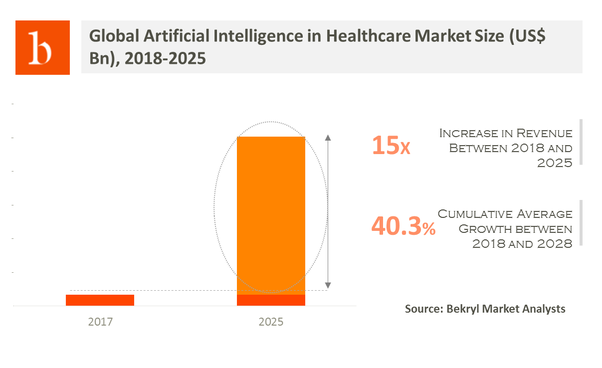
AI technology will make healthcare more accurate and less costly. AI professionals will be required to transform healthcare workflows, customizing individual clinician’s working, improving staff and patient experience, and much more. The ability of AI will be leveraged for acquiring electronic health records; information on staffing levels, equipment utilization; optimizing scheduling; automated reporting; and interpreting data in meaningful ways.
6. AI will become less data hungry
2020 will see data synthesis methodologies coming to the aid of AI technologies. Earlier AI algorithms built on deep learning could only work with real-time data, which was complicated with the need for feeding it with right kind and volume of data. It can be difficult and time consuming. Data synthesis techniques are helping AI techs leverage old data from videos and other mediums to create new scenarios and personalize experiences.
7. AI and Manufacturing
Manufacturing industry will embrace AI with full force in the year 2020. Quality control while keeping deadlines is always the biggest challenge in manufacturing. AI specialists will use edge computing to address this challenge. AI will automate existing processes and give worker’s time to innovate.
8. AI and Governance
As AI dominates most industries, the governance and ethical issues related to AI technology will burgeon in 2020. Successful adoption and scalability of AI will depend on resolving these dynamics. It involves creating policies around biased data leading to discrimination by technology.
Business innovations resulting from AI trends will reach new heights in 2020. There is no time like this to enter the industry. Are you career-ready to shape the future of AI?
