


Traditional banking approaches and practices have a nasty habit of excluding those who are in the most desperate need for economic stability around the world. Could the disruptive power of blockchain technology finally be the financial enabler that we’ve been waiting for?
Deprived communities globally can suffer from extremely high inflation rates, high unemployment, governmental corruption and a lack of access to any form of banking. However, the decentralised nature of blockchain could help millions – even billions – of people to bypass their regional limitations and access a more universal form of financial management.
(Image: Outsourcing Portal)
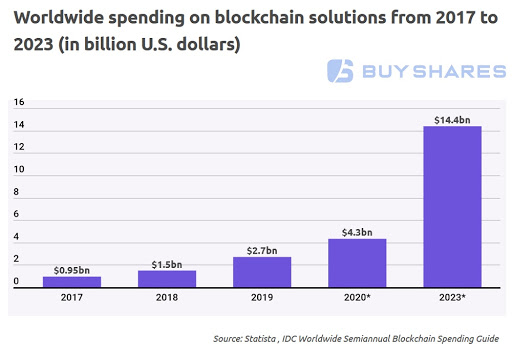
Data shows that worldwide spending on blockchain is set to grow exponentially between now and 2023, paving the way for the development of much more advanced and innovative solutions in aiding the world’s most disadvantaged citizens. Let’s take a deeper look into how blockchain can go where other financial functions haven’t in helping citizens combat poverty:
Universal Access to Banking
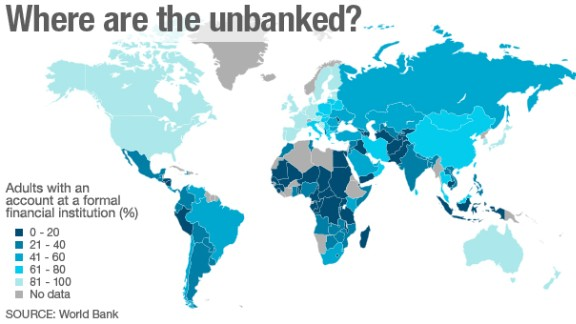
According to the World Bank‘s global financial index, around 2.5 billion citizens around the world remain unbanked – amounting to around a quarter of the global population. Due to the lack of proper identification or no credit history, people are unable to open bank accounts to manage their finances.
On top of this, organisations that attempt to help the poor operate in silos, building their own databases. Centralised systems can allow people to build up sufficient information and credit history to help improve their situation.
(Image: CNN)
Although much of the world’s unbanked population is located in Sub-Saharan Africa and South-East Asia, limited access to bank accounts is a problem that affects individuals all around the world.
Blockchain-powered digital identities could soon be used across organisations and even over borders as a means of helping those who don’t have proper identification in opening accounts. Blockchain can create access to financial systems and transactions that may pave the way for vital economic resources.
Because many blockchain-based wallets don’t require formal identification to allow users to start saving, they could feasibly manage their wealth with ease, and broker transactions and purchases around the world as a result.
Property Ownership
Another key factor of combatting poverty is the correctness and completeness of property ownership registration and the prevention of unauthorised and fraudulent changes to data records. Blockchain technology is perfectly capable of registering the ownership of the property – whether it refers to digital content or physical belongings. The distributed ledger can protect against theft and resolve disputes. The blockchain can even authorise the transfer of ownership after a sale in a way that can prevent fraud from occurring.
Today, multiple countries are looking into adopting blockchain to register and record land title ownership. Nations like Sweden, Honduras and Georgia have already tested the technology to date. Their efforts focus on developing a fully transparent land registry that respects ownership.
Registering property ownership on blockchain carries many advantages. Notably, it will limit the number of manual errors occurring while improving security processes for transferring documents, mortgages or contacts.
Blockchain allows an irreversible record of ownership to be developed because once data is on the blockchain it can’t be altered or changed. As well as this, smart contracts can be used on decentralised finance (DeFi) apps to automatically transfer ownership is a certain range of criteria is met – providing more protection for sellers.
In this regard, blockchain can guarantee a safe registration of property ownership, allowing greater protection for property owners all around the world from fraudulent activity and unjust claims of ownership.
DeFi Loans
Along with the ability to access financial services, blockchain can also enable wallet holders to access loans built on decentralised finance (DeFi) framework.
DeFi loans are becoming prevalent in the world of cryptocurrencies. Essentially, investors can use smart contracts to send their cryptocurrency holdings to other wallet holders on the pre-determined agreement over the terms of repayment.
Suddenly, unbanked citizens who may be suffering from accumulated debt or poverty can gain access to the tools needed to secure a loan that can help them to develop their business or better manage their debts over time.
Whereas secured loans have been an effective form of debt management loan in traditional finance, DeFi loans can be offered out based on just about any criteria – provided that you can repay at a certain date. What’s more is that users won’t need to list their home as collateral, for instance.
Blockchain and decentralised finance have the potential to go where no traditional finance has been before, and if it results in a greater level of financial inclusivity around the world, and the benefits can reach corners of the world that have never been catered to before.
