


Most of the young men would have considered the happy hour at Chainsaw Sisters Saloon as a target-rich environment. The place was packed and the drinks were cheap. Predominantly, the odds of getting lucky were very low. Empirically, millennials know that bar crawling is for recreation but not for low-percentage mating rituals, time-wasting, archaic. There are many dating apps and sites available if you wish to meet someone.
Space is Crowded
The major players of dating include eHarmony, Chemistry.com, and Match.com for romance and they all promise relationships that are long-lasting. Niche sites like JDate.com (intended for Jewish singles), BlackPeopleMeet.com (intended for African American people to connect), ChristianMingle.com (intended for Christians looking out for singles with similar values) and OurTime.com (intended for serious daters over the age of 50) provide eponymous consumer value propositions.
Tinder is the undisputed leader in the mobile first arena. There are numerous other offerings, but not even a single app comes closer to the market share of Tinder. Zoosk, OkCupid, and Hinge are all players and niche apps like The League (the curated members must be chosen to join), Bumble (women must begin the conversation), Happn (dating based on location) and JSwipe (Jewish Tinder) have all found an audience.
The Numbers are Enthralling
One in ten Americans has utilized a mobile app or dating site and twenty-three percent have met a long-term partner or a spouse based on a survey conducted by the Berkeley School of Information. As a matter of fact, only 11 percent of the American couples who have been living together for ten years or less met online.
The matching has enhanced. 47% of people accepted the fact that online dating enabled you to find a better match in 2009; that number had gone up to 53% in 2013. To meet people, is online dating a right way to meet people? In 2009, 44 percent said yes’ while in 2017, 59% said yes.’
Is it true that the combination of Big Data and Data Science is Love?
The answer is No’ according to experts cited in an article by Kristen V. Brown. She reported in that article that there is no affirmation that the dating sites do anything more than enhance the pool of potential partners. At the dating sites, the algorithms for matching are mostly mirrors and smoke.
Thinking Things are not Predictable Reliably
Various data scientists explain their calculated approaches to dating algorithms. The CTO of eHarmony, Thod Nguyen, explains its proposition as a system for compatibility matching containing highly sophisticated 3 tier process. The model for compatibility matching recognizes the prospect of communication between 2 persons and at last, the match distribution model makes sure that eHarmony provides the correct matches to the correct user at the right time and to provide as many matches as possible across the whole active network.
While this may actually work as matching strategy, bi-directionality is the inherent problem. When Amazon suggests a camera for you, it has no say in the matter. With human beings, this is not true. Some person may be your ideal match, but there can be any number of reasons that feeling might not be mutual. There is an axiom functioning for all the dating algorithms: girls and boys are predisposed genetically to be allured to one another and try to reproduce (or else, none of us would be here).
Several No’s equal a Yes
At the Chainsaw Sisters Saloon, the problem was not the very low odds; it was the prolonged investment of time needed to attain success. To accomplish the mission of having a 1-in-100 chance of taking someone home, on an average, you would need 100 trips on the bar. This gives a small twist to the role of big data in dating on Match.com, and aspire to get matched to your romantic partner, otherwise, you can simply play numbers.
The Combination of Big Data and Data Science Results in Deal Flow Increasing Exponentially
Tinder is time-saving. Over bar crawling, it provides an exponential rise in the opportunities. Nevertheless, to enhance their efficacy, the motivated programmers have designed Tinder bots. Few Tinder bots utilize game theory and the others make use of brute force, but Eigenface utilizes data science to attain its goal.
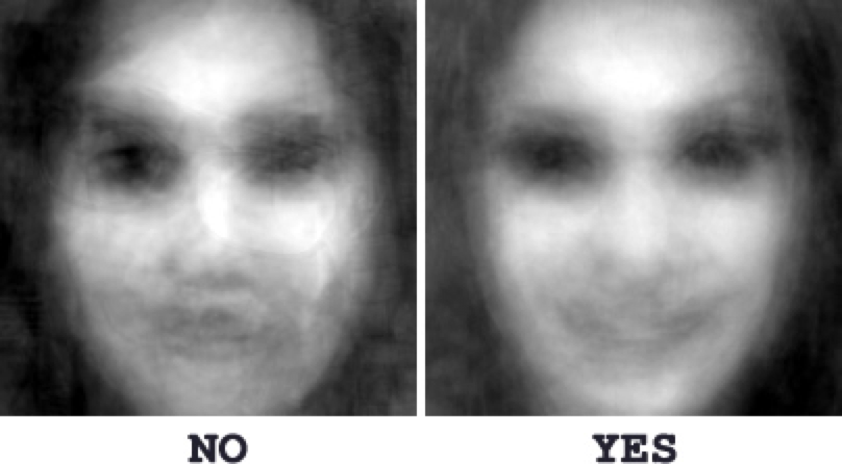
Example of Eigenface – Source: crockpotveggies
Utilizing Data Science to Date the Ideal Model
Justin long, a contributor and a consulting deep learning engineer, has provided on his own blog, the code for Tinderbox, a Tinderbot that exploits the APIs of Tinder and utilizes Eigenfaces to construct an invariant model of the face you are intuitive. You can be under the impression that it is your ideal model , a model consisting of all the characteristics that you love most. Justin Lang also utilizes Stanford NLP to help the bot examine the sentiment of chat responses. The program has learned enough to begin making choices for you after about sixty manual swipes at a speed you couldn’t replicate possibly.
Big Data Attempts to Find Online Love
To find you the ideal match, the online dating claims to merge both science and data. It is no wonder that in addition to generic sites like OkCupid, eHarmony and Match.com, the world of online dating is rich with specialty sites for daters who are in search for a match depending on many factors (for eg., religion, age, biological traits, income).
When it comes to trust, the industry has a very long way to go. A Pew study revealed that 54 percent of the online daters believed someone had misrepresented themselves in their profile and they are correct. About 81 percent of the online daters delineated wrong information about their age, height or weight. They are also likely to lie about their sexuality and income and utilizing flattering out-of-date photos is an all too common practice.
Big Data and Data Science explore the future, present, and past of online dating. When judging the prospective dates, on what data does the users depend? How do the matching algorithms of dating sites function? To find the ideal match, how can you optimize your profile? All these questions can be answered with Big Data and Data Science.
Online dating is booming today but can the algorithms be really utilized to forecast love? There are many positive as well as facts behind the phenomenon of online love.
The Facts
After visiting an online dating site, the users of online dating spend an average of 22 minutes. Every week, they get involved in the computer-based online dating activity for 12 hours. 66% of the people have gone on a date with the ones they met via a dating app or site and 23% have met a long-term partner or spouse through these sites. Most of the people today strongly believe that online dating is a much better way to meet people and it enables them to find the ideal match for themselves. 57% of the people of America has an annual income of $75k or more know someone who utilizes online dating. 40% know someone who has a partner or a spouse met through online. 11% of the couples of America who have been together for ten years or less met online. 54% of the people involved in online dating feel that someone has misrepresented themselves in their profile. 28% of the online daters have been harassed by the people whom they met through these online dating sites or apps.
The Algorithm
OkCupid makes its algorithm public but not the other dating sites.
The Patented Algorithm of OkCupid
When the member answers a question, OkCupid learns
- The answer of the member
- In what way the member would like the other person to answer
- How significant the question is to the member
A percentage score is assigned to the members. It calculates the probability of them being a good match.
Over the utilization of Matching Algorithms, there has been much criticism:
- Restricting the prospect pool doesn’t enhance the success rate.
- The sites present the members with unspecified odds, which is no different from meeting strangers at a bar.
- For the sites, there is no possible way to know how people really interact offline.
- The algorithms cannot account for intense psychological issues.
Some researchers indicate that the people are allured to others whom they realize to be identical to them, but that finding is not relevant to the dating sites that utilize matching algorithms that as the 2 people are not aware of each other’s existence when they fill the matching questionnaires and thus cannot report the perceived similarity. So, this summarizes the role played by big data in dating sites.
