


Digital Transformation Must Be a Priority for Learning Leaders in 2020
The beginning of a fiscal year is the ideal time to evaluate transformative ideas, and a potential digital transformation strategy. An organization‘s efforts to use technology to solve traditional problems is probably one of the most beneficial from a business perspective. Digitally transformed organizations can improve their customers’ experience, elevate their brand reputation, adapt more quickly to rapidly changing technology, and address sudden industry shifts more effectively and more.
The digital transformation market was valued at more than $342 billion in 2019 and is expected to reach $923 billion by 2025. So, things are heating up fast. The learning leader’s role in digital transformation is a critical one for any company to use technology to create new business models, elevate workforce performance and advance its marketplace position.
Embrace and Enable Change to Support Digital Transformation
You have to get in the game, said Kevin Wilde, Executive Leadership Fellow at Carlson School of Management, President and Founder of Flagship Consulting Group, and a learning veteran with a 34-year corporate career under his belt.
The former Chief Learning Officer for General Mills said if learning leaders are to effectively support digital transformation in 2020, they must get off the sidelines. Many may erroneously believe that they’ve missed the boat “ digital transformation is not a new idea “ but there’s a marked difference between related, rapid changes in the digital consumer experience and the digital corporate or academic experience.
Nobody’s ahead, he said. There are places that are moving faster on the topic, but everybody’s on the learning curve on this one; this is a huge learning and development process.
Development for technical talent is key to make modern business happen and to stay competitive in the global marketplace. Learning leaders must allocate the time, budget, and provide the structure and support needed to help this critical workforce cohort perform at optimal levels. Whatever the business is doing to transform and be more digital, more AI, etc. there is a critical learning component that the workforce desperately needs. It’s your job to champion that, Wilde explained.
Adri Maisonet-Morales agrees. The Vice President for Enterprise Learning and Development at Blue Cross Blue Shield North Carolina, recently built a learning strategy to support a digital transformation in the healthcare organization. She said given the rise of tech like cloud computing, AI, machine learning and data driven business, to effectively support digital transformation, learning leaders must acknowledge that their role is an active and ever changing one, one that must evolve along with the digital revolution.
Learning is by and large ubiquitous, she explained. It is accessible with the push of a button through any smart device. We must have a digital strategy that aligns with the enterprise strategy; one that blurs the lines between how people learn naturally and how they are expected to learn at work.
As she prepared for digital transformation at Blue Cross Blue Shield North Carolina, Maisonet-Morales had to reach beyond the scope of learning, and start in a broader organizational context. I made a point to answer five questions:
-
What are the top priorities or goals of the organization’s future state?
-
What are the current and future state skills and capabilities needed to achieve said goals?
-
What does the digital learning journey need to look like in order to create high impact experiences?
-
What are the investments needed to achieve the desired ROI?
-
What is the digital maturity of the organization, and what change levers do I need to pull to move the dial on adoption?
Once she had the answers, she had to reconcile them with the company’s learning in a way that enabled the learning function to maintain the organization’s core needs while iteratively introducing the digitalization of learning. It is important to keep in mind that the digitalization of learning is a slow process and should be done intentionally with the readiness of the workforce in mind. In order to do this, assessing learning preferences and clearly marketing the value of digital learning are important first steps.
Training Must to Evolve to Meet Changing Consumer Expectations
By its very nature, a digital transformation suggests that technology will be a key factor for business growth. Training has to evolve, but ironically, not always in ways that place a premium on learning technology as the primary driver for change.
Both Wilde and Maisonet-Morales said that savvy companies will certainly embrace chunky, sticky, micro- and nano-learning offerings that can be consumed in real time vs. lengthier formal programs. However, that does not mean the classroom doesn’t have a key role to play when it comes to creating interactive, immersive and engaging learning experiences.
Wilde said it’s best to have a dual or blended learning strategy, one that includes digital and traditional learning delivery systems. Micro-, nano, and just-in-time learning, the promise of machine recommended development or machine assisted performance support are all very much in play, but there are times where real learning is not a superficial five-minute YouTube video. It needs the investment, he explained.
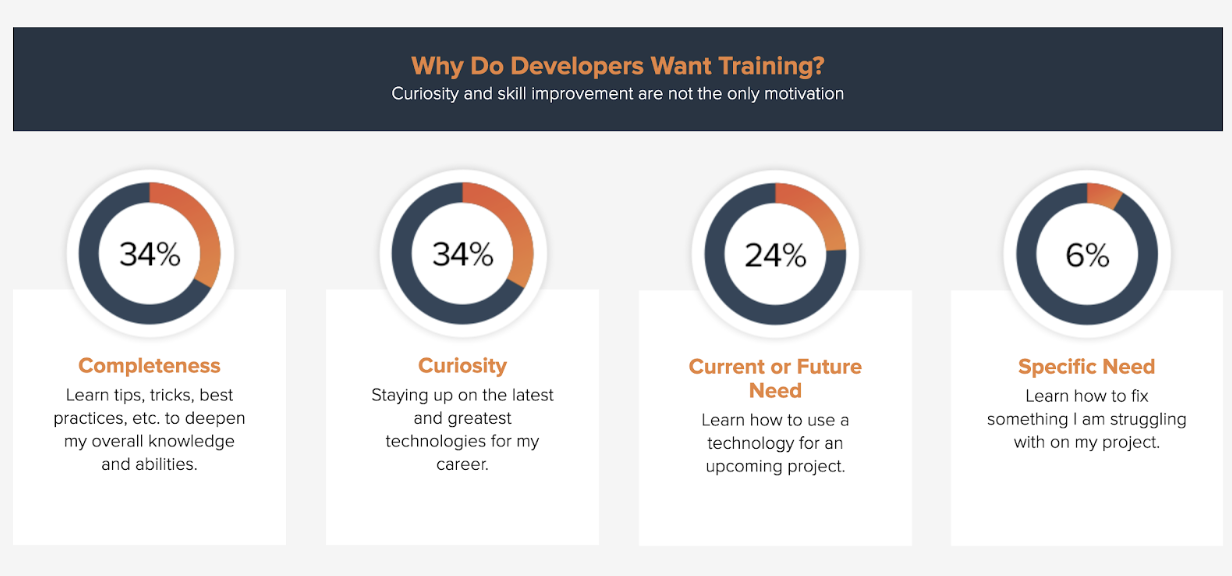
To view the Executive Summary of the 2020 Developer Survey, click here.
A blended learning strategy provides the short, quick hit, easily consumable information digital learning has enabled to conform to the way learners consume and work. But you have to reserve time and attention for things that take longer to learn, Wilde said. As learning professionals we are under serving our audience if we assume everything is going to be chunked and quick. There are some things where, if you want competence or mastery, you’re going to need to take a day, or four hours, or a week, and you’re going to be tested and have a cohort.
One of the biggest traits among our enterprise clients is their willingness to push the envelope internally, said Kelby Zorgdrager, CEO/Founder of DevelopIntelligence. We’ve seen some large brands successfully implement digital transformations when they spend the time to evaluate their skill gaps up front, create blended learning approaches that serve everyone’s needs, and get buy from both internal L&D and tech leadership teams, he added.
Whichever form training ultimately takes, it must be engaging. Learning is increasingly inspired by the consumer’s experience with technology. Maisonet-Morales said much like almost every other aspect of human social interaction, the consumer is king “ or queen. Therefore, it’s essential that learning organizations evolve beyond content creation as a development solution, and embrace learning journeys and experiences that adapt to rapidly changing technical skill needs.
Interactions must hold learners attention, they must be relevant, and they must illustrate clearly how acquisition of specific knowledge will improve learners’ performance, enhance their career, or ideally both. Otherwise learners won’t retain training, and few organizations have the time or budget for learning waste.
Your digital learning strategy must be customized to your organization, but it should also embody agnostic best practices for scale and sustainability, Maisonet-Morales explained.
Great Partnerships Produce Great Outcomes
Effective, impactful, learning supported digital transformations likely won’t happen without a deep partnership between an organization’s learning and technical leaders. Each function must be intimately aware of what challenges the other faces and the value each can bring to the table.
Maisonet-Morales said the relationship between the CTO (Chief Technology Officer) and CLO (Chief Learning Officer) is inextricably linked. The multimodal approaches and immersive simulations that sit at the heart of learning in the flow of work require partnerships that create a new foundation for the next generation learning ecosystem.
The complex and integrated systems needed to create and implement digital learning require collaboration and cooperation between CLO and CTO. If that partnership is not there, she said a digital learning strategy is far more likely to fail. Further, taking advantage of the technical leader’s expertise will help the CLO make informed decisions about what technology would integrate well within the larger technology stack, as well as meet the security standards for the organization, and determine a viable maintenance strategy for ongoing support.
Toward the end of his tenure at General Mills, Wilde said he spent a great deal of time with the
CTO because for that individual to do his job effectively required a heavy learning component. The best learning leaders understand that it’s not just become a friend of the CTO so you can do your stuff; it’s how can learning help them accomplish what’s important in their role? Then your stuff will come along.
Speaking of partnerships, vendor support is a valuable resource when it comes to digital transformation. Maisonet-Morales said that learning in the digital age requires a broader ecosystem that includes technologists, service providers, data analysts and more to keep content fresh, experiences favorable, and costs down.
Wilde echoed her. If you’re going to be a learning leader, you need a learning ecosystem beyond the people who show up to your meetings. The more you can nurture and cultivate a powerful network of good partners, vendors, mentors, etc., the more you’re going to be successful.
The world is changing so fast, you’re not going to have all the resources internally to make things work, he said. Figure out what’s core that you want to have inside. Then figure out, how do I forge great partnerships with vendors to do the things that either I can’t do because I’ve got high priorities, or that they can do so much better?
As for what makes a great vendor partner? Learning leaders will obviously want partners to provide access to skilled instructors with deep technical expertise and considerable experience working in the field. They’ll want to be able to customize learning content to meet specific organizational goals and challenges. They will also want partners to be accountable.
Great vendor partnerships include shared ownership of problems, Wilde explained. It’s all fun and games when you first start, right? But when things go haywire, how good a problem-solving partner are they going to be, or will I get caught in bureaucracy, the contract, etc.? Who owns the outcome? If I’ve got a great partner they’ve got skin in the game to get the job done, not just to deliver what you asked them to deliver.
Great vendor partners are invested in making sure they provide value. That takes time, energy, focus and creativity, Wilde said. When it comes to digital transformation, which vendor partners will “ in addition to providing good services and material “ make you look back and say, part of my success as a learning leader is that partner?
Technical Talent: the Architects for Digital Transformation
DevelopIntelligence’s 2020 Developer Report gathered metadata from hundreds of thousands of software developers, engineers and other technologists to identify how they like to learn new tech. Here are a few things learning leaders should consider as they develop learning programs for this critical workforce cohort.
54.4% – Developers prioritize learning on the job. Younger people place an even higher premium on learning. More than half of those surveyed put growth and learning at the top of their organizational wish list.
35% – Software developers enjoy self-directed learning, but formal learning programs are also quite popular. That’s especially true among experienced developers, though newer developers are not far behind. Some 35 percent say they have taken an immersive, highly interactive formal program like those DI creates for clients.
45% – Machine learning and data science are among the top skills software developers are looking to acquire, with good reason. This tech will be key for any tech savvy organization’s digital transformation efforts.
69.8% – When it comes to programming languages, technical talent shows a marked preference for JavaScript. That’s likely because it’s a key part of UI design, the Cloud and IoT apps. Other in demand languages include Python, C# and PHP.
