



- The next phase of machine learning, deep learning, relies on large amounts of data to train the algorithms. Normally, this would incur high-costs, but thanks to IBM‘s new Watson Studio costs can be kept low, resulting in a positive ROI for organisations.
- IBM Watson Studio allows you to train your models and easily add functionality thanks to their APIs using a pay-as-you-go model.
- IBM Watson Studio solves the main issues of developing neural networks: complexity, standardisation and skills gaps, making deep learning also available to small organisations.
We have entered the data age, where insights from streams of data can offer organisations valuable insights. Obtaining these insights is done using machine learning and the next generation in machine learning, deep learning, offers businesses the ability to streamline operational processes and cut costs. As long as development costs remain under control, organisations can achieve a positive ROI on their investments.
The challenge lies in effectively leveraging this newly available technology. Smarter machines require more in-depth programming, and that takes time, expertise and tremendous computing power. Now, the introduction of IBM’s deep learning as a service (DLaaS) brings the benefits to companies of all sizes, from larger enterprises all the way to small businesses. Driving the change is IBM Watson Studio that helps with some of the heavy liftings. IBM’s Watson Studio is a suite of tools that empowers organisations to develop AI solutions that drive innovation.
Deep Learning Depends on Data
The first, and arguably most crucial, part of the deep learning equation is the availability of data. With every successful iteration of a trained automated system comes reams of training data that can act as a shortcut for the next iteration. In a society where digital overload is a problem, lack of data might seem like a mind-boggling issue, but the challenge is not the sheer volume of data — it’s access to good data.
To train a machine, you need large amounts of high-quality data that is clearly tagged and curated to convey the right information. When teaching a machine to recognise an object, you require thousands of data points to prevent misidentifications. When done well, you have programs such as Google Maps that analysed 80 billion street view images to find new or updated information. In some countries, such as Brazil, this led to an improvement of more than 90% of the addresses, making Google Maps far more accurate for its users.
But everything starts with the data needed to help the machine understand what a face looks like and what points of commonality mean that two pictures are of the same person. If you don’t have the IT budget like Google, you can now start using IBM Watson Studio to train your algorithms at a pay-per-usage model, keeping your costs down. With already trained API options like facial recognition, Watson is ready to add functionality to your project. In addition, the easy workflow allows project managers to quickly assess data quality and collect new data for training, all within the managed workflow of Watson Studio.
Graphics Processing Units (GPUs) Accelerate Deep Learning
The use of GPUs to accelerate the process of training a machine was a major turning point for the industry. Before GPUs, all deep learning ran on very expensive CPUs, which meant that only the largest companies, such as Facebook, could afford to build these training systems. Now, GPUs cut the cost and streamline the process, making it possible for even small businesses to use GPU-enabled systems for their deep learning processes.
CPUs are still the gold standard for single process improvements, but when you need to get a lot done, in a hurry and on a budget, GPUs offer an affordable and effective option. Of course, even modest GPU systems can carry a price tag similar to the annual salary you might pay a developer, but with IBM Watson studio, you can now “rent” the amount of GPU time you need through a deep learning product provider.
Neural Network Architectures Grow Deeper and Wider
As developers work with deep learning, they create increasingly complex neural network architectures. These networks integrate equations in a system designed to resemble the human brain. Then, different values are assigned different weights, making them more or less valuable as a data point. Trial and error show which methods work best for which of your applications. Developing from scratch often means an exhaustively iterative process to determine which hyperparameters work best for a specific function. With IBM Watson Studio and the newly introduced Neural Network Modeler, a lot of the work is done for you. By creating a platform that uses a graphic interface during development, IBM has leapt over the most common barriers to entry with Deep Learning: complexity, standardisation and the skills Gap.
Think of it like putting up your first website. In the beginning, HTML coding was bulky, hard to use and made it easy to introduce errors. New coding languages and the development of templates left many of those problems behind. Neural network architecture benefits from the same process, and IBM Watson Studio helps make those templates available to smaller and smaller businesses.
What Is IBM Watson Studio?
Raw data has little value without the power to interpret and predict based on that data. With deep learning, machines can develop the skills needed to sort through vast amounts of data and reach meaningful conclusions. Watson Studio cuts down on the training time needed to deploy these AI solutions, thereby offering any type of organisation to benefit from the advancements of AI, while ensuring a positive ROI.
With Watson Studio, you get an open and flexible platform that lets your best developers accomplish tasks using the deep learning framework they are most familiar with. Elastic access to GPU systems means no more capital investment and no more paying for compute time you aren’t using. It turns the cost of training your systems into a pay-as-you-go pricing model.
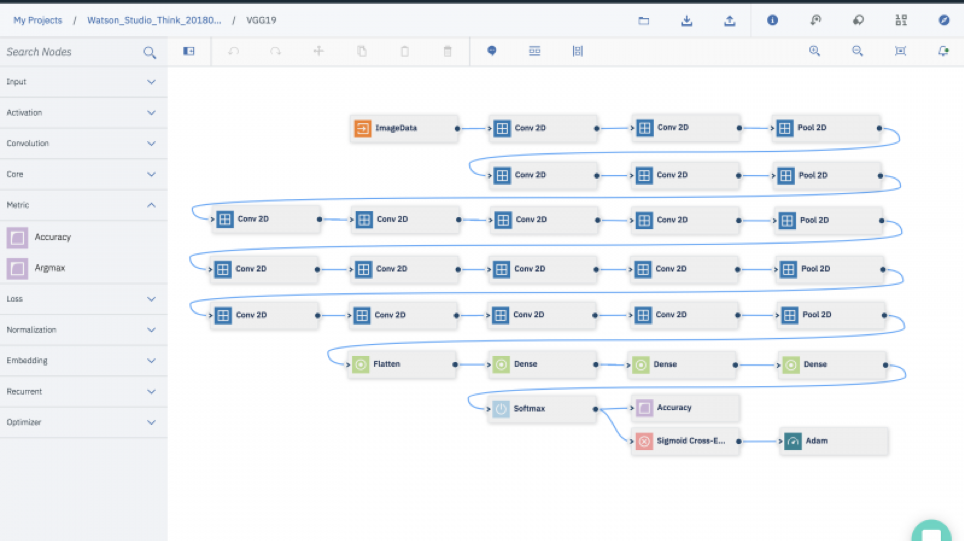

Source: IBM Watson Studio
Benefits of DLaaS With Watson Studio
First to market is a big deal. The faster you can enact change, the more agile you remain in the market and the better you can serve customers who constantly demand more from their providers. As a full-service option, Watson Studio includes the neural network architecture templates, GPU access and catalogued data you need to train your next AI project successfully. By giving you access to existing functions such as working facial recognition, you can use an out-of-the-box solution or customise from an existing template to cut down development time. Watson Studio offers a shortcut for deep learning that can help you deploy operational AI in the shortest possible time at low costs, making deep learning available to any type of organisation.
This article has been made possible by IBM Watson.