


The data ecosystem serving today’s modern enterprises is a multi-platform architecture that attempts to embrace a variety of heterogeneous data sources. This modern data ecosystem (MDE) might include data lakes, traditional data warehouses, SaaS deployments and other cloud-based systems, data hubs, and distributed databases.
Multi-Platform Architecture
Reality of Modern Enterprise
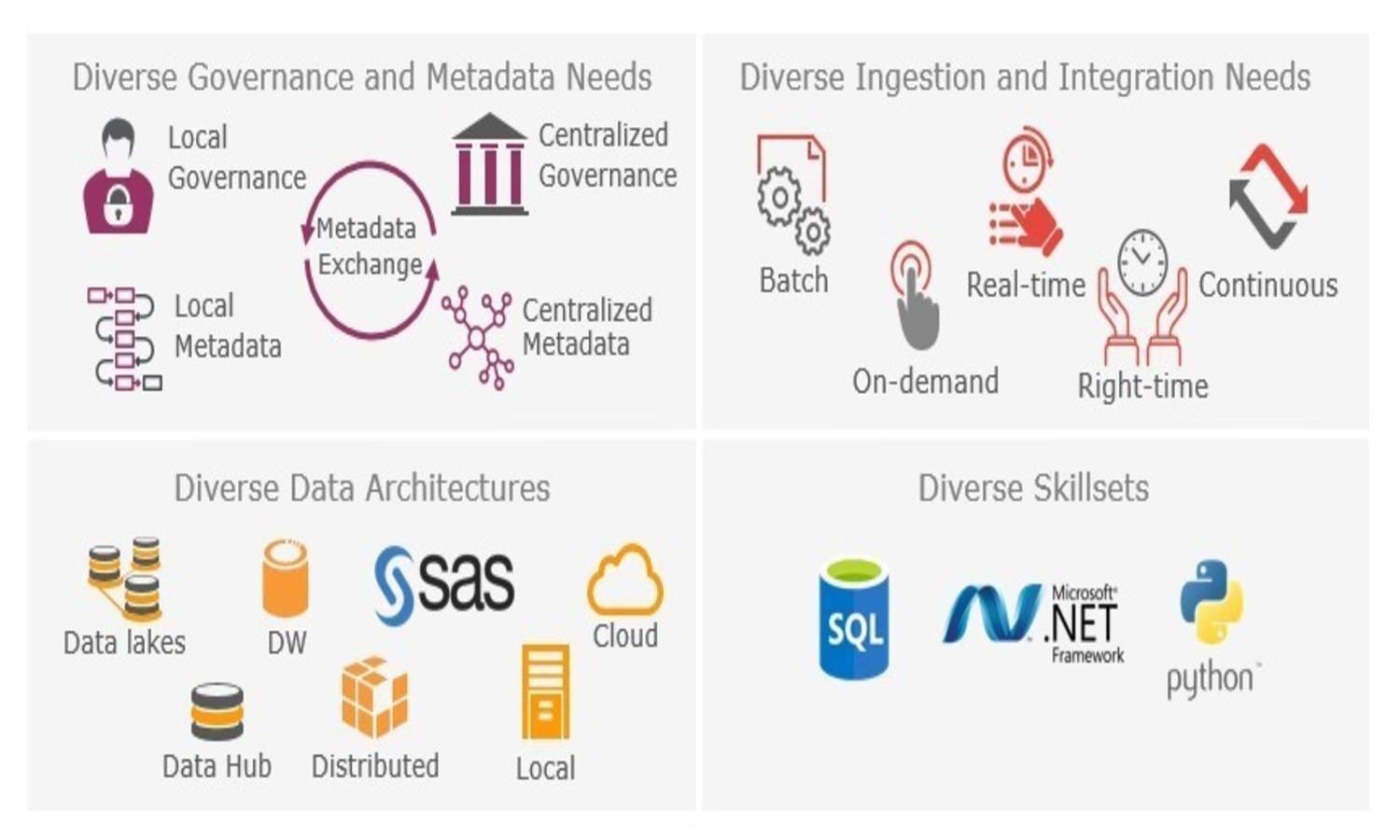
The MDEs can potentially enable a wide variety of business goals as well as support data diversity, optimize costs, and support multiple systems of insight. However, MDEs will never be able to deliver these benefits unless enterprises can surmount a series of formidable challenges:
- Data ownership. Who owns the data and with whom can it be shared?
- Integration and unification. How will disparate data be integrated and unified to support reporting and analysis across the entire portfolio?
- Data quality risks. How will an enterprise ensure adequate data quality given that different data systems will be characterized by different levels of data quality?
- Skillset scarcity. How will an enterprise fulfill the need for a diverse set of skills?
- Optimization issues. How will an enterprise optimize the interaction among MDE’s, separate, poorly orchestrated components?
- Multiple data models. How will an enterprise work with multiple data models that proliferate, reducing efficiency?
- Holistic view. How will an enterprise establish a sustainable method for gaining a holistic view in a fragmented MDE?
One Solution: A Unified Data Repository
Many companies establish data stores, or data warehouses, and replicate data to these central locations for reporting and analytics after transforming the data to a standard format. Although this approach seems an effortless way out to reduce complexity, it requires the maintenance of a monolithic data store which can be costly, time-consuming, and at risk of becoming yet another silo.
An Effective Solution: A Data Virtualization Layer for an Integrated Data Ecosystem
Data virtualization creates integrated views of data across multiple heterogeneous sources, without moving or replicating the data, and provides holistic views of data to applications and consumers in real time. By establishing data virtualization as a layer above an organization’s disparate sources, data virtualization also provides a way to apply security and governance controls across the underlying data systems from a single point of control.
Multi-platform architectures are inevitable in modern enterprises. Organizations should embrace this diversity to meet their business goals and should exploit a data virtualization layer to enable an integrated data ecosystem to provide holistic and consistent views of data. Modern enterprises can leverage data virtualization to understand, access, unify, govern, and model their data and unlock all its benefits.
