


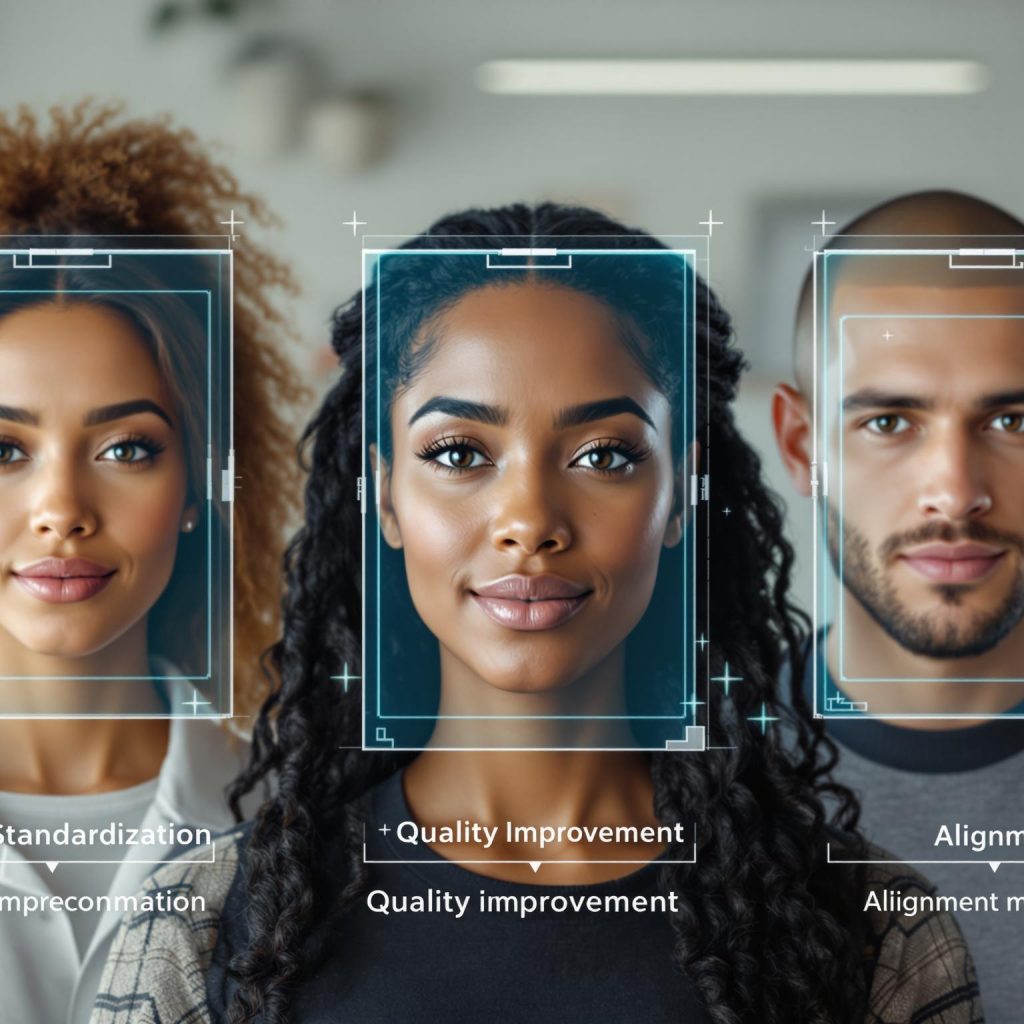
Face recognition works best with clean, consistent images. That’s where preprocessing steps in – refining raw images to improve recognition accuracy. Here’s what you need to know:
- Standardize Images: Resize to 224×224 or 299×299 pixels, balance lighting, and align facial features like eyes and mouth.
- Improve Quality: Use noise removal (e.g., Gaussian or median filtering) and sharpening methods to enhance details without over-processing.
- Detect and Align Faces: Tools like MTCNN and Dlib help detect faces, map key landmarks, and adjust head positions for better accuracy.
Preprocessing ensures images meet recognition systems’ requirements, handling challenges like uneven lighting, tilted angles, and noise. These steps are critical for reliable face recognition in real-world applications.
Introduction to Image Processing for Face Recognition

Image Standardization Methods
Standardizing facial images is crucial for consistent recognition across various input sources. It involves tweaking key image attributes like size, lighting, and head position to ensure reliable face recognition.
Size and Scale Adjustment
Facial images are typically resized to dimensions between 224×224 and 299×299 pixels. Here’s what matters:
- Preserve proportions: Avoid stretching or squishing the image to prevent distortion.
- Resolution management: Maintain enough detail during resizing to retain facial features.
- Boundary padding: Add padding to meet size requirements without cutting off important details like facial landmarks.
Light and Color Balance
Variations in lighting can throw off recognition accuracy. To address this, light and color balancing techniques are applied:
- Histogram equalization: Enhances contrast and normalizes brightness by redistributing pixel intensities.
- Color normalization: Converts images to a consistent color space (e.g., RGB or YCbCr), adjusts white balance to remove color tints, and evens out color intensity values.
Head Position Adjustment
Aligning the head position is essential for accurate feature extraction. This involves:
- Detecting key facial landmarks (like eyes and nose) to estimate pose.
- Using affine or perspective transformations to horizontally align the eyes, center the face, and standardize scale based on interpupillary distance.
Tools like OpenFace and Dlib can automate these adjustments, making it easier to handle head pose variations and enhance matching accuracy.
sbb-itb-9e017b4
Image Quality Improvement
Low-quality images can significantly reduce recognition accuracy. Preprocessing steps like noise removal and sharpening help improve clarity and eliminate distractions.
Noise Removal Techniques
Image noise often hides critical facial features, making recognition less effective. Here are some common methods to reduce noise while keeping important details intact:
- Gaussian Filtering: Smooths noise by calculating a weighted average of surrounding pixels using a small kernel (e.g., 3×3 or 5×5), while maintaining edge details.
- Median Filtering: Replaces each pixel with the median value from neighboring pixels, effectively removing "salt-and-pepper" noise without blurring edges.
- Non-Local Means Denoising: Compares similar patches throughout the image to reduce noise while preserving patterns and textures.
- Deep Learning Denoising: AI-driven approaches like DnCNN tackle complex noise patterns, ensuring key features remain clear.
After noise reduction, sharpening techniques can enhance the finer details.
Image Sharpening Methods
Once noise has been minimized, sharpening methods can bring out facial details for better recognition accuracy.
Traditional Approaches:
- Unsharp Masking: Enhances edges by subtracting a blurred version of the image from the original.
- Laplacian Sharpening: Highlights fine details using second-order derivatives.
Advanced Techniques:
- Adaptive Sharpening: Dynamically adjusts contrast in different areas of the image to enhance specific features.
- Super-Resolution: Uses deep learning to upscale images and add natural-looking details.
It’s important to strike a balance when applying these methods. Over-processing can introduce artifacts, which might confuse recognition systems instead of improving their performance.
Face Detection and Position Fixing
Effective preprocessing starts with accurate face detection and proper positioning. This ensures facial data is well-isolated and properly oriented.
Methods for Detecting Faces
Modern face detection combines traditional approaches with AI-driven techniques, each suited for different scenarios.
Traditional approaches include:
- Viola-Jones algorithm: Reliable in controlled environments.
- HOG (Histogram of Oriented Gradients): Handles variations in head poses and lighting well.
AI-based methods improve detection accuracy by leveraging advanced models:
- MTCNN (Multi-Task Cascaded Convolutional Neural Network): Uses a cascaded structure for improved results.
- RetinaFace: Designed to handle challenging situations, such as diverse angles and scales.
After detecting a face, precise mapping of facial features ensures proper alignment for further processing.
Mapping Facial Features
Detailed feature mapping is key to fine-tuning facial alignment, especially when working with standardized, high-quality images.
This process involves two main steps:
-
Key Point Detection
Identify primary landmarks like the eyes, nose, mouth, and other key facial contours. -
Alignment Techniques
Use similarity or perspective transformations to adjust for rotation, scale, and perspective distortions. Deep learning models can further enhance the precision of landmark detection.
Challenges like variable lighting, extreme head angles, partial obstructions (e.g., masks, glasses, or hair), low-resolution images, and motion blur can complicate detection. Modern systems tackle these issues with multi-scale detection, ensemble methods, real-time video tracking, and feedback loops for quality assessment.
Summary and Next Steps
Key Takeaways
Here’s a quick recap of the main preprocessing steps in facial recognition:
Critical Processing Steps
- Image standardization: Ensures consistent geometry, lighting, and facial orientation for better accuracy.
- Quality improvement: Reduces noise and emphasizes key facial features.
- Detection and alignment: Maps facial features to ensure precise recognition.
Recent Advancements
New technologies are enhancing preprocessing techniques, making them more effective and adaptable:
AI-Powered Enhancements
- Deep learning models handle challenging lighting conditions.
- Neural networks adjust for extreme head angles.
- Algorithms compensate for obstructions, like glasses or masks.
Real-Time Processing
- Streamlined systems optimize images on-the-fly.
- Tools adjust dynamically to changing environments.
- Feedback loops ensure continuous improvements in image quality.
Where to Learn More
Staying updated is key as these methods continue to evolve. Here are some helpful resources:
Online Platforms
- Visit Datafloq for insights and updates on AI preprocessing.
Technical Materials
- Explore research papers on the latest methods.
- Check out implementation guides for hands-on learning.
- Review case studies showcasing real-world applications.
As facial recognition technology advances, staying informed about new preprocessing techniques will help you stay ahead. Dive into these resources to keep your skills sharp and up to date.