


It’s no longer just tech giants testing Large Language Models; they’re becoming the engine of everyday apps. From your new virtual assistant to document analysis tools, LLMs are changing the way businesses think about using language and data.
The global LLM market is expected to explode from $6.4 billion in 2024 to $36.1 billion by 2030, a growth of 33.2% CAGR according to MarketsandMarkets. This growth only leaves one assumption: building with LLMs is not a choice; it is an imperative.
However, using LLMs successfully largely depends on selecting the right tools. Two developers keep hearing about LangChain and LangGraph. While both let you easily build apps powered by LLMs, they do it in very different ways because they focus on different needs.
Let’s look at some key differences between LangChain and LangGraph to help you determine which is the best for your project.
What is LangChain?
LangChain is the most commonly utilized open-source framework for developing intelligent applications utilizing large language models. It is like an “off-the-shelf” toolbox that provides easy connections between LLMs and external tools such as websites, databases, and various applications, enabling quick and easy development of language-based systems without the need for starting from nothing.
Key Features of LangChain:
- Simple building blocks for building LLM applications
- Easy and simple connection to tools like APIs, search engines, databases, etc.
- Pre-built prompt templates to save time
- Automatically save conversations for understanding context
What is LangGraph?
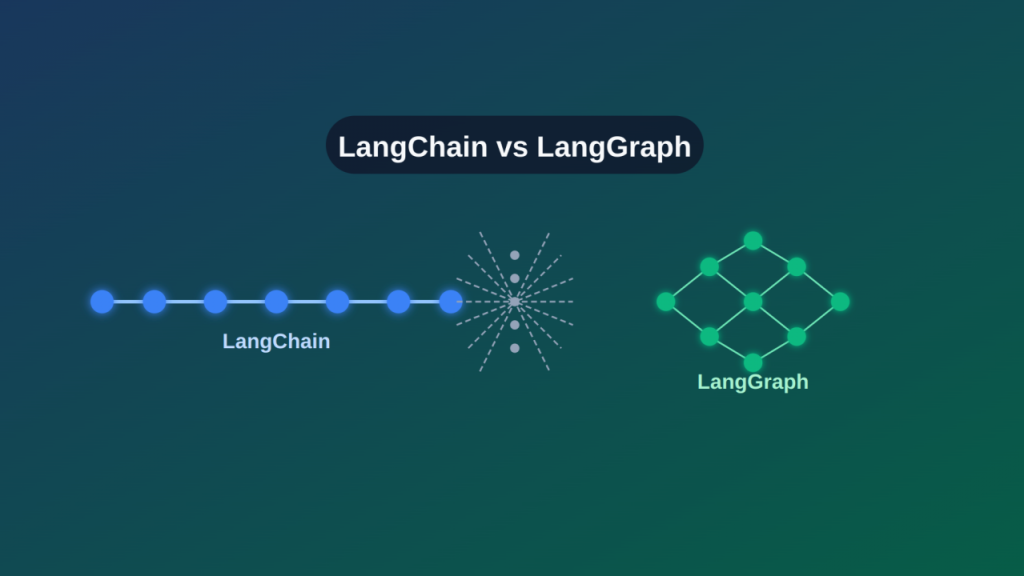
LangGraph is an innovative framework built to expand the capabilities of LangChain and add structure and clarity to complex LLM workflows. Rather than taking a normal linear workflow, it follows a graph-based workflow model, where each of the workflow steps, such as LLM calls, tools, and decision points, acts as a node connected by edges that specify the information flow.
Using this format allows for the design, visualization, and management of stateful, iterative, and multi-agent AI applications to more effectively utilize workflows where linear workflows aren’t sufficient.
What are some of the advantages of LangGraph?
- Visual representation of workflows through graphs
- Built-in control flow support for complex flows such as loops and conditions
- Well-suited for orchestrating multi-agent artificial intelligence systems
- Better debugging through enhanced traceability
- Actively integrates into components of LangChain
LangChain vs LangGraph: Comparison
|
Feature |
LangChain |
LangGraph |
| Primary Focus | LLM pipeline creation & integration | Structured, graph-based LLM workflows |
| Architecture | Modular chain structure | Node-and-edge graph model |
| Control Flow | Sequential and branching | Loops, conditions, and complex flows |
| Multi-Agent Support | Available via agents | Native support for multi-agent interactions |
| Debugging & Traceability | Basic logging | Visual, detailed debugging tools |
| Best For | Simple to moderately complex apps | Complex, stateful, and interactive systems |
When Should You Use LangChain?
Are you unsure which framework is best for your LLM project? Depending on the use cases, developer requirements, and project complexity, this table indicates when to select LangChain or LangGraph.
|
Aspect |
LangChain |
LangGraph |
| Best For | Quick development of LLM prototypes | Advanced, stateful, and complex workflows |
| Applications with linear or simple branching | Workflows requiring loops, conditions, and state | |
| Easy integration with tools (search, APIs, etc.) | Multi-agent, dynamic AI systems | |
| Beginners needing an accessible LLM framework | Developers building multi-turn, interactive apps | |
| Example Use Cases | Artifical intelligence powered chatbots | Multi-agent AI chat platforms |
| Document summarization tools | Autonomous decision-making bots | |
| Question-answering systems | Iterative research assistants | |
| Simple multi-step LLM tasks | AI systems coordinating multiple LLM tasks |
Challenges to Keep in Mind
Although LangGraph and LangChain are both effective tools for creating LLM-based applications, developers should be aware of the following typical issues when utilizing these frameworks:
- Learning Curve: LangChain is widely considered easy to get up and running early on, but it takes time and practice to become proficient at all the advanced things you can do with LangChain, like memory and tool integrations. Similarly, new users of LangGraph may experience an even greater learning curve because of the graph-based approach, especially if they don’t have any experience building node-based workflow designs.
- Complexity Management: LangGraph can assist you with the development of workflows as your project has grown large and complex, but without appropriate documentation and organization, it can quickly become overly complex and chaotic, managing the relationships of nodes, agents, and conditions.
- Implications for Efficiency: Statefulness and multi-agent workflows add another computational layer that developers will need to manage in advance so the performance doesn’t get dragged down, specifically when building big, real-time apps.
- Debugging at Scale: Even though LangGraph adds more traceability, debugging complex multi-step workflows with many interdependencies and branches can still take a lot of time.
When creating LLM powered applications, developers can better plan projects and steer clear of frequent mistakes by being aware of these potential obstacles.
Conclusion
LangChain and LangGraph are important players in the LLM Ecosystem. If you want the most flexible, beginner-friendly framework for building standard LLM apps, choose LangChain; however, if your project requires complex, stateful workflows with multiple agents or decision points, LangGraph is the better option. Many developers use both LangChain for integration and LangGraph for more advanced logic.
Final tip: As AI continues to advance, learning these tools and pursuing quality Online AI certifications, or Machine Learning Certifications, will help enhance your edge in this fast-changing landscape.