



Master Data Management (MDM) promises to reduce supply chain costs and standardize business activities across the enterprise, resulting in faster implementation of goods and services. According to Supply Chain magazine, many companies falsely believe they already have an acceptable MDM solution or even forgo one. However, to truly leverage your MDM system, whether to be or already implemented, an enterprise-grade MDM strategy is needed, one that pays close attention to data quality.
Companies believe that poor data quality costs them an average of $15m a year in lost revenue, this fact leads to a paradox. Organizations think that MDM will fix all their data quality issues and then, after a long slog to implement an MDM are disappointed to realize that data quality issues, like missing zip codes, continue to exist.
Here, the business needs to revisit its MDM strategy or create a good one if it does not exist and apply master data management best practices. Good MDM strategies with a data quality focus reap a variety of benefits including reduced costs, use MDM quicker, and getting to a more straightforward solution. Also, this kind of planning attracts more participation from non-technical users and a data quality that meets the business’ threshold of error.
This article will answer and explain:
- What Is A Master Data Management Strategy?
- Why Do You Need A Master Data Management Strategy?
- How To Create A Master Data Management Plan?
- Data Management Strategy Example
What Is A Master Data Management Strategy?
An MDM strategy combines cross-business requirements and data governance and data management perspectives to understand and control master data access and synchronize operations across the organization. Master data describes shared critical data assets (such as product, part, and customer data) that flow as a value chain, a unique series of activities and assets, from product or service conception to consumption.
MDM strategies are created and applied to align master data quality across multiple internal or external data systems vendors and with industry standards. Through a Master Data Management plan, you control how to clean and match data elements, preserving the integrity of each customer, vendor, or product entity.
When you coordinate master data quality according to sound MDM principles and your requirements, you get a single, trustworthy view of business operations. You know what to expect when you search for your master data and get repeatable results. These advantages make it much easier to integrate other data systems with your MDM, even those streaming real-time data.
Why Do You Need A Master Data Management Strategy?
Without a master data management plan, you may get consistent data but not at the data quality threshold your business needs. This result makes the master data unusable to other departments.
For example, suppose you do not have clear guidance on who will be responsible for keeping your customer data in good quality. In that case, information technology (IT) may take charge of data cleansing and matching, by default, to keep the system and business running.
Then, your organization’s subject matter experts find that they cannot use the customer data as standardized by IT because it does not make sense in the business context.
So, your subject matter experts end up exporting the master data from the system and cleaning it up on their own to make it usable. A master data management plan with a data quality focus avoids such messiness and complexity.
How To Create A Master Data Management Plan?
To achieve a good Master Data Management plan with excellent data quality, you need to do the following:
- Understand your business plan and strategy: A MDM system functions as a tool to simplify business operations across the organization. But if you do not know what your business does and how different departments interact, then an MDM system cannot help you.
- Do a data management assessment: You need to determine what data strategies, governance, qualities, technologies, processes, and roles already exist to inform your master data management.
- Identify your data quality requirements for Master Data Management: Put together the information from your business plan and strategy and the enterprise-wide data management assessment to identify your data quality requirements. What will make your data more usable and relevant?
- Be clear about what defines your master data: Different MDM systems organize master data across various domains and sub-domains, like customers and products. Choose the MDM scheme that works best for your master data definition.
- Some departmental data will live outside of the MDM: Some data may remain siloed in a department, like public transit reimbursement. That is ok unless the data falls under your definition of master data needed for cross-business activities.
- Execute your MDM strategy: Implement data quality activities and processes from your MDM strategy (like data cleansing and matching).
- Periodically Improve Your MDM Plan: As the business climate changes and new technologies release, you will need to tweak your MDM strategy. Be sure to measure your MDM effectiveness to see how much of a change you need to your MDM strategy.
Data Management Strategy Example
In this data management strategy example, a client found that business users lacked access to critical master data from a homegrown MDM SQL system because of poor and inconsistent data quality. This SQL server ingested data from a variety of sources, including real-time data feeds.
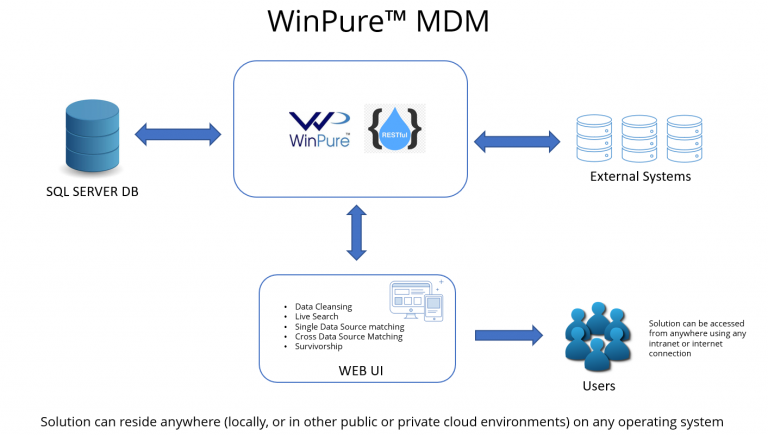

The customer developed a master data management plan to simplify master data transformation with better data quality. WinPure developed a solution where it cleaned, deduped, and matched the incoming data to meet the client’s master data management strategy and data quality requirement needs.
As a result, the customer updated its master data faster by better merging information from the new data feeds. The company’s non-business users also found it easier to search and narrow in on its master data.
Final Words
An MDM system, in itself, will not fix your data quality problems. You need to have an enterprise-grade master data strategy and ensure best practices are adhered to in line with your business.
Overall, taking a data quality approach to your MDM planning will make your master data more comprehensive and easier to adapt to changes in the future by batch updating your data to meet the new standards.
Originally published here