



A couple of weeks back, I attended a business owners’ conference that was focused on leveraging digital technologies for small businesses. A recurring item in the discussions was how it was difficult to justify investing money in analytics. Web analytics as a technology has been around for nearly the same amount of time that the Internet has. And yet the value analytics brings to the table is still not fully understood or articulated.
So how does analytics help a website? The obvious answer might be that it provides reports on site visitors, revenue, transactions, etc. Even though it reports on what happened over a period of time, there is a lot more to that story. In addition, web analytics can be a key competitive advantage that your competition may never figure out and outpace you in.
Before we get too deep into this topic, lets quickly establish the definition of web analytics for the purpose of this article. Web analytics covers the technologies that are used to measure the performance of a website, mobile application, or social media account. So tools such as Google Analytics, Piwik, and Twitter Analytics are part of this universe of technologies.
Here is an easy way to think about the ROI of analytics:
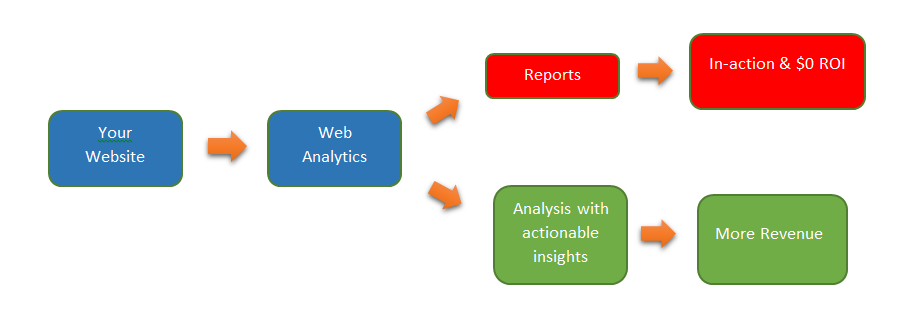

As you see in the image above, analytics frequently defaults to basic reporting. And that leads into dead ends with $0 ROI. This approach eventually results in disinterest in analytics. When one changes that process to focus on data analysis to find actionable insights, then the benefits of using analytics become the case for investing in analytics. Now analytics becomes instantly more appealing.
For any organization, the key to getting an initiative funded is to show significant benefit as a result of the initiative. As long as that benefit has a higher payoff than the amount of money invested, it is deemed to have a positive ROI.
For analytics, the challenge comes in with lack of ownership over areas that are directly responsible for revenue. For example, marketing channels are responsible for traffic. The ecommerce operations team might own the conversion funnel on the site. But the web analytics team doesnt own anything they can directly leverage to drive benefit to the bottom line.
So the approach for displaying a positive ROI for analytics is steeped in the analytics teams ability to foster strong partnerships with areas of the business that can directly impact the bottom line. Here are a few of those teams:
- Marketing channel teams (Organic search, display ads, etc.)
- Product teams (Checkout, shopping, merchandising)
- Optimization team (A/B testing)
Each of these teams has a vested interest in being more effective. The marketing teams are interested in optimizing their marketing spend to drive more qualified traffic at lower cost. The optimization team is interested in improving the conversion rate on the site to drive higher revenue. And there is no better way to find such opportunities than through web analytics!
So here are two key ways to measure the ROI of web analytics when partnering up with one of these teams:
- Maintain the integrity of installations
- Drive incremental revenue
Lets look at each of these in detail.
- Maintaining the integrity of installations: The quality of data fed into an analytics tool depends on the quality of tags that are implemented on web pages. These tags tend to break or fall off the pages because of routine changes to the site. And that impacts teams ability to measure analytics accurately. While maintaining integrity of tags is very important for web analysts, it is even more important for marketing teams that manage third party ad or affiliate networks to drive traffic to the site. So investing in regular tag audits can be hugely beneficial to both teams. Heres how to model the ROI for integrity checks:
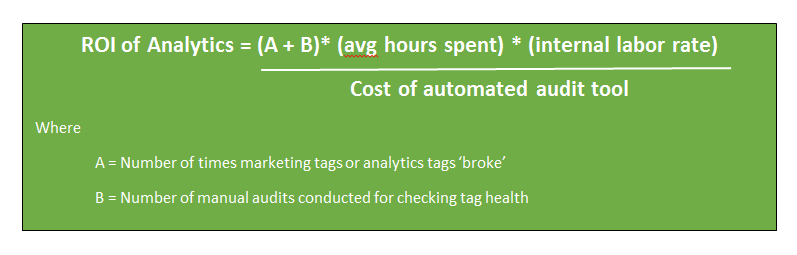

With this case, the focus is on cost savings by investing in automated tag audit tools. This has a second benefit of freeing up resources from such fire drills so they can focus on providing true actionable insights instead.
- Driving incremental revenue: Being able to generate incremental revenue will drive a lot of interest across teams for sure. The topic of how to identify opportunities that could generate revenue is a series of articles in itself. Whether it is figuring out how media spend can be optimized, or how click through rates can be improved, the process starts with analyzing data from web analytics and forming theories that can be tested to improve the bottom line.
Heres the formula for calculating the ROI for this opportunity:
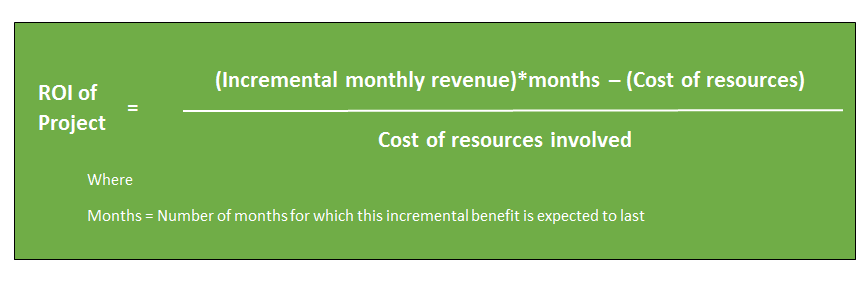

This second approach requires a close partnership with the team directly benefiting from the changes. The responsibility of a good web analytics team is to look beyond the obvious in the data, and to identify trends in data that could point to opportunities for improving the bottom line.
In summary, web analytics can be an unbeatable competitive edge if used effectively. Whats required to make this happen is for web analysts to focus on finding actionable insights that can either drive incremental revenue or cost savings.