


We can find loads of content and articles about How are the big boys using big data? But how ready is the little guy; the medium and large company? For companies it is important that the strategy is aligned and focusing on customer value. To be ready to get added value from big data developments is in the first place, a clear focus on the companys unique customer values.
Successful Companies Are Unique
Successful companies are unique and they have a strong focus on specific customer values. These are the values that distinguish these companies from their competitors and make the customer choose for buying its required service or product with that company. Are you cheaper, faster, friendlier, more trustworthy, transparent, flexible, providing better service, easy, specialized, professional etc.? That your original uniqueness is important, is clearly expressed by Jack Trout [1]If you ignore your uniqueness and try to be everything for every-body, you quickly undermine what makes you different. Consider Chevrolet. Once the dominant good-value family car, Chevrolet tried to add “expensive,” “sporty,” “small,” and “truck” to their identity. Their “differences” melted away as did their business. The brand is now behind Honda, Ford, and Toyota (Honda, 735,633 cars; Toyota, 679,626 cars; Ford, 591,010 cars; Chevrolet, 479,802 cars; total sales in 1998). Based on the perceived and factual preference of customers they decide to buy its product or service from you. If there is a small pattern of dissatisfaction, you should act. If there is a fallback in sales you should analyze it, find the root cause and fix it. We see however that the real benefit of the new generation analytics solutions lies in answering questions which have a more predictive character: What will happen? e.g. Which customers will leave us in the coming month/quarter? Currently 80% of analytical investments have been in producing reports from lagging information [2]. The new generation of advanced analytics tools give these companies the means to get the insights to act upon. These tools are highly stimulated by big data development but most companies are not ready yet, to use them effectively.
For medium and large (national) companies it is even more important to turn useful insights from analysis directly into action. This can for example have the format of a calling list for sales representatives with customers who have a gradual or sudden decline in their sales. A quick and detailed follow up showing the differences in sales for these profiled customers offers a direct opportunity to win sales back. This sales or even the customer would have been surely lost if it was not followed up quickly with the correct analysis of the changing buying patterns.
The usage amongst medium and large companies of analytical solutions is not as common and effective as it could be. There are some hurdles, which will be explained here. 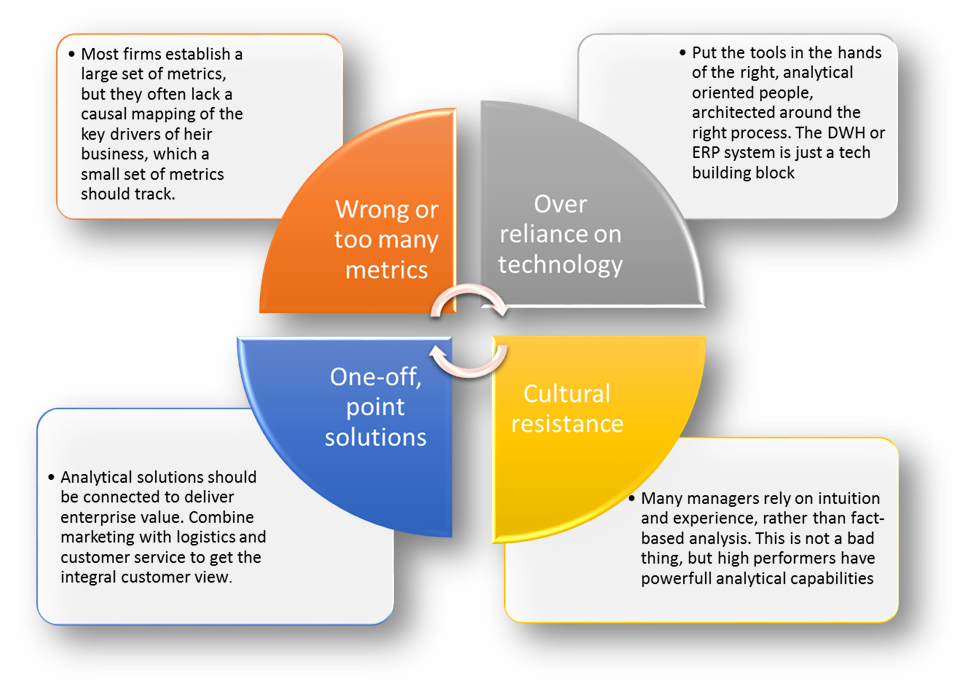
Hurdles for Using Analytics Capability
In the paper of Accenture: Beyond Nice to Know: Getting Serious About Analytics to Drive Outcomes is explained what are the hurdles for companies to use their analytical capabilities effectively [3]So the lessons for the (smaller) companies are:
- Use and choose only the important KPIs (the right mix of leading and lagging)
- Find, hire and train the right people for the job
- Focus on enterprise and customer value as a scope for the analytical solutions
- Use the facts that you gather around your products and customers in combination with your experience and intuition.
So now we know that your unique customer values, tools, KPIs and (surrounding) facts are important, but also the people that are supposed to use them. These people need a special set of skills and capabilities, which is currently not in the standard portfolio of our higher education system. So we need this person: but Plus communication and personal skills
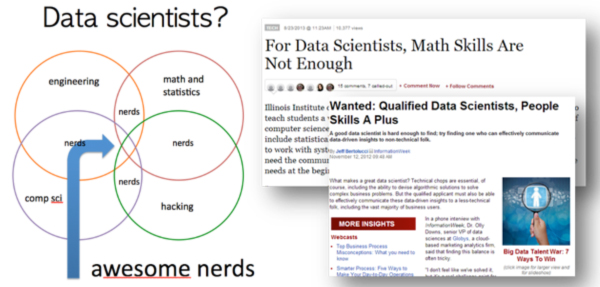
As seen in the press there is growing need for data scientist. Projections by the McKinsey Global Institute point to a need for 190,000 more workers with analytics expertise and 1.5 million more data-savvy managers by 2018 in the US alone. The list of ideal skills and capabilities is extensive, so how realistic is it to find these people within the coming years? It is probably better to create your own data scientist staff or employee, like CITO Research is saying in growing your own data scientists: The role of the data scientist is a hybrid role that can solve this problem. While the definition of the role is compelling, it’s a lot easier to define the role than it is to hire someone to fill it, and even when you do, communication problems may persist. … We also believe these people will have to be “created,” rather than hired. Often, the solution will not be to create a just one person who can be the data scientist, but rather to open up communication so that a team can do the job instead of having to have a virtuoso. The article also points out three ways to grow your own:
- Provide the business staff with tools so they can analyze data and answer questions on their own.
- Communicate the questions that need to be answered to the analytics and IT experts who can then use the advanced technology to answer them.
- Improve communication so that business staff along with the analytics and IT experts can work as a team.
This action should be combined with creating a analytical culture, where Thomas Davenport has written about. In this interview he is making a very clear statement: Organizational issues are more challenging than technology puzzles. There will be ongoing rapid progress on developments with Hadoop and other emerging technologies. Technology problems will be easier to solve than the skills needed to make the technologies work. The big constraining factor is the people, who are not open source.
