


You’ve undoubtedly heard the words project management and workflow management used, perhaps interchangeably, but having a strong sense of what each of them will bolster your team’s ability to effectively plan and execute both daily assignments and big projects with clarity.
The easiest way to understand the differences from Project and Workflow Management is to parse the What and When from the How.
What is Project Management?
Project Management is the plan that has been laid forth to achieve a goal. Project Management defines the definitive timelines for when clusters of tasks need to be achieved in order to complete the entirety of the project’s tasks on schedule.
In this way, Project Management types define the What and When of a group of tasks that constitutes a project. Project Management deals with a clear beginning, middle, and end of the project.
The goal of project management is to assess and measure the tasks within its scope to ensure that the end goal can be reached. A project’s structure is somewhat flexible and can be adjusted to react to the inevitable changes or delays within the project’s scope.
Project Management deals with:
-
The Goals of the project
-
The Length of the project and its phases
Project Management software serves to make the execution and reporting of tasks within the project clear and effective to reduce the risk of project overage or failure.
Thinking of Project Management as a Group of Tasks
A simplified way of approaching the concept of a project and its management methodology is to think of the project as a group of tasks that are to be conducted, monitored, and reported on in order to align with project’s goals and timelines. Note that this form of management doesn’t specify how the tasks will be carried out, rather focuses on which tasks will be carried and how they factor into the timelines and goals of the initiative which results in a deliverable.
As a means of measurement, Project Management asks:
-
Were these tasks completed on time?
-
Does the quality of these completed tasks contribute to the goals of the project?
How Does Workflow Management Differ from Project Management?
If Project Management defines the What and When that needs to be done within the scope of a project, Workflow Management defines the How, or perhaps more simply, the processes in which tasks are taken up, passed off, and completed.
Workflow Management speaks to the steps within a task that must be accomplished in order for that task to be deemed complete. This is why Workflow Management is conducive to checklists and automations, as by nature it is process-oriented rather than deadline-oriented.
Workflow Management deals with:
-
The Steps within a task’s lifecycle
-
The Completion of the task based on its workflow requirements
Thinking of Workflow Management as a Lifecycle of Tasks
Unlike its Project counterpart, Workflow Management is extemporaneous and cyclical, and is measured by its completion, rather than its time or quality, as those are assessed through the lens of Project Management. A Workflow makes sure that all of the steps within and between tasks are taken so that the task can be completed.
As a means of measurement, Workflow Management asks:
-
Is the task completed in entirety, including all of the steps required as part of the workflow?
An Example of the Two in Action
The melding of the two concepts into Project Management Workflow can be found in everyday services as we examine a simple example of when a vehicle is brought into a shop for repair.
In this case, the Project is repairing the exhaust system of a vehicle and conducting a steering alignment. This project must be completed in two days at under $300 of parts and labors. Finally, this job must satisfy quality control and customer approval.
Here we’re tracking:
-
What needs to be done
-
When it needs to be done by
-
How success will be measured
Next, we’re going to engage in the Workflows of this project. The mechanic must follow the guidelines set forth by the garage on how to assess the exhaust system, dissemble for repairs, reassemble, and test the outcome for success. Next, they will engage in the workflow process of a steering alignment to make sure the vehicle drives straight.
Here we’re tracking:
-
The completion of these workflows in adherence to the checklist to complete them
The project is then completed with the results of:
-
The deliverable (the fixed vehicle that passes garage and customer inspection)
-
Profitability of the project (the difference between the internal costs and the price charged to the customer)
Implementing Your Own Project Management Workflow
Nowadays society is blessed to have a myriad of different types of softwares that can be helpful in assisting your team in clearly defining your Project Management Workflow quickly and effectively. For an update list of the easiest to use and most reliable project management solutions check out this list from g2.
Structuring Your Project
Plan
Built-in project communication aligns stakeholders from the project’s inception and creates a conversational space where a knowledge base will accumulate throughout the project’s life cycle. For teams who utilize Slack, an easy to use Slack integration will bring any discussion items into the Slack channel of their choosing.
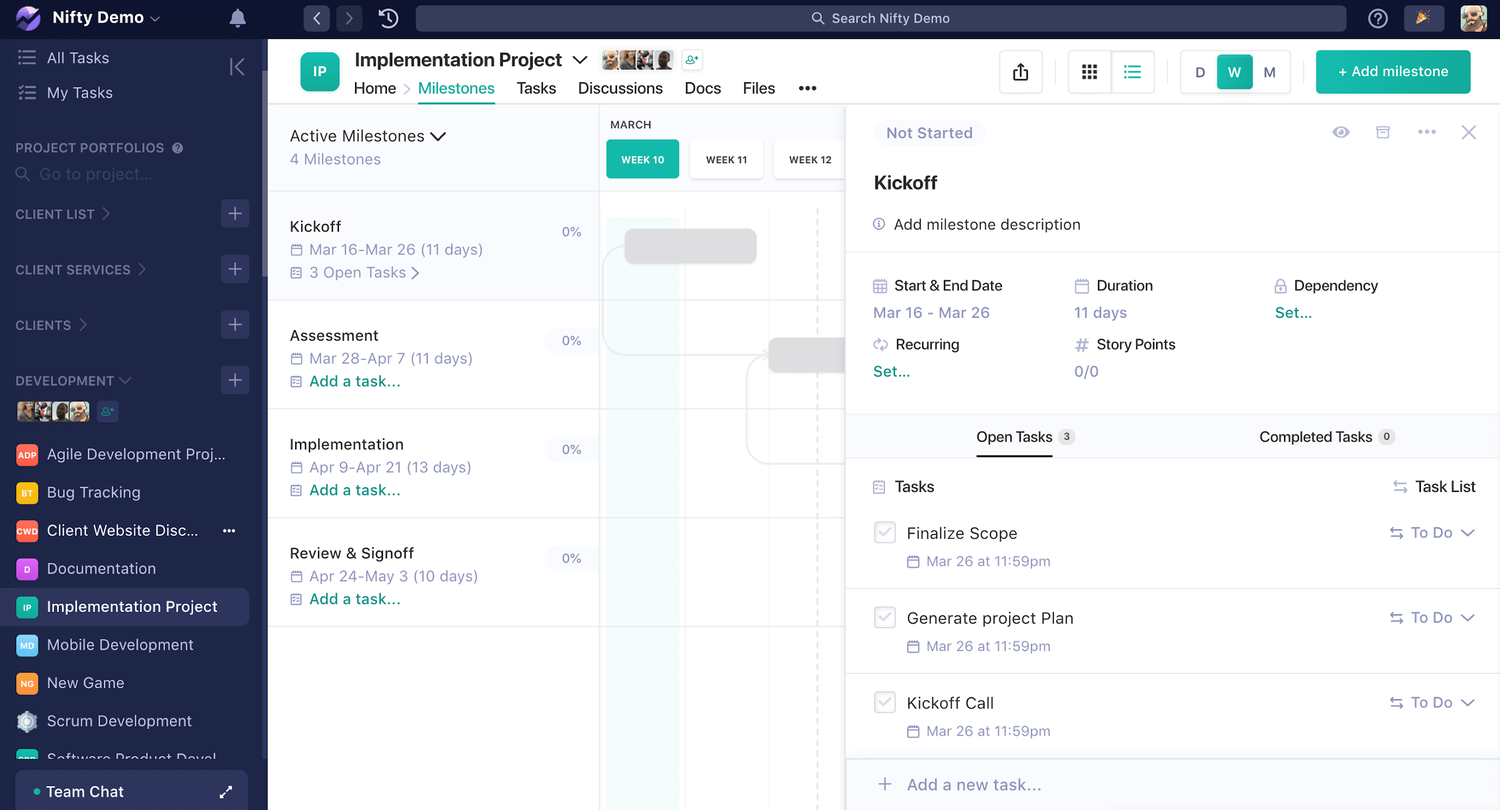
The project’s phases are portrayed as Milestones which indicate phase start and end dates. From there, tasks are tied to these Milestones to indicate when this Task needs to take place within the course of the project. Milestones can be joined with dependencies to enforce the workflow process, and the end date of the final Milestone indicates the project’s conclusion.
Involve
Assigning members of the projects to tasks indicates the ownership of these tasks. Task Lists and Tags are great ways to further define the workflow methodology.
A List layout might look like To Do → In Progress → Review → Completed. Automating the ownership of the Review list ensures that the proper oversight of these Tasks is in place to ensure that the workflow’s conclusion (the completed task) aligns with the project’s scope and goals. Tags are popularly used to indicate priorities or blockers.
Anticipate
When a task that’s tied to a Milestone is completed, that Milestone reflects the progress towards its goal. The project manager can gauge the milestone’s completion percentage against its due date, as well as refer to any Blocked tags on Tasks, to anticipate impending concerns with project deadlines.
If project adjustments need to be made, the project manager can adjust a Milestone due date accordingly. If dependencies are set between milestones, any future Milestones will also adjust to reflect the change in project schedules.
Track
The Milestones screen creates a visual tracker of the project’s progress based on relevant task completion. This screen can be observed by project members and can even be shared out as a public link for external shareholders to remain involved and up to date. Reports can be downloaded on Tasks and Milestones to report on the project as it unfolds up until the conclusion of the final Milestone.
Conclusion
Your Project Management Workflow is a synthesis of two concepts which, when combined , answer the questions: What will be done, Who will do it, How will it be done, and How do we measure success?
Your Workflow Management determines the framework of a task’s lifecycle, while the Project Management places context and qualitative analysis on each individual, as well as the collection of Completed tasks.
Utilizing a workflow automation solution helps align your project stakeholders around your project plan, your workflow, and your progress reporting, to ensure your project crosses the finish line successfully.
