

The price of freedom in 21st Century communications is steadily rising. As technology becomes more intuitive, so too does the tools at the disposal of both hackers and prying eyes dead set on attaining your personal data. As years go, we tend to keep more and more personal information on out phones, including personal finances, IDs, addresses and passwords. Although we are led to believe that smartphone companies are upgrading their security features, the increased volume of personal information stored on out personal devices provides hackers with more motivation to invade our personal data.
Smartphones are now accepted by hackers as more valuable than both PCs and laptops as a means for accessing confidential information, and the number of breaches that are being experienced are expanding at a rapid rate.
Sadly, in this day and age, there are plenty of potential vulnerabilities behind modern smartphones. From out-of-date software, to trojan apps, to phishing emails, to brute force attacks – we’ve become so accustomed to saving our personal information on the pages of our trusty sidekicks that any prospective breach could be disastrous.
Here’s a distribution of new mobile malware by type.
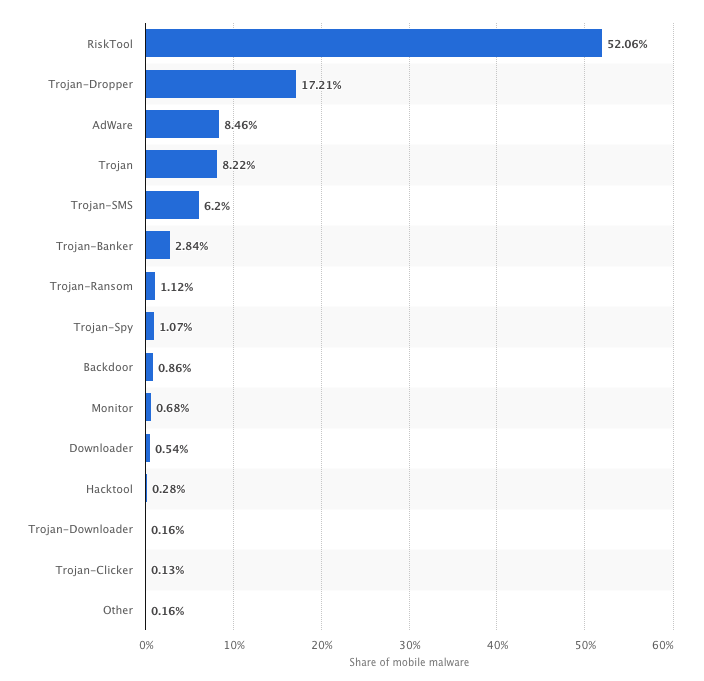
Image Source: Statista
Especially concerning is the rise of trojan applications, which typically pose on app stores as well known apps like Facebook and WhatsApp, and once downloaded grant access to a range of smartphone functions, such as its camera, stored conversations – it can even record audio through a handset’s microphone – all without the owner’s awareness. This data is then used for marketing perpusoses, and hopefully, only that.
Our data is precious, especially when our smartphones are used in connection with confidential information, and in the face of the rise in cellular malware, 2019 has seen an evident peak in interest regarding secure GSM networks that offer supreme privacy compared to mainstream consumer mobile networks.
Especially now, with the rise of cryptocurrencies and online finances accessible from a mobile phone, hackers are tempted to get into our smartphones.
Back in 2017, hackers were able to swipe Bitcoin by simply stealing your phone number first. As most virtual currency wallets ask users to confirm their identity with their phone number, hackers were simply able to call the operator and transfer the number to a network/provider under the hacker’s control. By doing this, they were able to access the user’s wallet and transfer the cryptocurrency to other wallets.
The rise of the secure GSM
A Global System for Mobile communication (GSM), refers to the most common form of digital mobile network used worldwide today.
In terms of its specifications, technological site, TechTarget, defines GSM networks as using a variation of time division multiple access (TDMA). GSM digitizes and compresses data, then sends it down a channel with two other streams of user data, each in its own time slot. It operates at either the 900 megahertz (MHz) or 1,800 MHz frequency band.
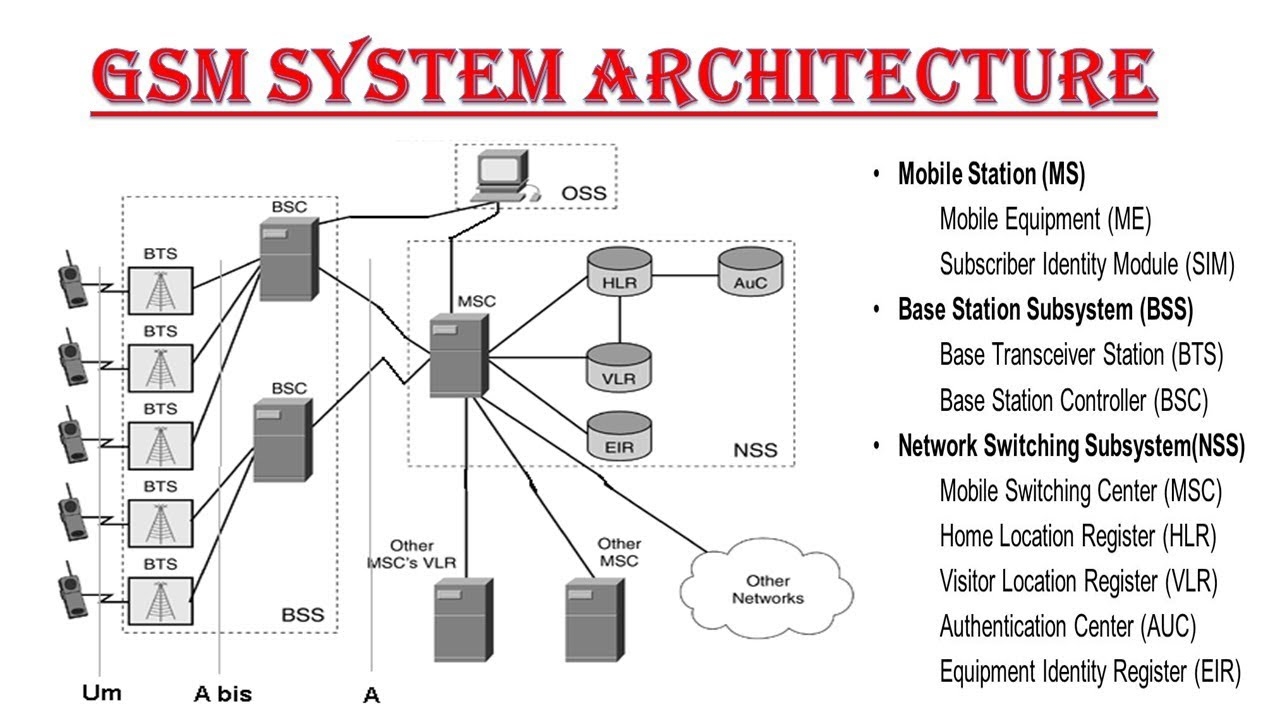
Image Source: Thapa Technical
Fundamentally, GSM was structured to act as a fully secure wireless system in which mobile phones can operate, but is still vulnerable to attacks. However, an increasing number of independent networks are looking to utilise the GSM system as a means for producing their own iteration of private providers – and with the freedom of confidential conversations and roaming assured, the systems are gaining plenty of interest.
Modern preventative measures
It can be essential for businesses to utilise networks that guarantee sensitive information can be transferred securely and efficiently. With this in mind, TruMobility has focussed on becoming a renowned name in the field of private cellular networks.
Billing itself as the most resilient form of a cellular network for small-to-medium businesses, TruMobility operates on an entirely separate platform to mainstream providers – ensuring closed communications and only the highest of voice quality and download speeds.
Other companies, like SafeCalls, utilise blockchain to ensure end-to-end phone network security. This allows SafeCalls to achieve some promising security features, including a ban of geodata – enabling users to stay anonymous, random routing, virtual numbers and even a voice change – isn’t a feature most people would use, but nevermind – maybe someone just doesn’t like the sound of their voice.
Another excellent and truly private GSM can be found in the form of RapidNet. This GSM enables communication to take place where no terrestrial infrastructure exists, is congested or has been compromised. All that’s needed to utilise RapidNet is a compatible handset that’s capable of connecting to a Voice of Internet Protocol (VoIP).
We live in a time where it’s never been more important to look after our sensitive information. As our mobile devices become smarter and more powerful, the delicacy of the material they contain naturally increases. If you’re tasked with taking care of highly confidential business information, or have become the subject of repeated security breaches, switching to a private GSM may be the best solution to ensure that your private information stays private for good.
Although we’re being marketed that new phones released come packed with security features, we, the users, need to remain sceptical. For instance, face ID or face recognition may sound like a super secure system, it’s a double-edged sword. On one hand, you do need your face to unblock the phone, but on the other hand, your face is the only thing needed for hackers to unblock the phone. Considering advancements in technology, recreating person’s face is no longer impossible.
That said, smartphone companies are constantly thinking of new ways to make their products more secure. At the end of the day, it is their reputation and revenue that is on the line. If companies aren’t keeping their users safe and protected, it will only stimulate the market for new arrivals to take a share of the market.
