


It is already difficult to surprise modern customers with personalized offers, fast delivery, and promotions. However, in the coming year, retailers will do everything to ensure that customers get the experience that they want, not even instantly, but with lightning speed. With artificial intelligence technologies, this becomes possible, and in this article, we will learn what to expect from AI in retail in 2020.
AI in the Retail Industry – 3 Main Spheres of Application
Artificial intelligence, augmented reality and new ways for interaction between brands and customers have given retail the opportunity to enter a new era of highest sales and the highest quality service. How will this happen in practice? Basically, it is possible to divide the scope of AI in the retail industry application into three large groups.
Customer Service Improvements with AI
So, the client is the first person in the sales chain, and it can be said with confidence that the technologies that retailers will introduce in 2020 will be entirely customer-oriented.
Voice and Visual Search
Voice and visual search was the trend of 2019, but there is every reason to believe that in 2020, retailers and users will begin to use this technology to its full potential. Wallmart is already working in partnership with the Google Assistant, and this allows the store customers to simply voice their desire, for example, order 1 kg potatoes, and get their order delivered home.
As for visual search, this technology will give users the opportunity not to give up their desires, in cases when they do not know where to buy a product that they saw somewhere on the Internet. In this case, sophisticated intelligence technology recognizes the image and immediately tells which stores offer this product. Moreover, geo-positioning makes it possible to choose the nearest point of sale.
Virtual Fitting Room
It is expected that in 2020 customers will no longer spend their time looking for clothing that suits them. And human shopkeepers in stores will also not be wasting their efforts in helping to choose. It will become possible to make a preliminary purchase decision with the help of virtual fitting rooms, which will work on augmented reality technologies in conjunction with artificial intelligence.
Robotic Assitance in Physical Stores
In addition, it is expected that very soon employees of retail companies that serve customers at physical points of sale will be able to become more flexible due to the fact that their routine tasks will be performed by robots. In Japan, this is already a reality, and it is expected that in 2020 more and more retail brands will use assistant robots to help customers.
For example, it will be possible to tell the robot what item it should bring to the fitting room. Moreover, due to the facial recognition function, robotic AI technology will recognize the client, immediately analyze his purchase history, evaluate the mood and intentions of the client at the moment and make personalized offers about what he wants right now and what will suit him with a large share of probability.
An Attractive Goods Layout
Moreover, in 2020, artificial intelligence will help retailers improve the layout of their products in the store based on best-selling data for a particular season, or at a specific point in time, for example, on New Year’s Eve. So, customers will get another additional opportunity to immediately choose the product that they want, without wasting time searching and not even contacting consultants.
Predictive Analytics in Retail
Predictive analytics is one of the greatest strengths of artificial intelligence. As for retail, for this industry, this means the ability to receive true information for building strategies. Previously, marketing and business strategies were based on common sense and intuitive assumptions, and in 2020, thanks to predictive analytics in retail, companies will have the opportunity to learn about events before they come and respond with lightning speed. Let’s find out how it will be possible.
AI Price Prediction
Artificial intelligence will analyze the whole picture of the market, and make predictions about how the price of a particular product will change based on economic and financial fluctuations, supply and demand, certain trends or events. Previously, such predictions were only hypothetical, for example, retailers could say with confidence that the prices of goods for the school will increase depending on the proximity of the beginning of the school year. In this case, retailers could only evaluate the time period, however, AI makes it possible to analyze a whole set of data about customers, for example, their solvency, preferences, fashion, and trends, and on this basis draw a conclusion about the price of a certain product.
AI Price Optimization
Having predictive data, it becomes possible to optimize the price, based not only on general information but also on specific data about the customers of a particular company. Moreover, the ability of AI to predict the best price provides even greater opportunities for personalization. This means that when selling online, retailers can personalize not only experience but also the price – and offer each customer the price that he is really able to pay.
In practice, this means large profits due to the sale of goods at a higher market price to those customers who are able to make such a purchase and even greater loyalty on the part of those buyers who received a certain discount based on data on their solvency.
Demand and Sales Forecasting
At this stage, having data on the best possible price at a certain stage, retailers armed with artificial intelligence, also receive the opportunity to predict the demand for their products and make the correct assumptions about the level of sales and profit. This gives all reasons for the formation of long-term strategies, which were previously impossible, or possible, but only with a very low probability.
Customer Behavior Prediction with AI
We already said a few words that in 2020, AI will recognize the intentions of customers by analyzing their facial expressions, but this is not a complete list of features. By integrating AI into their business processes, retailers will be able to learn about the client’s intention to abandon brand products. As you know, it is much easier to keep an old customer than to attract a new one, so at this stage, knowing about this intention, retailers will be able to take the most emergency retention measures. In practice, this means maintaining a high level of sales and lowering the cost of acquisition.
Fraud Prevention and Detection
We have already listed the most effective and amazing opportunities for retailers that they will be able to realize in 2020. However, do you know which question remains one of the most relevant in the retail industry? Yes, this is fraud when making offline and online purchases. Fortunately, AI is evolving to make credit card fraud prevention a reality.
Credit Сard Fraud
Credit card fraud is the most common form of retail fraud. Fraudsters still successfully continue to trick customers by phone, but now AI can recognize these cases. How does this happen? This is due to an analysis of user behavior. For example, if a client was tricked and right now the AI ‹ ‹system monitors that he is making a purchase in another country or other time zone, and other indicators also indicate anomalies in behavior, then the system immediately signals a possible fraud.
However, at the moment there is a flip side to the coin, but it is expected that in 2020, this problem will be solved. It happens that the AI ‹ ‹system shows a false-positive result. That is, in fact, a legitimate user performs a number of atypical actions with his credit card, and the system thinks that this is an attempt to fraud.
RTO Fraud
Practice shows that return to origin is one of the main problems of retailers not receiving profit. In the case of fraud, a dishonest buyer purchases the goods at full cost and returns the fake to the retailer according to the return conditions. AI allows companies to analyze the behavior model, read intentions from the user’s face if the purchase occurred in a physical store, and notify the company of such an attempt.
Promo Codes Fraud
This is the case when a fraudster tries to use one promo code from several IP addresses. The AI monitors this behavior pattern, and if a specific IP address has already been recognized as suspicious, the program signals an attempt to cheat the retailer.
AI in Retail Cases – Get Ideas for Your 2020 Strategy
We already said a few words that Wallmart works perfectly with Google assistant and allows customers to make instant orders with delivery, and now let’s look at other examples of the use of AI in retail in 2020. Use these ideas to shape your strategies in the coming year.
-
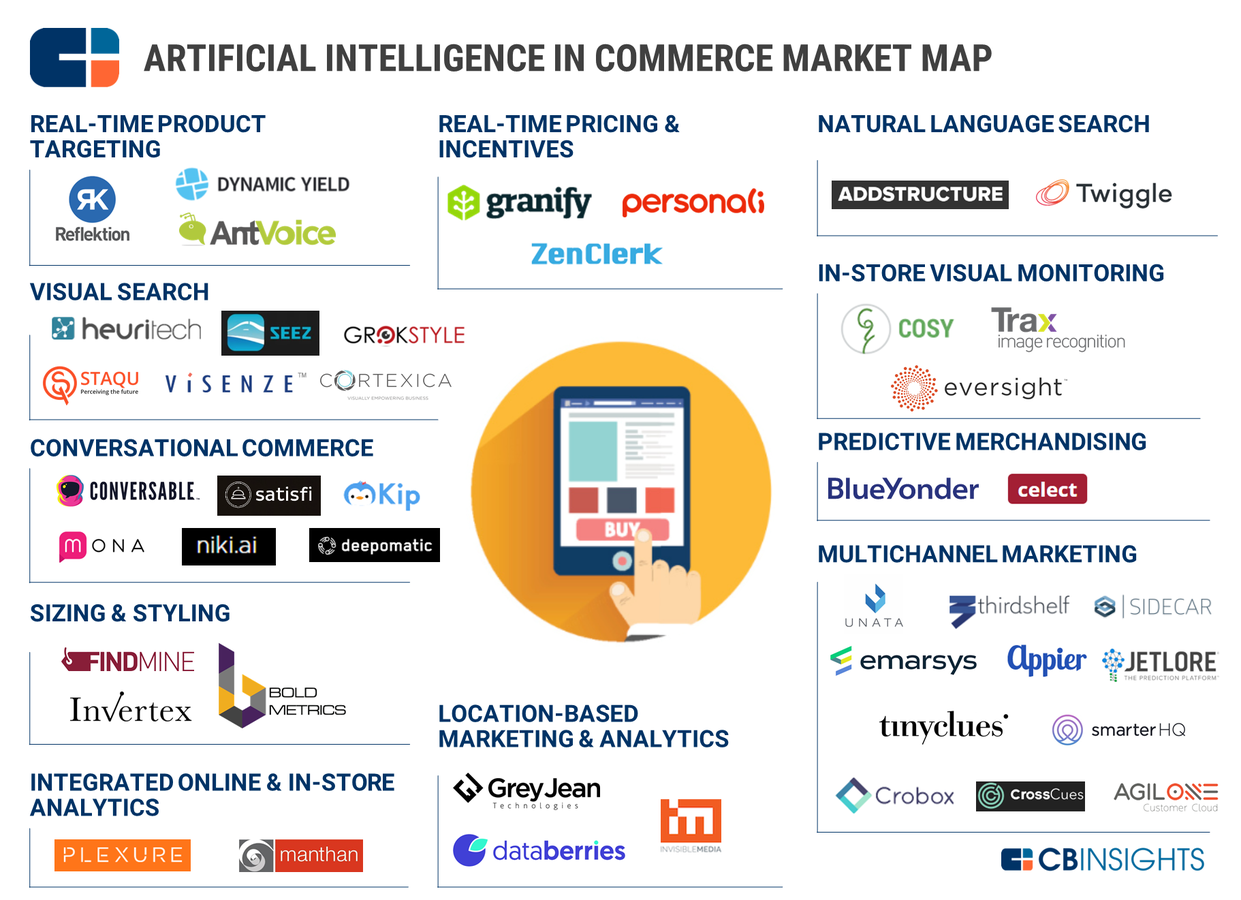
With regard to supply and demand prediction technologies, the British food retailer Morrisons uses the Blue Yonder system, which makes more than 13 million decisions per day, helping the company optimize its strategy taking into account the totality of factors – weather, holidays, trends and user moods, their possible reactions to marketing and promotional initiatives.
-
An H&M chatbot helps customers develop their perfect outfit. AI-powered chatbot literally listens to the wishes of customers, analyzes their purchase history, and having data on their preferences, seasonality, and size of the desired clothes, selects the perfect combination. Plus, it shows the nearest physical points of sale where it is possible to buy the right clothes.
-
US retail chain Kroger has developed an application that has become a personalization guru – as soon as a customer opens a smart shelf in an app, he immediately sees a selection of suitable products based on his purchase history.
-
Me-Ality is a virtual fitting room technology that we have already talked about. Having installed the application, the client can scan his physical data, and the application will offer clothes that suit him.
AI-Driven Strategies For Retailers – Where to Start in 2020
So, it becomes obvious that in 2020 AI should be integrated into retailers’ business processes. Otherwise, there is a great chance to lose competitiveness against the background of companies that will turn out to be more tech-savvy and open to innovations.
Moreover, AI integration is a request not only of the modern market but also of modern users, whose requirements are growing exponentially. So where do you start?
Define the Main Task That You Want to Solve Using AI
We have named many opportunities for the use of AI in retail, but to start this process, you need to start from one direction, which will be the most important for your business. To do this, analyze your indicators and find the pain point of your business. This will be the one that the AI ‹ ‹will solve for you.
Contact a Reliable Vendor
An AI solution cannot be created and implemented in an instant – a complex analysis of business processes and many hours of technical work are needed for this. In addition, in order for the AI ‹ ‹solution to work in your favor, the company that will create it for you should already have wide experience in developing such solutions. For example, SPD-Group specializes in creating AI and ML solutions for businesses, and for retail as well. Feel free to analyze the case studies of this company and make sure that it is potentially suitable for your project development!
