


Having been a part of consumer electronics customers IoT journey, Ive been keenly following this space. It is fascinating to see the transformational journey that the customer has embarked on in the home automation space. I believe that the Insurance industry has similar potential. This thought has prompted me to look at the potential of IoT in the Insurance space and the architectural considerations.
Before I share my views on the impact of IoT in the Insurance industry, I would like to share how the Internet of Things is impacting the agriculture equipment industry. Ive chosen this example as the agriculture equipment industry was among the early adopters moving from selling basic tractor to an ecosystem play.
The Evolution of Products to Ecosystems
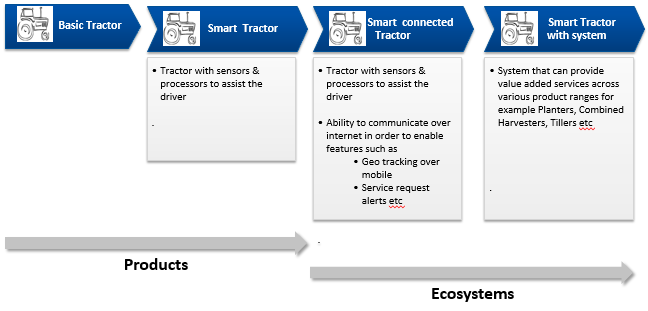
The journey from a basic tractor which is a 100% mechanical and standalone product to a smart connected tractor has enabled the equipment manufacturer to be more connected with their customers. Some of the use cases that enable a better customer experience include:
- Monitoring the tractors health to send alerts about servicing
- Leveraging geo fencing to prevent theft.
Connected tractors are just the start of the ecosystem play. The use of IoT at this stage of the journey is mostly related to helping the owner with tractor related use cases. There is HBR article on this topic which describes how this has played out.
The evolution of Smart Tractor with systems goes beyond what connected tractors. The same HBR article calls this many to many play. Here many refers not only to the tractor but also the rest of the farm equipment including tillers, seeders, harvesters etc.
The possibilities are limitless really. As the use cases show, various equipment talk to each other and help in data driven decisions driving greater amount of productivity.
Strategic Impact of the Ecosystem Play”
As the previous section suggests, we are continuously moving to buying into ecosystems rather than buying products.
For example, whenever we decide to purchase a smartphone one of the primary considerations is to check if the smartphone supports all the required applications that we use. App ecosystem serves as the primary filter and then we move on to other features that differentiate smartphones.
“Ecosystem play” will mean the following for firms operating in this day and age:
- Change in business models: Product as a service will be the new norm. We already see the adoption of this business model in windows as a service;
- Shift in emphasis to VAS: Value added services (VAS) will weigh in a lot more in purchasing decisions;
- Greater customer experience: Advanced data analytics will help firms in having a better understanding of their customers;
- Higher barriers to entry: Focus will shift on to accumulating more users and collect data. This data will ensure competitive advantage and new entrants will find it that much harder as they start at a smaller customer base.
Impact of IoT in the Insurance Industry
With the above understanding of the evolution from products to ecosystems and the impact of ecosystems on organizations, let us now see the latest trends in the Insurance industry.
Roland Berger has done an in depth analysis of the impact of IoT in the insurance space. The connected car solution for auto insurance is a now a known success story. Europe has been an early adapter of telematics in auto insurance and as the statistics show, close to 60% of insurers in the Europe already have some sort of UBI for cars. In comparison approximately 36 percent of all auto insurance carriers are expected to use telematics UBI by 2020.
The connected home solution with monitoring and control systems for intrusion detection, water pipes and HVAC operations, and connected health solutions using wearable devices like fitness bands that capture vital parameters e.g. pulse rate, blood pressure etc. and lifestyle data like exercise duration and sleep patterns are predicted to be the next growth areas.
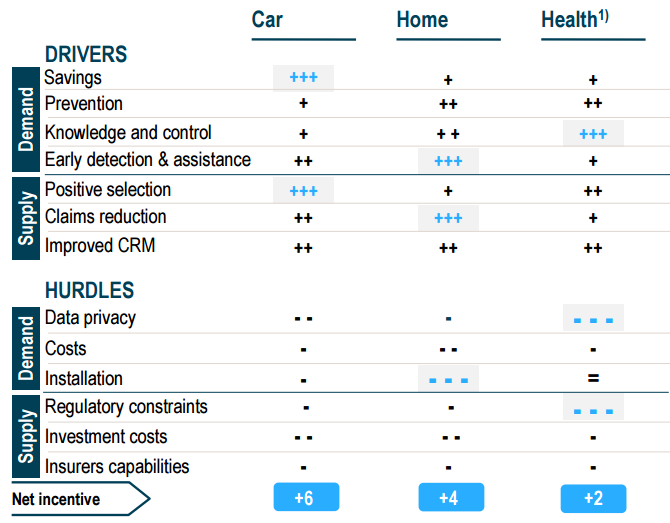
The next big opportunity is in the Property & Casualty Insurance (P&C Insurance) space, especially since health is highly regulated as shown in the graphic above. I would go one step further and say that Commercial & Industrial spaces are a bigger opportunity than homes.
There would be skepticism among home owners about installing sensors in their private properties. However, commercial and Industrial spaces might be more open to installing IoT devices, monitoring buildings and industrial equipment operations against prescribed parameters, for the following reasons:
- Better transparency between insurers and customers in the underwriting and rating process leading to more accurate risk assessment and pricing
- Improved claim servicing facilitated through automated loss notification and damage related data provided from sensors
- Better loss prevention through early detection of unsafe environment, breakdowns, malfunctions as well as proactive repair and preventive maintenance based on real-time data
Given this context, there are 2 possible roles for Insurance Providers while implementing IoT
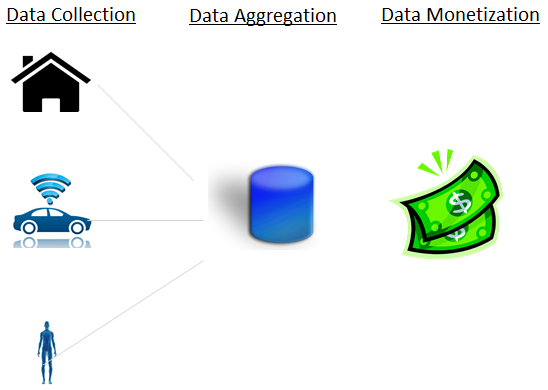
- Build an IoT Platform and provide personalized insurance plans: This is an end-to-end implementation where the Insurance provider does the Data Collection. This includes the deployment of sensors, Data Aggregation and Data Monetization.
- Collaborate with platforms to provide Risk assessments: In this scenario, Insurance provider collaborates with providers of IoT infrastructure for data to do risk assessments.
Approach 1, would be an ‘ecosystem play’ enabling insurers to differentiate from competition and providing similar risk covers through value added offerings of risk mitigation mechanisms and improved loss control services.
Both the above options make the risk assessment process very transparent and accurate. Personalized premium offerings will also make this attractive to users.
IoT Challenges While Building Solutions
There is a good case for usage of IoT in the P&C space to determine the premium but implementation of the same is not so straight forward. The following is a list of challenges that I foresee when firms tread the path of building IoT solutions:
- How does one ensure a highly scalable architecture to deal with real-time analytics and large volume and velocity of data. What part of the compute and analytics should be closer to the sensor and which once should go to the cloud?
- How does one ensure day-to-day tasks are automated for maintaining these devices? Examples:
- Patch update for new features or bugs
- When a device exceeds monthly data usage, de-activate it
- If a device loses its connection, notify appropriate person
- If a device makes too many connections within a 24-hour period, notify
- Establishment of a well-defined support process. Activities include
- Defining the approach on the frontline support work, if devices fail in the field
- Defining the approach on the backend systems support
- Identifying who will bear the expense of sending out a service technician
- Identifying what to fix and eliminating redundant service trips to save on operational expenses
- What kind of rate plan (Bandwidth) is most optimal? Activities include
- Setting up rate plans
- Setting up real-time controls for visibility into every deployed device and the associated data management
- Wireless spend optimization
- Scalability for multi-operator and multi-country use
Along with some of the questions above, I would also love to hear your thoughts on how you are seeing IoT in the Insurance space play out? What have been your learning rolling out IoT solutions? Please leave your comments below.
