


In March 2019, Google made an announcement that had huge ramifications for the wide world of gaming. Stadia is on its way and with it comes a brave new era of video game streaming.
The arrival of Google Stadia has caused a stir in the gaming community, but its rather significant implications for Augmented Reality hasn’t commanded much media coverage over the past few months. So now seems like an ideal time to take a deeper look into Stadia itself, and what it means for the fledgeling field of AR.
Introducing Stadia
Even without taking the effort to dip into its wide-reaching implications, Google Stadia is a revolutionary concept that challenges the very need for the console-based gaming that’s commonplace today.
Stadia is entirely cloud-based, meaning that Google’s servers handle all the processing power that users need before beaming a fully fledged, high-quality video game directly to their television.
With Stadia, the concept of downloading content will be a thing of the past. There are no installation processes to worry about either. Games are simply streamed directly onto any compatible device – from TVs to PCs, to laptops, to smartphones.
Subscriptions to Google’s Stadia Pro service starts at around £8.99 per month and the resolution quality of the games you play is entirely dependent on the quality of your internet connection – with 4K gaming achievable for users with 35 Mbps download speeds or better.

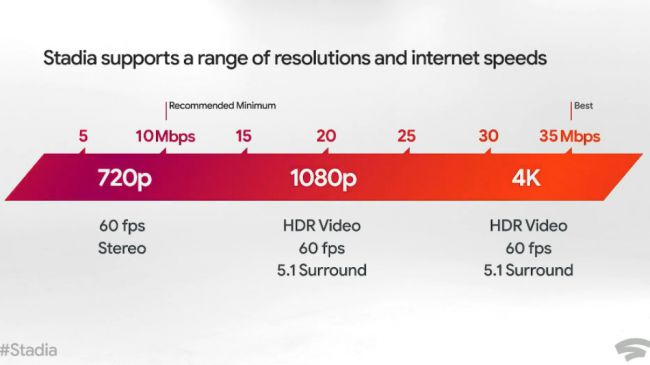
(An example of just how scalable Google Stadia’s service is for varying users. Image: GamesRadar)
The bigger picture
The significance of Stadia is that it’s a project aiming to interrupt the computing hardware industry. Cloud computing has a level of potential that’s only limited by consumers’ respective internet connections. Using only cloud-based technology, Google believes that it can enable users to stream games with more-than twice the processing power of the PlayStation 4.
Google isn’t renowned for its hardware packages, and the bigger picture here is the company’s bid to bypass the notion of utilising physical devices to enable high performance where possible. The idea of streaming powerful games through a tiny Google Chrome USB stick may sound the alarm for other more hardware oriented businesses.
Writing for Medium, Colby Gallagher explains: Apple or Samsung saying they’ve increased speeds by 20% on a new release of phone isn’t going to mean anything next to someone that can run a full 3D CAD package on their handset. All streamed from the cloud.
Augmented implications
The announcement of Stadia will have huge ramifications for Augmented Reality, among other industries heavily involved in the world of gaming and technology as a whole.
AR is still a developing industry in its own right. We’ve seen widespread success with the likes of mobile apps such as Pokemon Go! but this brand of tech hasn’t quite made the transition into everyday usage.
However, the cloud-based power of Stadia may well be set to equip Augmented Reality hardware with the boost it needs in emerging into mainstream usage.
The problem with much of modern AR is that it’s still heavily dependent on hardware to provide users with a complete immersion into an augmented world. Microsoft‘s Hololens and Magic Leap operate with all the required computing power to be stored within the physical wearable device.
While both Hololens and Magic Leap are designed ergonomically, the headsets are bulky and clumsy at times. Magic Lens, in particular, needs users to attach a computing puck’ to their belt in order for the device to work efficiently.
The arrival of Google Stadia may solve the AR industry’s problem of bulky unappealing devices. Given that Stadia can handle huge levels of computing power via the cloud, hardware like AR glasses will be able to handle levels of processing power that’s unfathomable by today’s standards. The limitless possibilities of Stadia could ultimately result in users having the power of a gaming PC within their AR glasses while on public transport.
Such technology will enable Augmented Reality to really think big, and expand way beyond the limitations of today. Remote AR companies like Watty are already developing games and social applications that focus on bringing people together from around the world, seemingly in the same room, through advanced augmented techniques. Now imagine the level of interaction that can be achieved with the power of the cloud firmly behind their technology.