



MARL represents a paradigm shift in how we approach mesh refinement. Instead of relying on static rules, MARL creates an ecosystem of intelligent agents that work together to optimize the mesh. Each mesh element becomes an autonomous decision-maker, capable of learning and adapting based on both local and global information.
In traditional mesh refinement techniques, the process is often governed by static rules and heuristics. These methods typically rely on predefined criteria to determine where and how to refine the mesh. For example, if a certain area of the simulation shows a high error rate, the mesh might be refined in that specific region. While this approach can be effective in some scenarios, it has significant limitations:
- Inflexibility: Static rules do not adapt to changing conditions within the simulation. If a new feature emerges or the dynamics of the problem change, the predefined rules may not respond effectively.
- Local Focus: Traditional methods often focus solely on local information, which can lead to suboptimal decisions. For instance, refining a mesh element based only on its immediate error may ignore the broader context of the simulation, resulting in inefficiencies.
Instead of relying on static rules, MARL creates an ecosystem of intelligent agents that work together to optimize the mesh, and transforms the mesh refinement process:
1. Autonomous Decision-Makers
In a MARL framework, each mesh element is treated as an autonomous decision-maker. This means that instead of following rigid rules, each element can make its own decisions based on its unique circumstances. For example, if a mesh element detects that it is about to encounter a complex feature, it can choose to refine itself proactively, rather than waiting for a static rule to dictate that action.
2. Learning and Adaptation
One of the most powerful aspects of MARL is its ability to learn and adapt over time. Each agent (mesh element) uses reinforcement learning techniques to improve its decision-making based on past experiences. This learning process involves:
- Feedback Loops: Agents receive feedback on their actions in the form of rewards or penalties. If an agent’s decision to refine leads to improved accuracy in the simulation, it receives a positive reward, reinforcing that behavior for the future.
- Exploration and Exploitation: Agents balance exploring new strategies (e.g., trying different refinement techniques) with exploiting known successful strategies (e.g., refining based on past successful actions). This dynamic allows the system to continuously improve and adapt to new challenges.
3. Collaboration Among Agents
MARL fosters collaboration among agents, creating a network of intelligent entities that share information and insights. This collaborative environment allows agents to:
- Share Local Insights: Each agent can communicate its local observations to neighboring agents. For instance, if one agent detects a significant change in the solution’s behavior, it can inform adjacent agents, prompting them to adjust their refinement strategies accordingly.
- Optimize Globally: While each agent operates independently, they are all working towards a common goal: optimizing the overall mesh performance. This means that decisions made by one agent can positively impact the performance of the entire system, leading to more efficient and effective mesh refinement.
4. Utilizing Both Local and Global Information
In contrast to traditional methods that often focus solely on local data, MARL agents can leverage both local and global information to make informed decisions. This dual perspective allows agents to:
- Contextualize Decisions: By considering the broader context of the simulation, agents can make more informed decisions about when and where to refine the mesh. For example, if a feature is moving through the mesh, agents can anticipate its path and refine ahead of time, rather than reacting after the fact.
- Adapt to Dynamic Conditions: As the simulation evolves, agents can adjust their strategies based on real-time data, ensuring that the mesh remains optimized throughout the entire process.
Key Components of MARL in AMR
- Autonomous Agents: Each mesh element functions as an independent agent with its own decision-making capabilities
- Collective Intelligence: Agents share information and learn from each other’s experiences
- Dynamic Adaptation: The system continuously evolves based on simulation requirements
- Global Optimization: Individual decisions contribute to overall simulation quality
Let’s visualize the MARL architecture:
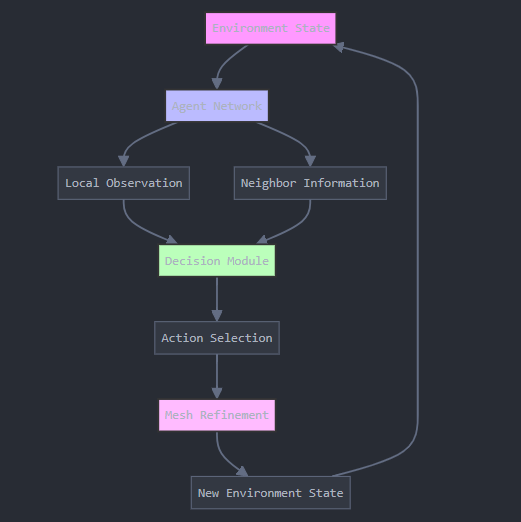

MARL Architecture in AMR
Value Decomposition Graph Network (VDGN)
The VDGN algorithm represents a breakthrough in implementing MARL for AMR. It addresses fundamental challenges through innovative architectural design and learning mechanisms.
VDGN Architecture and Features:
- Graph-based Learning
- Enables efficient information sharing between agents
- Captures mesh topology and element relationships
- Adapts to varying mesh structures
- Value Decomposition
- Balances local and global objectives
- Facilitates credit assignment across agents
- Supports dynamic mesh modifications
- Attention Mechanisms
- Prioritizes relevant information from neighbors
- Reduces computational overhead
- Improves decision quality
Here’s a performance comparison showing the advantages of VDGN:
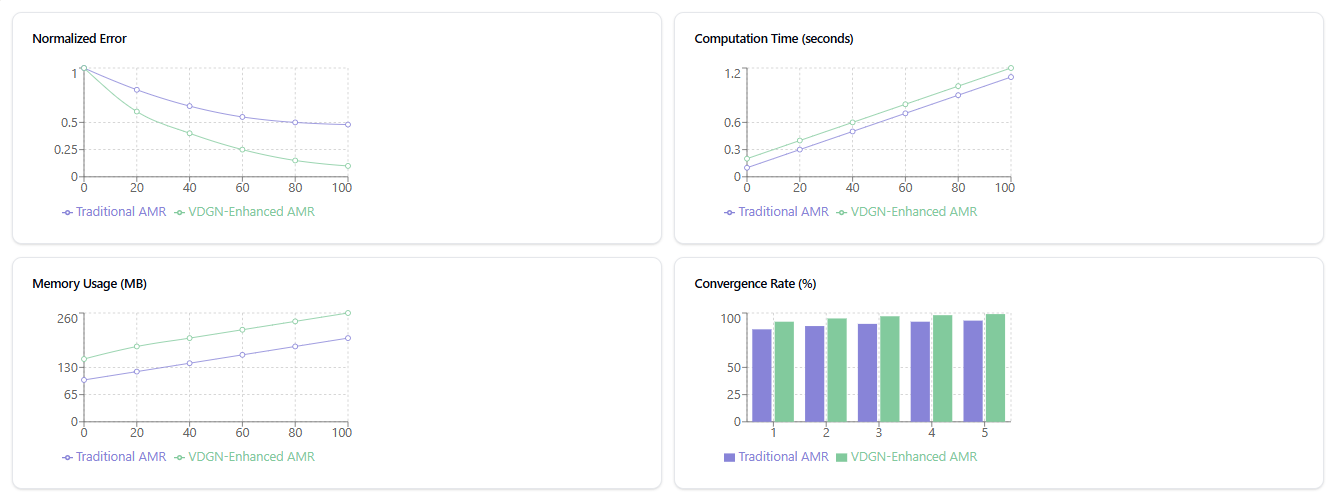
Future Implications and Applications
The integration of MARL in AMR opens up exciting possibilities across various domains:
1. Computational Fluid Dynamics (CFD)
Computational Fluid Dynamics is a branch of fluid mechanics that uses numerical analysis and algorithms to solve and analyze problems involving fluid flows. The integration of Multi-Agent Reinforcement Learning (MARL) in AMR can significantly enhance CFD in the following ways:
- More Accurate Turbulence Modeling: Turbulence is a complex phenomenon that can be difficult to model accurately. By using MARL, agents can learn to refine the mesh in regions where turbulence is expected to be high, leading to more precise simulations of turbulent flows. This results in better predictions of fluid behavior in various applications, such as aerodynamics and hydrodynamics.
- Better Capture of Shock Waves and Discontinuities: Shock waves and discontinuities in fluid flows require high-resolution meshes to be accurately represented. MARL can enable agents to anticipate the formation of shock waves and dynamically refine the mesh in those areas, ensuring that these critical features are captured with high fidelity.
- Reduced Computational Costs: By intelligently refining the mesh only where necessary, MARL can help reduce the overall computational burden associated with CFD simulations. This leads to faster simulations without sacrificing accuracy, making it feasible to run more complex models or conduct more simulations in a given timeframe.
2. Structural Analysis
Structural analysis involves evaluating the performance of structures under various loads and conditions. The application of MARL in AMR can enhance structural analysis in several ways:
- Improved Stress Concentration Prediction: Stress concentrations often occur at points of discontinuity or geometric irregularities in structures. By using MARL, agents can learn to refine the mesh around these critical areas, leading to more accurate predictions of stress distribution and potential failure points.
- More Efficient Crack Propagation Studies: Understanding how cracks propagate in materials is essential for predicting structural failure. MARL can help refine the mesh in regions where cracks are likely to develop, allowing for more detailed studies of crack behavior and improving the reliability of structural assessments.
- Better Handling of Complex Geometries: Many structures have intricate shapes that can complicate analysis. MARL enables adaptive refinement that can accommodate complex geometries, ensuring that the mesh accurately represents the structure’s features and leading to more reliable analysis results.
3. Climate Modeling
Climate modeling involves simulating the Earth’s climate system to understand and predict climate change and its impacts. The integration of MARL in AMR can significantly improve climate modeling in the following ways:
- Enhanced Resolution of Atmospheric Phenomena: Climate models often need to capture small-scale atmospheric phenomena, such as storms and local weather patterns. MARL can allow for dynamic mesh refinement in these areas, leading to more accurate simulations of atmospheric behavior and improved climate predictions.
- Better Prediction of Extreme Events: Extreme weather events, such as hurricanes and heatwaves, can have devastating impacts. By using MARL to refine the mesh in regions where these events are likely to occur, climate models can provide more accurate forecasts, helping communities prepare and respond effectively.
- More Efficient Global Simulations: Climate models typically cover vast geographical areas, making them computationally intensive. MARL can optimize the mesh across the entire model, focusing computational resources where they are needed most while maintaining efficiency in less critical areas. This leads to faster simulations and the ability to run more scenarios for climate impact assessments.
4. Medical Imaging
- Enhanced Image Resolution: Improved detail in MRI and CT scans through adaptive refinement based on detected anomalies.
- Real-Time Analysis: Faster processing of imaging data for immediate diagnosis and treatment planning.
- Personalized Imaging Protocols: Tailored imaging strategies based on patient-specific anatomical features.
5. Robotics and Autonomous Systems
- Dynamic Path Planning: Real-time optimization of robot navigation in complex environments, adapting to obstacles and changes.
- Multi-Robot Coordination: Improved collaboration among multiple robots for tasks like search and rescue or warehouse management.
- Efficient Resource Allocation: Optimal distribution of tasks among robots based on real-time performance metrics.
6. Game Development and Simulation
- Adaptive Game Environments: Real-time adjustments to game difficulty and environment based on player behavior and performance.
- Enhanced NPC Behavior: More realistic and adaptive non-player character (NPC) interactions, improving player engagement.
- Dynamic Storytelling: Tailored narratives that evolve based on player choices and actions, creating a unique gaming experience.
7. Energy Management
- Smart Grid Optimization: Real-time adjustments to energy distribution based on consumption patterns and renewable energy availability.
- Predictive Maintenance: Improved monitoring and prediction of equipment failures in energy systems, reducing downtime and costs.
- Demand Response Strategies: More effective implementation of demand response programs, optimizing energy use during peak times.
8. Transportation and Traffic Management
- Adaptive Traffic Control Systems: Real-time optimization of traffic signals based on current traffic conditions, reducing congestion.
- Dynamic Route Planning: Enhanced navigation systems that adapt routes based on real-time traffic data and incidents.
- Improved Public Transport Efficiency: Better scheduling and routing of public transport systems based on passenger demand and traffic patterns.
Conclusion
The marriage of Multi-Agent Reinforcement Learning and Adaptive Mesh Refinement represents a significant advancement in computational science. By enabling mesh elements to act as intelligent agents, we’ve created a more robust, efficient, and adaptive simulation framework. As this technology continues to mature, we can expect to see even more impressive applications across various scientific and engineering disciplines.
The future of numerical simulation looks bright, with MARL-enhanced AMR leading the way toward more accurate, efficient, and intelligent computational methods. Researchers and practitioners alike can look forward to tackling increasingly complex problems with these powerful new tools at their disposal.