


The healthcare industry is battling to cope on two fronts:
-
The spiralling costs of healthcare in the developed world, where medical insurance companies and the patient cannot cover the huge costs of life-threatening diseases, which are on the rise.
-
Delivering medical services to most of the planet’s population, who live in remote and underserved areas, and do not have the luxury of health insurance or an income to pay for even the most basic charges.
Traditionally, diagnosis and procedures have mainly been on a human-to-human basis. But providing that costs could be contained, there are still not enough doctors, nurses and other healthcare professionals to treat even the simplest maladies. To extend services, hospitals increasingly use high-resolution sensors and order custom medical software development. There is a double benefit in using technology, in that costs can be reduced, while data collection and knowledge can be increased.
Healthcare IoT Borrows Across Industries
Service providers of IoT for healthcare had their origins in other industries where sensors were needed. The name McLaren conjures images of Formula 1 racetracks, rather than a service provider to hospitals. In fact, the requirement to monitor a driver’s condition and the stresses on the vehicle he is racing has made McLaren an expert in this field, and they have opened a division that offers IoT technology services.
For example, a Spanish IoT company who provides industrial and agricultural sensor-driven solutions has designed a multifunctional device that is invaluable to healthcare providers and innovators in remote areas, as well as the developed world.
“Wearable” devices were initially targeted at the lifestyle market, where the hype appears to have dropped off somewhat. The same technology to measure one’s fitness for sport can be used to monitor someone whose health has been compromised.
To communicate with these sensors, and for them to push data through, mobile application development is required, that is specific to the data to be collected. In addition, traditional data storage in relational databases may have to be either replaced or augmented with a big database, like Hadoop or Cassandra, to cope with the volumes. Protocols and formats like JSON can be used to integrate the different platforms and the different classes of data.
While there are endless opportunities to use sensors both for managing patients and for preventative maintenance, where early warning signals can be picked up before the individual becomes sick, there is only so much we can discuss here.
Formula 1 in a Children’s Ward
McLaren has the capabilities and equipment to assist in improved care of child patients.
When the Formula 1 driver is on the track, continuous messaging is relayed back to the pits, both about the car and about the driver. With regards to the car, all potential points of failure in the engine are measured. What’s more, predictive intelligence is also applied to see what might happen. With the driver, the focus is on heart rate, breathing rate and any other vital signs that might signal that the driver is in distress, that is, treating the body as a machine, but applying biotelemetry. McLaren took the lessons learnt from their work with cars and drivers into sport, firstly for the 2012 Olympics and then into rugby in preparation for the World Cup.
They then partnered with Glaxo Smith Kline in 2011 in areas where patients suffered decreased mobility, such as stroke victims.
With the experience gained, McLaren cooperated recently with Isansys Lifecare, manufacturers of sensors, to develop “Rapid”, a biometric technology that checks vital signs of young cardiology patients like the one named Lucas West, via sensors contained in a device strapped to his ankle and two heart monitors. Before this, Lucas had limited mobility because he was attached to a series of wires. What is more, the data gathered was manual and updated once an hour at best. Now the data is real-time and has a built-in alarm system.
This is very much a first-world solution, and currently, the cost is prohibitive, even for Britain’s NHS system, and would only be used in MDCs (Most Developed Countries).
Diminishing Infant Mortality from Pneumonia
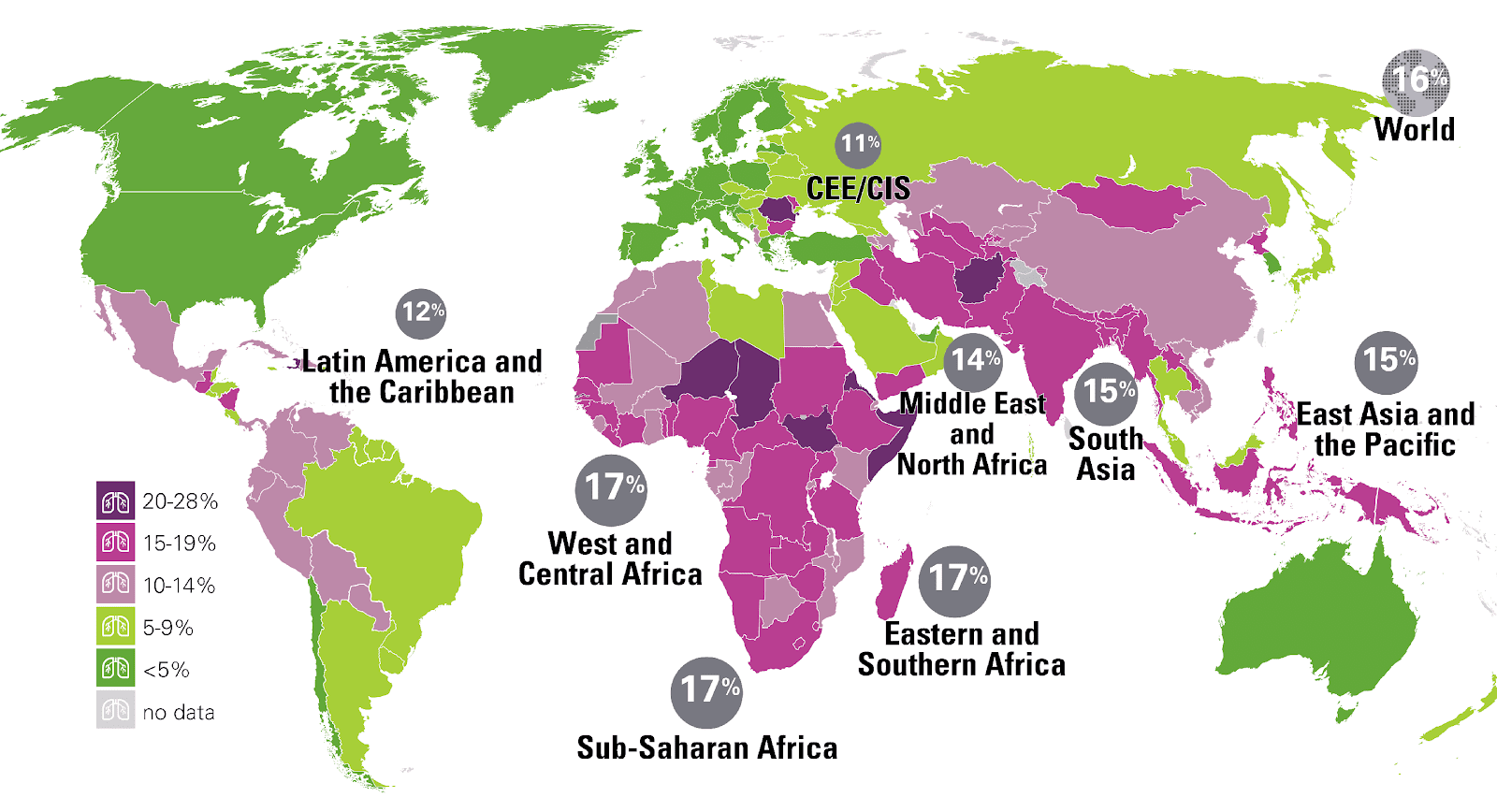

Figure 1: Percentage of deaths among children under age five attributable to pneumonia, 2015.
Source: WHO and Maternal and Child Epidemiology Estimation Group (MCEE) provisional estimates 2015
Pneumonia remains a terrible scourge, even in developed countries, and accounts for 15% of all child mortalities under five years of age. One of the easiest methods of early detection is to monitor the infant’s respiration rate. The traditional apparatus for doing this in LDCs (Less Developed Countries) is using a string of beads or a stopwatch to count the aspirations, both of which are prone to error. Inspire Living used a combination of an e-Health sensor platform with a smart object sensing array to build a low-cost device to do the job.

Since then, e-Health has evolved into MySignals, a device that can measure 20 biometrics and upload them to the cloud. The benefit of such a platform is that the vital signs are already being measured; all that is needed is to develop the appropriate application.
Looking Ahead and Beyond
There are many potential applications where IoT will create value in the industry. IoT can support the Patient Journey from start to finish. Currently, health providers have to rely on appointments and patient feedback for their diagnostics, which is an imperfect science. Sensors can pick up vital signs on a continual basis, which can then be translated into a snapshot for diagnosis.
The proliferation of IoT devices is expected to reach $250 billion by 2020, according to The Boston Consulting Group. The demand will triple in the healthcare sector, as can be seen in the graphic below.
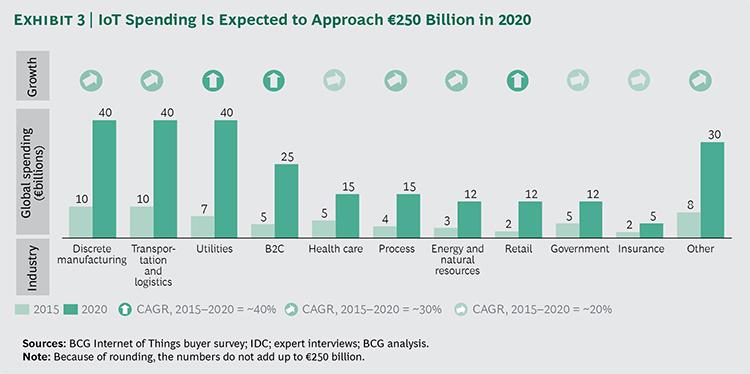
The velocity and the volume of the data will grow even more from then on. Michael Nova, CIO of Pathway Genomics, predicted that the data volume would double every three days in 2020. The healthcare industry will need to be ready to cope with this avalanche.