


The Internet of Things is not just connecting devices but bringing people together as well. With more than 10bn active devices part of millions of IoT networks around the world and with statistics revealing that over 25 bn devices will be connected to the internet in the coming years, IoT is only becoming more functional, purpose-driven and specific in terms of its deployment.
As the number of use cases increases, what simultaneously increases is the need for equally powerful tools and applications as well. Developers cannot simply work on creating some of the most commonly operated functions from scratch for their projects. They need helpful resources that would allow them to conveniently integrate into their workflows.
That’s exactly where open-source tools and platforms come in. For the uninitiated, several open-source tools for IoT ecosystems exist and some of them are powerful enough for full-fledged incorporation into specific applications and projects.
So, if you’re working on an IoT project and looking for ways to cut down your development time, here is a list of extensive open-source tools you could use immediately.
Let’s get started.
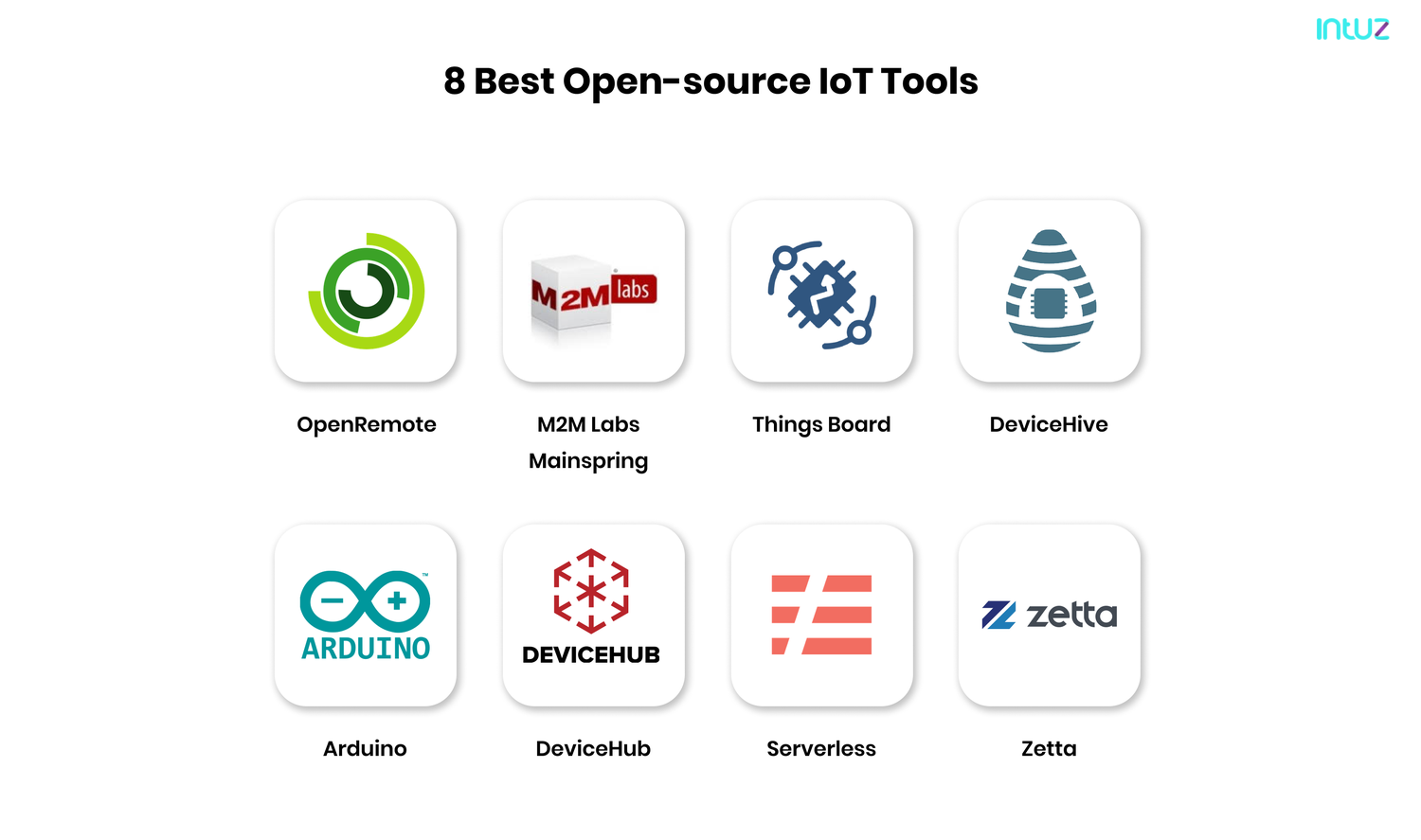
8 Best Open-source IoT Tools For 2021 (And Beyond)

OpenRemote
One of the major reasons OpenRemote was launched was to integrate multiple devices in an IoT architecture into one single platform. The goal was to make the device more manageable and unified.
To do this, the open-source tool shows compatibility with the most standard protocols such as MQTT, HTTP and even less-popular protocols like KNX. For those of you wondering how data from across multiple devices is managed, it is primarily converted as an OpenRemote asset, making the entire ecosystem seamless.
With OpenRemote also offering solid front-end development abilities, the tool is as useful as it gets. Besides, the tool is also learner-friendly. It features airtight documentation and a range of guides to offer a minimal learning curve to beginners. So, when you’re using OpenRemote, you wouldn’t end up spending too much time learning the tool but directly get started working with it.
M2M Labs Mainspring
If your IoT development services involve the creation of machine-to-machine communication devices or architectures, M2M Labs Mainspring would be the most ideal choice. With this open-source framework, you could develop apps for fleet administration, remote controls and more.
Some of the most resourceful features it offers include:
Flexibility in designing and developing varied services
Seamlessness in connecting machines and apps
Normalization and validation of data
Hassle-free data retrieval function
Data repositories for long-term storage and more
Powered by Apache Cassandra and JavaScript, it would take only a few days to develop an M2M solution rather than weeks. With decreased development time, you could push your solution for real-time validation and testing in a superior environment and make way for a more powerful solution.
Things Board
ThingsBoard is a full-fledged data-centric open-source solution for your IoT ecosystem. With data lying at the heart of IoT operations and functions, you could deploy ThingsBoard to collect data from multiple devices and sensors, process it, visualize it and even use it to manage multiple devices at once.
With ThingsBoard, it doesn’t matter if there are diverse devices in your architecture with each following a distinct protocol. It’s compatible with MQTT, HTTP and CoAP and makes data collection and transmission seamless.
Despite being the hub for multiple devices, ThingsBoard is built for stability and scalability thanks to its microservices architecture. To give you an idea, it can handle over millions of connected devices at once. With such a massive scale of connectivity, the next question we are sure you would have is on its security. The tool is highly secured and assures you zero moments of failure.
DeviceHive
Launched in the year 2012, DeviceHive still is one of the most widely used and preferred IoT development tools in the market. This is an M2M framework similar to your M2M Labs Mainspring.
It offers a cloud-based integration API that lets you control it remotely across any network configuration. Besides the main tool, you could also manage and control libraries and protocols from remote.
Because it has been in the market for long, it has an exceptional community of veteran developers. So, should you have any questions or a requirement to seek support for your IoT development project, you would easily find answers in the community.
DeviceHive is most ideal for the development of remote sensing applications, smart home solutions, automation and more.
Serverless
If you’re looking to develop IoT solutions that would be cost-effective in terms of the development and maintenance expenses involved, Serverless framework would be your ideal choice.
The primary reason for this claim is that Serverless allows you to develop frameworks and modules based on microservices architecture. With that said, Serverless also offers a paid version you could upgrade to if you really like its features and capabilities.
The framework is compatible with leading cloud vendors and lets you deploy your project onto AWS, Google Cloud, Microsoft Azure and more. You could develop in a language of your choice including C#, Python, PHP, Node.js and more.
To help you reduce development time, Serverless also offers you a host of plugins for specific operations and commands contributed by its community. Do check it out.
Arduino
If you’re in IoT, chances are highly likely that you already know what Arduino is. We’re sure it would’ve been one of the first hardware devices you would have gotten hands on for your IoT projects. For those of you who didn’t know, Arduino also offers an open-source tool or a development kit that allows developers to code in Arduino using an IDE.
If you intend to send and receive messages from (and to) one board to others in your network, Arduino has a cloud module configured over the MQTT protocol to transmit data.
The capabilities of Arduino make it ideal for the development of location tracking systems, automated photo sharing systems and more.
DeviceHub
DeviceHub is an extensive open-source solution that blends elements like cloud integration and business intelligence together for a more comprehensive outcome. Claiming its services as a PaaS (Platform as a Service), it offers benefits for both hardware developers and application developers.
DeviceHub is also pretty prominent among the SME and entrepreneurial committees, where the capabilities of the tool has paved the way for the development of efficient solutions such as wearable devices, intelligent kiosks, smart fleet management modules and more.
If you’re looking for a convenient solution for your bootstrapped business, this is ideal.
Zetta
Ask any experienced IoT developer you know and you would hear them saying that Zetta is one complete IoT development tool. An API based tool powered by Node.js, it is ideal to develop HTTP-based APIs for solutions.
If your project is data-heavy, where you need to stream or transmit massive volumes of data, Zetta is the perfect choice. One of the major advantages of Zetta is that it is versatile. Meaning, you could deploy Zetta on a PC, the cloud or even the least powerful device you could think of.
It also simplifies controlling and programming of sensors and controllers in an architecture. Built for scalability, Zetta is one tool you should check out for your next project.
Wrapping Up
So, these are the top open-source tools for IoT ecosystems. Depending on what your project requirements are, you could choose one and fast track your development process. Let us know in your comments what you would prefer for your next project.