



The Internet of Things (IoT) is among the most booming emerging technological niches of today. It can help your business gain a competitive edge and improve many internal and external operations. But how does it all work when it comes to monetization? Let’s take a look through the main specifics of IoT and highlight the main methods of IoT monetization.
A trendsetting technology
For many businesses in the modern global market, employing various IoT applications has become practically a necessary trend that gives product and service providers an up-to-date competitive edge. With over 20 billion devices interconnected within centralized networks all over the world, the future of IoT is certainly promising to say the least. And helping companies and entrepreneurs automate workflows and optimize crucial business aspects, the integration of a good IoT strategy is also a powerful marketing-booster.
Thus, according to the Forbes Insights Survey, the IoT helped 41% of entrepreneurs boost their profits by 5-15%, and 94% of entrepreneurs expecting to see the same boost in 2021.

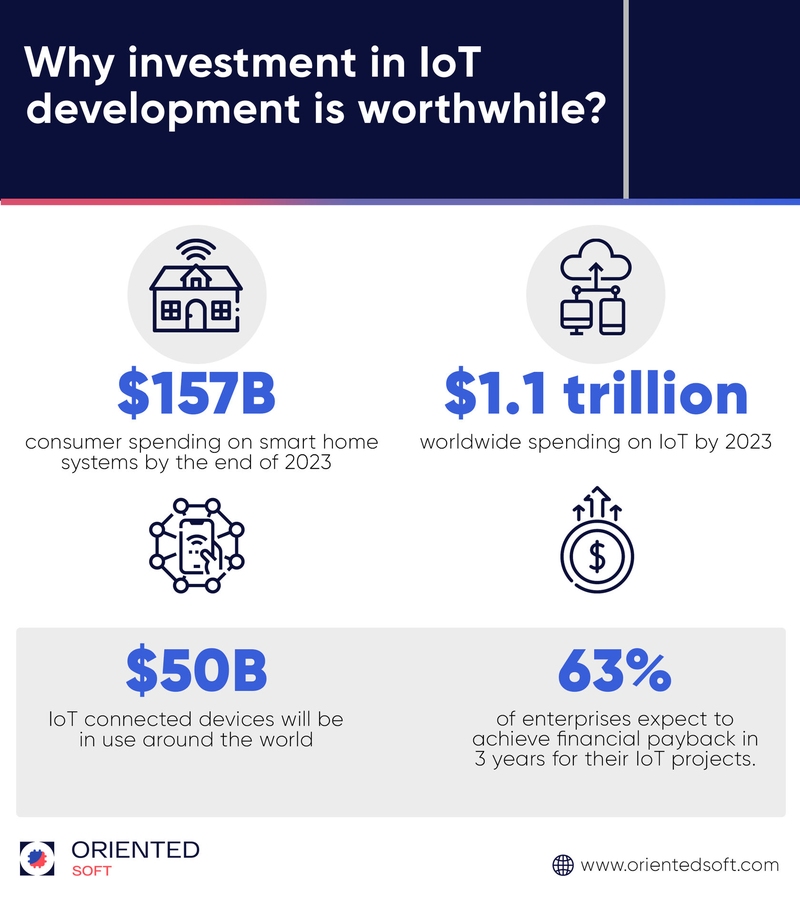
The IoT has already helped numerous businesses discover new profitable horizons while at the same time boosting performance and cutting costs. And it remains beneficial for multiple user audiences.
Who to target with IoT?
You should be well-aware of the main targeted user groups before you start seeking ways to monetize your IoT. These include three major parties.
Regular customers
IoT targets heavily B2C distributed transportation optimizations (Gartner claims that about 250 million smart and regular cars should have been interconnected last year) and smart home solutions. On top of that, most everything smart falls under the category of a potential IoT device, including all sorts of indicators, home appliances, wearables, applications, etc.
Public agencies
Governments actively use IoT capabilities to cope with city infrastructure management and make various internal processes smoother. The IoT contributes a lot to modern healthcare, residential security, and municipal management.
Product/service providers
Business is by far the most IoT-dense sector where the technology is employed in most various niches, be it workflow management and optimization, corporate infrastructure handling, and other processes in retail, logistics, manufacture (35% of manufacturers have adopted smart sensors), agriculture, banking, IT services, etc.
How to use IoT?
Considering its broad range of capacities, the IoT can be used for different purposes.
Create projects and build products
You can offer innovative interconnected solutions managed by a centralized network. For instance, some companies create smart doorbells and other appliances for automated domestic use. Depending on the niche you are tackling and the breadth of your innovative imagination, most various advanced products and services can be developed.
Optimize and manage business aspects
Supplying a business workflow with IoT capacities allows tieing up internal corporate infrastructure more tightly, smoothing out many underlying processes, and automating lots of routines. In logistics, for example, the IoT has long become an efficient tool to monitor and interact with drivers on different routes in real time, making immediate route corrections where need be.
Analyze data
Interconnected devices also do a great job at accumulating heaps of various data. The data can be used for user behavior patterns elaboration, internal business analysis, and even demand forecasting. IoT is an ultimate tool for inventory management, helping companies better manage storage capacities.
How do I monetize my IoT?
We can point out the following major ways you can monetize your IoT project.
A freemium-like model
The simplest method is to basically sell IoT expansion opportunities. i.e., clients can purchase extra features and capabilities (storage, number of smart devices, area coverage) for extra payments when they experience the need to expand their IoT system. For businesses and entrepreneurs, this means that they get to scale easily by investing more in the existing system.
The subscription model
You can achieve a continuous stream of income by providing services based on a regular subscription fee. This allows subscribers to transparently pay only for what they get and use, enables you to better retain users, and gives regular profits. Subscription plans can also be diverse, covering different sets of services/capabilities at different prices.
Data marketing
As mentioned above, IoT systems are great generators of insightful data. This data can be valued extremely highly by companies and entrepreneurs. Many market players are willing to pay a pretty penny for particular market niche analysis data assets. This can be a great opportunity to monetize – gather proper data and sell it to proper clients and that’s all.
IoT infrastructure expansion
You can also earn on the IoT ecosystem expansion. Connecting more and more businesses, users, and service providers to a single ecosystem widens marketing opportunities and subscription possibilities. In such a way, you can also provide plain technical capacities for other providers to build their solutions and collect profits for ecosystem usage and expansion.
Bottom line
Integration of innovative IoT tools and approaches isn’t a booming tech trend for no reason – it is a sure way to boost one’s business dramatically while contributing to the global interconnected services’ convenience. We outline the main benefits and monetization specifics in the article to point out the prospects IoT is currently brimming with. Let this info help you on your own IoT journey