


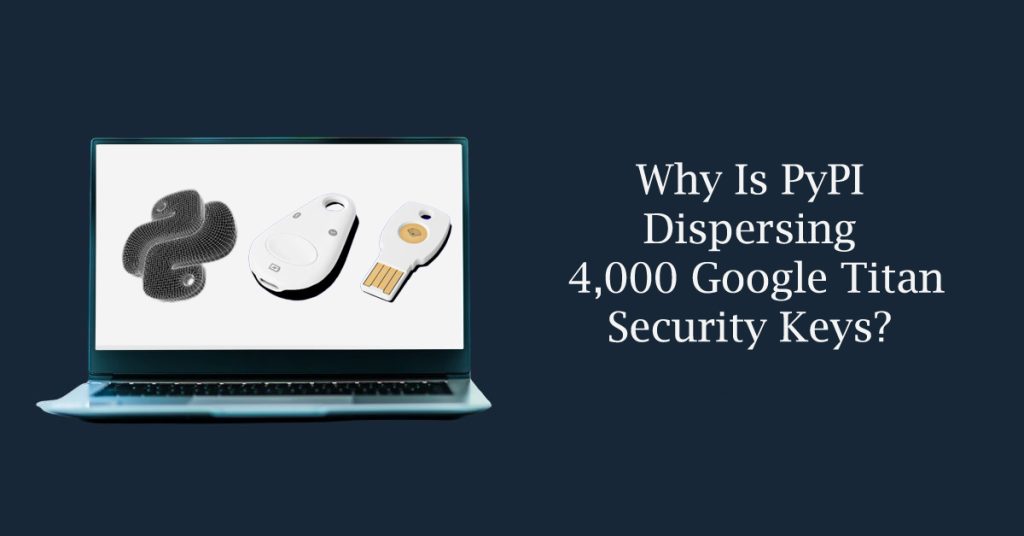
The PyPI/Python Package Index, the authoritative collection of third-party open-source Python initiatives, declared that it is planning to introduce two-factor verification, or 2FA, for what the platform considers to be critical projects. This move is expected to add a new level of security to the universe’s most popular programming language.
Though each well-known developer chose to remove their work from PyPI before reposting it as a big venture that is independent of its declared critical classification, the security-driven approach, which was announced in early July, has been generally well received by individuals in the Python development services.
PyPI Dispersing Security Keys:
The PyPI package will provide 4,000 Google Titan security keys to programmers as part of the campaign to require two-factor authentication for important projects. The authorized third-party software source for Python, PyPi, is known as “Cheese Shop.” It is comparable to CRAN for R and CPAN for Perl repositories.
PyPI is used as the primary repository for modules and their dependencies by certain package managers, notably pip. As of January 17, 2022, PyPI provides access to more than 350,000 Python packages.
The majority of the Python packages that PyPI hosts are in the format of executable sdists/source distribution or wheels archives. When using PyPI as an index, users may look for packages using filters or keywords based on their information, including free software licensing or compliance with POSIX.
As part of its transition to requiring two-factor authentication or 2FA, for crucial projects created in the Python programming language, the Python Package Index is offering up to 4,000 Google Titan security keys.
Software supply chain assaults, also known as fraudulent packages that are similarly titled to legal ones, have been used by hackers to infiltrate their Apple, Linux, and Windows devices by forcing developers to upgrade these packages often.
The primary resource for Python programmers to obtain open-source modules for their applications is PyPI, which is run by the Python Software Foundation, or PSF.
The move to require two-factor authentication is an effort to increase the integrity of the Python ecosystem’s distribution network and is reminiscent of GitHub’s earlier this year move to require two-factor authentication. Since libraries on npm, PyPI’s JavaScript counterpart, is becoming a more popular target for hackers, GitHub automatically registered the top 100 npm package technicians with 2FA.
Understanding Python Packaging:
Both seasoned professionals and newbies may find Python packaging challenging and confounding. You’ll find contradicting recommendations on the Internet, and what was formerly seen as acceptable practice can now be looked down upon.
Python’s history as a programming language is the primary cause of this issue. Python’s initial release came out in 1991, long before the public had access to the www or World Wide Web.
The early versions of Python didn’t contain or even have plans for a contemporary, web-based system for module distribution. Instead, throughout the years, as user demands crystallized and technological advancements opened up new options, the Python packaging ecosystem has grown naturally.
With the inclusion of the distutils package in Python 2.0 and 1.6, the initial packaging capability was introduced in the fall of 2000.
The Python Packaging Index, which lacks hosting capabilities, first went online in 2003 as a simple index of already-existing packages. Over the past ten years, numerous initiatives have transformed the packaging environment from the Wild West to a rather advanced and functional system.
The Python Packaging Authority, or PyPA, working group reviews and implements PEPS, or Python Enhancement Proposals, which are the primary method for accomplishing this.
Titan Security Major Characteristics Include:
Phishing-Proof 2FA:
Titan Security Keys give users cryptographic evidence that they are using the authorized service where they first registered their safety key and that they are in ownership of their security key.
Hardware With Tamper Resistance:
To ensure that the keys haven’t been manipulated, Google-developed firmware is housed on a hardware chip. The hardware chips are built to withstand attempts to physically extract the software and secret key material.
Various form factors are used to guarantee device compatibility. There are two different Titan Security Key form factors: USB-C/NFC and USB-A/NFC.
Titan Security Key Perks Include:
Strengthens Account Security:
To ensure that attackers cannot reach your account, even if you are misled into supplying your account password and username, security tokens employ public-key cryptography to validate digital credentials and the URL of the login page.
Dependable Hardware:
The hardware chip used in Titan Security Keys has firmware that was developed by Google to check the integrity of the key. This makes it easier to verify that the keys haven’t been tampered with.
Generally Accepted:
Titan Security Keys is compatible with widely used hardware, browsers, and a developing ecosystem of FIDO-compliant services. Both professional and private services can be accessed with the same security key.
Wrapping Up
PyPI has started adopting a two-factor authentication, or 2FA, provision for essential projects to increase the overall security of the Python ecosystem. More information about this requirement and when it will take effect is provided above.
The Google Open Source Security Personnel, a supporter of the Python Software Foundation, has also offered a constrained amount of security keys to be distributed to maintainers of crucial projects to guarantee that they can build robust 2FA using security keys.
Starting is simple when using Titan Security Keys. Clients all over the universe may now purchase sets of two keys (one Bluetooth and one USB) on the Google Play store (with additional regions coming soon). Promo codes for two free Titan Security Keys and free delivery will be available to qualified maintainers.
Titan Security Keys are also available to enterprise clients via a Google Cloud representative or our business partner, Insight.
Any FIDO security credential works with Titan Security Keys. Navigate to the 2-Step Verification site to link them to your Google Account after signing in.
Google Cloud administrators may configure security key compliance in G Suite and GCP to ensure that users use the security keys for existing profiles through Cloud Identity.