


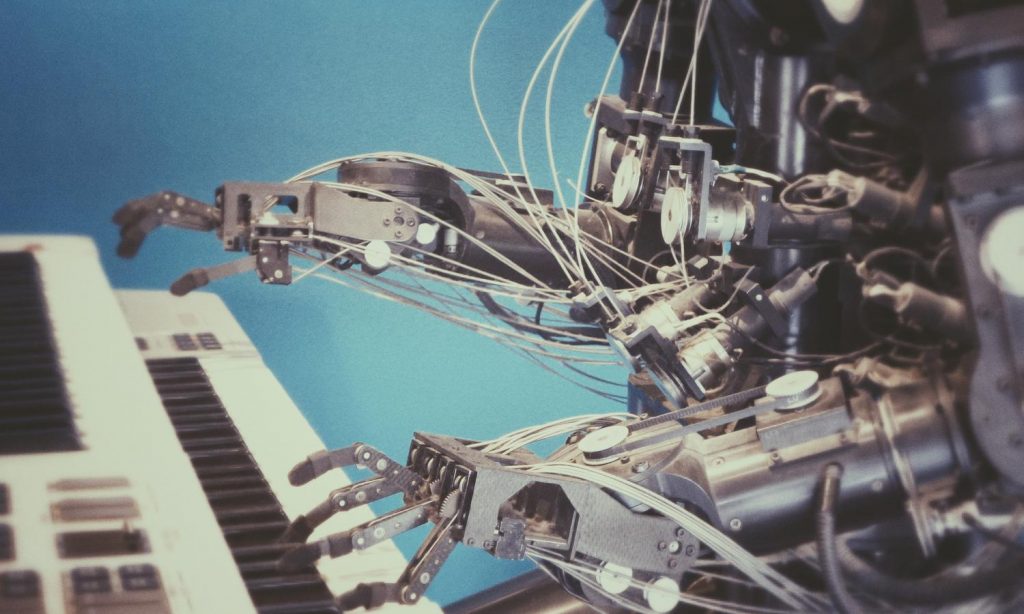
Artificial intelligence (AI) and robotics are changing the way our world works. In the last few years alone, astounding strides have been made in these fields to aid human efforts in a variety of ways. Let’s take a look at some of the most notable advancements in robotics and AI in different fields:
Healthcare
AI and robotics have both been utilized in the healthcare industry. In fact, this field is one that could arguably benefit the most by these technologies. They can assist in surgery, rehabilitation efforts, therapeutic practices, and providing patient companionship. Note the word assist ; AI and robotics are not displacing healthcare professionals. Rather, the use of these tools can make the duties of healthcare professionals much easier.
An article by Ohio University cites the example of the da Vinci Surgical System. This system utilizes the hand movements of the operating surgeon to control tiny, precise instruments inside the patient’s body. This allows for minimally invasive cardiac, colorectal, gynecologic, head and neck, thoracic, and urologic (procedures). These developments make surgical procedures much more efficient and comfortable for the patient too.
Another example of robotics in the medical field includes the use of devices such as exoskeletons for patients who have suffered strokes, spinal cord injuries, or paralysis. Robotic exoskeletons greatly aid patients during rehabilitation, and robotic lifting machines help medical professionals lift elderly or immobile patients.
Gaming
A more fun application of AI, albeit still very worth mentioning, comes via the gaming industry specifically, in the form of a poker-playing computer program. Named Libratus, this program was developed by Tuomas Sandholm, a professor in the Computer Science Department at Carnegie Mellon University in Pittsburgh, and graduate student Noam Brown.
Poker is a complicated game and has been especially hard for AI to crack. In an article on Gaming Today, Will Knight, MIT Technology Review’s senior editor for AI, explains: (P)laying poker involves dealing with imperfect information, which makes the game very complex, and more like many real-world situations.
With the immense amount of possibilities and combinations, it’s no surprise that putting Libratus together was quite a task, taking Sandholm about 12 years to complete. Ultimately, it was game theory that proved successful to determine the optimal strategy for each hand while considering numerous uncertainties.
Today, Libratus is able to beat some of the best Texan Hold Em players out there. There were clear signs that the AI had potential when, a little over 10 days into a 20-day poker tournament, Libratus was winning by nearly $800,000. This became even clearer when the computer program was the final winner, with a whopping $1.7 million lead.
The ability to win at a poker game against professional players is a major win for AI software in general. The article above explains that, Poker requires both knowledge and reasoning that has proven difficult for machines to imitate. It is fundamentally different from checkers, chess, or Go, because an opponent’s hand remains hidden from view during play. Due to this imperfect information , it is hard for AI to figure out an ideal strategy and quickly respond to an opponent’s actions. But the success of Libratus shows that it is indeed possible. The potential for other imperfect information AI applications is now within reach.
Civil Engineering
Robotic advancements have had a great impact on the field of engineering. Integrating robotics and AI into civil engineering processes is making the field more efficient and giving engineers room to innovate on a larger scale.
A particularly notable advancement comes from Dutch robotics company, MX3D. In late 2018, the company used a 3D printer to print a 39-foot-long steel pedestrian bridge. The bridge is expected to be installed on Amsterdam’s Oudezijds Achterburgwal sometime in 2019. This technology is also being used to print commercial housing. In fact, a single-story, three-bedroom-bungalow is expected to be completed in 2019.
Another achievement is the use of photovoltaic glaze. Cambridge-based specialists at Polysolar work to create solar panels that can be used in place of windows essentially making one’s window a means to trap solar energy. Using renewable energy is the way forward, and these transparent panels provide an efficient way to harness it.
In fact, as stated by Joanna Slota-Newson. Chief Technology Officer at Polysolar, the panels are good at scavenging low-level, non-directional ambient light, and the photovoltaic glaze can increase the solar energy used to meet a building’s power requirements. These developments are made possible by the major advances in the field of AI, which allows for unprecedented experimentation and innovation.
Athletics
Robots today are capable of many things, and that includes parkour! Boston Dynamics’ Atlas robot is able to execute some amazing stunts, including flawless backflips. For those who don’t know, parkour is a discipline that came out of military obstacle course training. It involves moving quickly through obstacle courses or complex urban areas in creative ways that require a good deal of dexterity and strength.
Atlas is able to navigate different environments, and its control software uses its whole body to jump over obstacles and leap up steps without slowing down. The robot uses cameras to visualize itself in its environment with visible markers, thus enabling it to maneuver accurately across the terrain.
Not long ago, robots were unable to move up and down in a straight line. Considering this, Atlas’ ability to run, jump, flip and more is incredible. The AI technology that governs Atlas shows much potential in the real world, where similar robots could possibly be used to help evacuate humans from disaster zones and save lives during times of war.
Art
The fine arts are not an area you might not associate with robotics and AI, yet advanced technology has made its way into this field too. The prowess of AI in more human areas was seen in October 2018, when a painting co-created by AI was auctioned at a Christie’s auction house.
The portrait was that of plump man in a dark coat and white collar, and it was created using a specific type of AI known as a generative adversarial network (GAN). Titled Portrait of Edmond de Belamy, the painting was estimated to sell for anywhere between $7000 and $10,000. In reality, the portrait ended up selling $432,000, showing that AI-powered art is actually in demand.
The crossover of AI into subjective fields like art, literature, and music has been relatively slow, but advancements such as this are sure to speed up the transition. AI and robotics are here to stay, and there’s no doubt that these advancements in technology will slowly but surely change all aspects of human life.