



The European Accessibility Act (EAA) 2025 will establish clear, unified accessibility rules for digital products and services. The directive, which takes effect on June 28, 2025, aims to remove barriers for people with disabilities and functional limitations, creating a more inclusive market.
For businesses, the EAA means more than a compliance obligation. It’s an opportunity to innovate, tap into new markets, and significantly improve user experience. The act will require most companies operating in the European market to follow common accessibility standards for digital products and services – notably, EN 301 549, which aligns with the Web Content Accessibility Guidelines (WCAG 2.1 AA). Non-compliance with the new directive will have serious legal, financial, and reputational consequences.
If you’re an executive, business owner, or product leader looking to navigate these changes, the ITRex team can assist. Collaborate with us to:
- Assess whether your digital products and services meet EAA requirements
- Receive expert UI/UX and accessibility recommendations
- Tweak user-facing digital products and services – from banking and mHealth apps to e-commerce websites and IoT solutions – with our team’s help
In this article, we’ll walk through the EAA’s scope, core obligations, penalties, and the strategic opportunities it offers. You’ll also discover how our UI/UX design services can turn compliance into a competitive advantage.
European Accessibility Act 2025: what you need to know
To help you better understand the EAA, we’ve divided the article into QA sections that answer the most common questions businesses have about the disruptive directive.
What is the European Accessibility Act?
The European Accessibility Act, formally Directive (EU) 2019/882, is a legislative instrument that standardizes accessibility requirements for various products and services distributed in Europe.
The EAA’s definition of “persons with disabilities” aligns with the United Nations Convention on the Rights of Persons with Disabilities (UN CRPD) and includes individuals with long-term physical, mental, intellectual, or sensory impairments. However, the EAA’s benefits go beyond this group, as it establishes product design guidelines for “people with functional limitations,” such as the elderly, pregnant women, and those traveling with luggage.
Why is the European Accessibility Act important?
This directive will bring the existing patchwork of national accessibility regulations to a common standard, creating a unified set of rules every company needs to follow. This will facilitate trade across the EU and open up new markets for all businesses, large and small. Additionally, thanks to the EAA’s broad definition of people with disabilities, the initiative will make digital products and services more accessible for Europe’s aging population.
When will the European Accessibility Act come into force?
The European Accessibility Act was unveiled on June 7, 2019, and it went into effect on June 27, 2019. EU member states were then required to adopt and publish the EAA-compliant national laws, regulations, and administrative provisions by June 28, 2022.
For businesses, the critical date to mark is June 28, 2025. Starting this date, any new products and services introduced into the EU market must meet its accessibility standards.
The European Accessibility Act, however, includes transitional periods for some existing digital products and services.
For instance, services that were already marketed to consumers have an extended compliance deadline of June 28, 2030.
What products and services are covered by the European Accessibility Act 2025?
The European Accessibility Act applies to a specific set of products and services that have been identified as being most important to people with disabilities and whose accessibility requirements vary across EU member states.
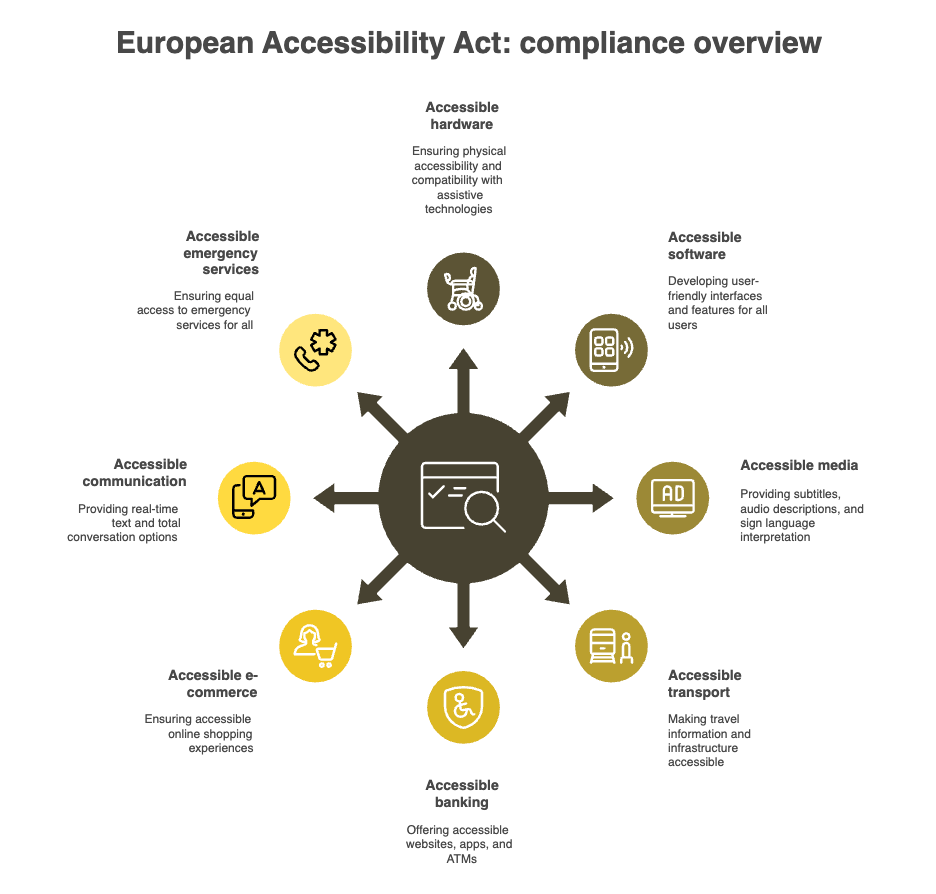
The EAA’s scope is heavily geared toward digital products and services, which reflects the growing digitization of modern society and commerce. For a full list of digital solutions that must comply with the European Accessibility Act, check out the infographic below.
Press enter or click to view image in full size

Are there exemptions from the European Accessibility Act?
Digital products, services, and content published before June 28, 2025, are currently exempt from EAA requirements. The EAA deadline for such products and services, as we’ve previously mentioned, is June 28, 2030.
Specifically, exclusions from the EAA compliance apply to pre-recorded time-based media (such as videos), office file formats, and online maps and mapping services (unless used for navigation). The same goes for third-party content that is not sponsored, developed, or controlled by the service or product provider.
Other scenarios where exemptions may apply include the following:
- Products and services developed by microenterprises. The EAA defines a microenterprise as a business with fewer than 10 employees and an annual turnover or balance sheet under 2 million.
- Instances of fundamental alteration. If compliance with the European Accessibility Act necessitates a complete change of product or service, an exemption may be granted.
- Inability to cover compliance costs. In cases where compliance would impose an unreasonable or disproportionate economic burden, a company may be exempt from mandatory EAA compliance based on a thorough cost-benefit analysis.
What are the key principles and requirements of the European Accessibility Act?
The European Accessibility Act’s requirements align with the four core digital accessibility principles: your product or service should be perceivable, operable, understandable, and robust (POUR).
Here’s what this means in practice:
- Perceivable. Content must be presented in a way that users can recognize and process it. Think: image alt text, video captions, readable fonts, and layouts that work across devices. If users can’t see or hear your content, there should be alternatives.
- Operable. Your audience must be able to interact with and navigate your site or application effortlessly. This requirement includes keyboard navigation, avoiding design choices that may cause seizures, and providing clear paths to content.
- Understandable. Your content and interface must be easy to navigate. This means using straightforward language, consistent layouts, and helpful guidance for tasks like filling out forms.
- Robust. Digital products must integrate seamlessly with current and future technologies. By following web standards and using clean code, you ensure compatibility with assistive tools like screen readers.
While the European Accessibility Act is specific to the EU, the practices it promotes are based on the internationally recognized WCAG standard.
That’s why the EAA compliance translates into tangible business benefits:
- Less duplication of effort across markets
- Fewer legal and technical risks when entering new territories
- Stronger alignment with global accessibility expectations
In short, investing in EAA compliance today can streamline your accessibility efforts worldwide – saving time, reducing costs, and supporting long-term scalability.
Who’s responsible for accessibility under the EAA?
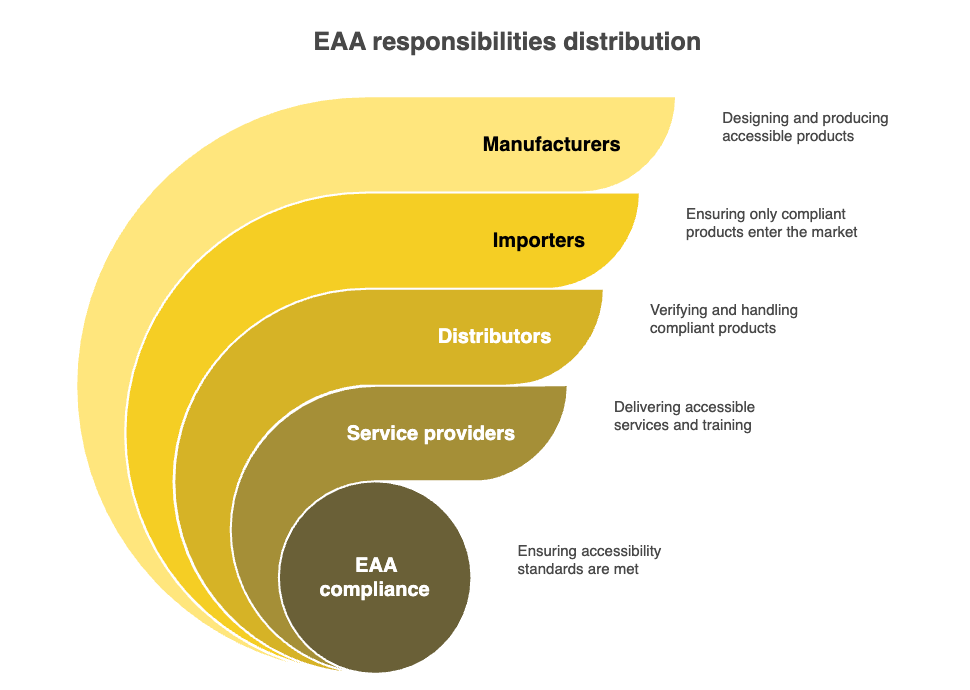
The European Accessibility Act sets out clear responsibilities for all players involved in the development, sale, and delivery of covered products and services – including manufacturers, importers, distributors, and service providers.
Press enter or click to view image in full size

A key point: products covered by the EAA must carry the CE marking, just like products that meet EU safety or environmental standards. If your product fails to meet accessibility requirements, you cannot sell it in the EU legally.
How can businesses ensure European Accessibility Act compliance?
Here are several practical steps to meet the European Accessibility Act requirements:
- Determine where you are. Examine your digital platforms, customer communications, and services to identify accessibility issues.
- Remediate issues. To remove barriers, update the designs, code, and content. This may include adding alt text to images and captions to videos and ensuring users can navigate your applications with a keyboard or screen reader.
- Establish continuous monitoring. Accessibility isn’t a one-off task. Build in regular checks to keep up with evolving standards and product changes.
- Train your teams. Educate designers, developers, marketers, and support staff about accessibility principles to ensure they are implemented consistently.
What are the European Accessibility Act non-compliance penalties in 2025?
Each EU member state determines its own enforcement rules, but the directive requires penalties to be effective, proportionate, and dissuasive. Companies that fail to meet accessibility obligations may face significant fines, corrective mandates, or even legal action.
Here’s a look at potential penalties in select EU countries in 2025:
- Ireland: Fines of up to 60,000 and/or 18 months imprisonment
- Sweden: Fines of up to 200,000, with mandatory remediation
- Belgium: Up to 200,000 per violation; repeated offenses may result in business suspension
- France: Fines up to 250,000 for non-accessible public platforms
- Italy: Ranges between 5,000 and 40,000, or up to 5% of annual turnover in severe cases
- Germany: Fines of up to 100,000
- Spain: Tiered system, with penalties of up to 600,000 for serious infractions
- The Netherlands: Up to 900,000
- Poland: Up to 1,500, or 10% of annual revenue
Who is responsible for enforcing the European Accessibility Act?
Each EU country will appoint surveillance authorities to carry out the EAA enforcement. These authorities will have the power to inspect products and services for compliance with the EAA.
If your business falls short, the government agencies can:
- Require corrective action
- Order product withdrawals
- Restrict or suspend the provision of non-compliant services
What opportunities for businesses does the EAA present?
The European Accessibility Act (EAA) brings new compliance obligations, but it also presents lucrative business opportunities, particularly for companies that prioritize accessibility:
- Easier market expansion across the EU. Whether you’re a product or services company, the new legislation could boost your company’s growth by ensuring:
One set of standards to follow across borders
Lower compliance costs by avoiding country-specific regulations
Simplified access to a broader EU market
- Underserved customer base. Designing for accessibility isn’t niche – it’s smart business. In Europe alone, over 100 million people – that is, 27% of the entire EU population – live with disabilities, and millions more experience age-related limitations. By building inclusive offerings, companies can serve a broader and growing market segment.
- Stronger brand and reputation. Corporate values are important to today’s consumers. Businesses that invest in accessibility demonstrate a commitment to inclusivity and social responsibility, which fosters trust, loyalty, and long-term brand value.
- Fuel for innovation. The EAA does more than just drive compliance; it can also inspire “inclusive innovation.” Designing for people with diverse abilities often leads to better products for everyone. From clearer interfaces to convenient voice controls, scalable visuals, and easier navigation across devices and digital channels, this “curb-cut effect” (where a feature built for one group benefits many) gives businesses a chance to stand out from the crowd and delight customers.
- Creative freedom. The European Accessibility Act focuses on functional outcomes rather than strict technical requirements. That flexibility promotes creative problem-solving and helps businesses design solutions that truly meet user needs.
How to ensure EAA compliance through expert UI/UX design?
User interface and experience design are the cornerstone of the EAA compliance, particularly for websites, mobile apps, and connected devices.
To create accessible digital experiences, your in-house or outsourced UI/UX team must address the following aspects:
- Empowering users to find what they need without confusion
- Using legible fonts, proper sizing, and line spacing to improve readability
- Validating that text and visual elements stand out against their backgrounds
- Ensuring that every action in a web application can be performed using only a keyboard (no mouse required)
- Creating seamless interfaces that work with screen readers, magnifiers, and other assistive tools
How can ITRex help you meet EAA compliance?
At ITRex, experienced design and software engineering teams will work closely with your company’s stakeholders and, if necessary, target audience to ensure that your products and services are EAA-compliant.
For this, we:
- Evaluate your product against WCAG and inclusive design principles. We use a combination of automated tools (like Lighthouse) and manual testing techniques to assess how your digital product performs against WCAG 2.1 A/AA and EN 301 549 standards. Our reviews go beyond technical checks to ensure usability for people with disabilities.
- Identify usability barriers for diverse user groups. Alongside automated scans, we evaluate how your interface performs with assistive technologies and whether it uses semantic HTML and ARIA attributes properly to communicate roles, states, and structure to screen readers.
- Provide actionable recommendations. Our experts provide clear, prioritized guidance on how to overcome accessibility obstacles, ranging from layout changes to content enhancements.
- Uncover opportunities to boost user engagement. Better accessibility often translates into a better experience for everyone. We can help you identify the overlap between accessibility improvements and increases in conversion, retention, or user satisfaction.
By entrusting the EAA compliance audit to ITRex, you get the knowledge and tools to future-proof your products and services. These include:
- A comprehensive audit report covering all relevant WCAG 2.1 A/AA criteria, with annotated examples
- A list of critical issues and quick wins, prioritized by urgency and impact
- Design and content improvement recommendations tailored to your digital product/service, industry, target market, and user base
- A custom EAA accessibility checklist your in-house development team can follow to maintain compliance as your product evolves
And if you don’t have a dedicated IT department, you can collaborate with our enterprise software development company to fix the issues that undermine your EAA compliance efforts.
As an AI-first technology company, we use artificial intelligence to streamline EAA compliance checks and improvements, reducing project timelines from months to weeks. Our AI toolbox includes:
- Robust Figma plugins like Stark, Able, and Clueify, which detect color contrast issues, missing labels, and keyboard focus problems early in the design phase
- Instruments like Seeing AI and ChatGPT-based generators, which help us draft alt text (don’t worry – our team always refines it to ensure clarity and relevance)
ITRex’s UI/UX design services, spiced up with AI, drive tangible business outcomes:
- Streamlined EAA compliance. We spot accessibility issues and align your product with EN 301 549 and WCAG 2.1 AA standards, so you’re always one step ahead of the deadline – and your competitors.
- Lower remediation costs. If you build software with ITRex, we’ll tackle accessibility early in the project lifecycle to avoid costly redesigns and late-stage development bottlenecks.
- Compliance that scales. With our guidance and custom checklists, your company gains the tools and processes to maintain accessibility as your products grow.
European Accessibility Act summary: turning compliance into competitive advantage
The European Accessibility Act is about to change the way businesses have built and delivered digital products and services for decades. With the June 28, 2025 deadline just around the corner, organizations throughout the EU and beyond must act decisively – not just to comply, but to lead.
The EAA affirms a fundamental truth: everyone deserves equal access. While meeting its requirements can be difficult, the benefits of getting it right are enormous. Companies that embrace accessibility early will gain more than just peace of mind; they will open up new markets, improve user experiences for all, and strengthen their brand’s reputation as inclusive and forward-thinking.
To unlock true accessibility, however, your company needs a cultural shift, not one-time fixes. You need to make inclusive design an integral component of your product’s lifecycle. This is where pros like ITRex Group step in. With our AI-powered UI/UX design services, you’ll turn the EAA regulatory hurdles into a source of innovation, cost savings, and long-term value.
EAA Compliance 101: FAQs
- How do I make my website compliant with the European Accessibility Act?
To comply with the EAA, ensure your website meets the WCAG 2.1 accessibility standards, focusing on the four POUR principles: perceivable, operable, understandable, and robust. Key steps include ensuring adequate color contrast (at least 4.5:1 for normal text), allowing full keyboard navigation, clearly labeling form fields, and providing accessible video content with captions and audio descriptions. Conduct thorough accessibility audits using automated tools and manual testing, then prioritize and implement the necessary improvements. As standards and technologies change, compliance should be reassessed on a regular basis.
- What accessibility testing is required under the European Accessibility Act?
To ensure real-world accessibility, testing should include automated scans, manual inspections, and user testing with people with disabilities. Tests should ensure WCAG 2.1 compliance, including keyboard navigation, screen reader compatibility, color contrast, form usability, and media accessibility (captions, audio descriptions).
- How does the European Accessibility Act affect e-commerce businesses?
E-commerce websites must follow the WCAG 2.1 guidelines to make their content accessible to users with disabilities. This includes easy navigation, understandable product descriptions, error detection, and multiple ways to complete transactions. Compliance improves user experience, broadens customer reach, and lowers legal risk. Most e-commerce businesses targeting EU customers must comply by June 28, 2025, although microenterprises with fewer than 10 employees and less than 2 million in revenue may be exempt.
- What assistive technologies need to be supported under the EAA?
Digital products and services must be compatible with commonly used assistive technologies like screen readers, magnifiers, voice recognition software, keyboard emulators, and switch devices. This ensures that users with sensory, motor, or cognitive impairments can access digital content and interact with interfaces efficiently.
- What are some industry-specific EAA considerations?
Banking services must provide accessible online banking platforms and ATMs with audio output, tactile indicators, and sufficient transaction time
- Digital publishing requires screen reader compatibility, alt text for images, and accessible navigation
- Transport services need to ensure accessibility of ticketing systems, apps, and information displays
- E-readers and software must support adjustable text sizes, contrast settings, and screen reader compatibility
- Self-service terminals need tactile feedback, audio instructions, and accessible interfaces
- Smart home devices should offer voice control, accessible apps, and compatibility with assistive technologies
- How does the European Accessibility Act relate to WCAG guidelines?
The European Accessibility Act establishes broad accessibility goals for digital products and services but does not go into technical detail. Instead, it refers to harmonized standards that businesses can use to demonstrate compliance. The primary standard for digital accessibility in the EU is EN 301 549. It specifies requirements for websites, apps, software, documents, and certain hardware. The global WCAG guidelines, particularly the WCAG 2.1 Level AA standards, are also essential for accessibility compliance. This means that meeting WCAG 2.1 AA is often the foundation of EAA compliance. However, EN 301 549 also addresses issues beyond WCAG’s scope, such as biometrics and hardware accessibility. Also, while WCAG 2.1 AA is the current baseline, WCAG 2.2 has been published and is likely to be adopted in future EN 301 549 updates. As a result, EAA compliance requires ongoing effort. Businesses must stay current and adapt their digital accessibility practices as standards shift.
By acting now, businesses can future-proof their operations, expand their customer base, and play a key role in shaping a more inclusive digital economy. Let accessibility be your competitive advantage! To get started, contact us today.
Originally published at https://itrexgroup.com on June 10, 2025.