



Your business might be smaller than Facebook or Google, but you are still handling data, still building customer profiles, and still have all the hassles that data-handling creates for every business.
The two most significant issues regarding your data are; costs and security.
Reducing Costs
Holding data helps your business to grow, but there are environmental and financial costs you need to try to minimize
Environmental Costs
As your customers become more environmentally aware, you will come under more pressure to reduce your carbon footprint. You need to share what you are doing to reduce your business’ carbon dioxide emissions: reducing your energy bill, your employees’ travel emissions, and your web hosting carbon footprint.
Carbon-Neutral Hosting
The Internet may be free at the point of use (except for equipment costs and the energy your tablet, phone or computer uses), but web servers cost your business money and add to your carbon emissions unless you insist on a carbon-neutral hosting company.
Look for a green hosting company that has a full range of hosting options, including dedicated server hosting: You might not need it now, but you will as your data needs grow.
As your websites and data storage needs grow, it becomes ever more important to consider the environmental impact of your server decisions because every web server requires electricity and cooling. However, there are many hosting companies that boast of being carbon neutral.
Hosting companies achieve carbon neutrality in one of two ways:
- They use only wind or solar-generated electricity
- They buy carbon credits to offset their emissions
Buying carbon credits seems like cheating the system, so if that’s how you feel make sure your host uses exclusively wind or solar power.
Financial Costs
Data storage and processing costs real money, and looking after the pennies will pay off in the long run.
Store Less Data (De-duplication)
Every computer has duplicate files, where a document was filed in the wrong location and then refiled without deleting the first misfiling. The more employees and computers you have the bigger this problem becomes. Backups and backups of backups exacerbate the problem.
CRMs are notorious for duplicated data and not only does this cost more to store, but it can lead to lost sales leads and poor use of employee time while they try to sort out the vagaries of your data set.
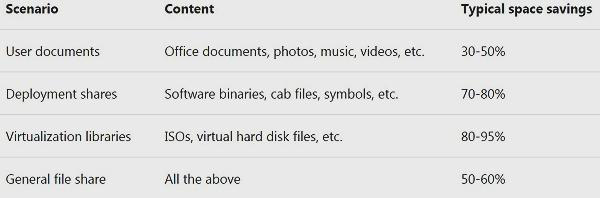

Microsoft tells us that some stored data sets could be reduced to one-twentieth of their size by deduplication. If you are using Windows Server’s Deduplication feature, users continue to access their documents as before, but your data storage costs are reduced.
Deduplication can be done on the fly’ before being stored, or after storage. Given today’s powerful processors and solid-state disks, it makes sense to use on the fly deduplication mostly because less data needs to be stored than if raw data is saved which is then deduped at a later date.
Modern backup solutions incorporate dedupe software into the server, and when you are updating your systems, this is an option you should insist on.
Cloud Storage
Using Microsoft or Google cloud storage solutions ensures that your data storage is carbon-neutral. Amazon isn’t there yet, and it looks like it could be many years before AWS is carbon-neutral. Cloud storage providers often use a higher proportion of renewable energy than your company has available, so might be one way to reduce your carbon footprint.
Securing Your Data
If you think a data breach couldn’t happen to you then check out this data breach download from PrivacyRights.org: And that isn’t even the whole picture!
If you have a breach, you can’t even keep it quiet because you are legally obliged to notify anyone affected. What would that do to your reputation among your suppliers and customers?
How Do You Store Your Data Safely?
No matter how secure your system, personnel errors are always going to be an issue:
- Isolate sensitive data and ensure it is only accessed by those who need it
- Install a firewall to make hackers’ lives difficult
- Never allow mobile devices to log onto your network because the danger of them being lost is significant
- Get rid of your BYOD policy: You cannot police devices you don’t own
- Educate everyone about the dangers of clicking links in emails because malicious links are still important hacking tools
- Change your wireless network to WPA2 encryption: WEP is vulnerable to attacks
- Update ant-virus and anti-spyware at every opportunity
- Passwords! Insist on frequently changed and strong passwords at a network level
The Short Version
Every business stores a virtually immeasurable amount of data; on customers, processes, and suppliers. Securing your data is the best means of securing the future of your business, so this must be your top priority: A data breach is an existential crisis you don’t need.
Storing your data has financial and environmental costs you need to minimize by taking informed decisions on storing and managing your precious information.