



Recently I wrote on growing data files dilemma: should we recycle or erase them. Afterwards I realized that forgetting old stuff is much more natural behavior of us, humans, than continuous going back to the past. The memories should be very impactful and emotionally loaded to make us reminding them frequently. Then I read up a very interesting survey by Apical with its key finding that only 35 percent of smartphone owners view the videos they have taken again. The survey itself was designed to disclose the ways consumers engage with their smartphones but collateral findings are interesting as well.
Big Data on Personal Level Smartphone Generated Content
Smartphone generated content is a sort of big data, on personal level. There are many different sources of data generated by and stored on the device. Think about all interactions one makes with the mobile including texting, messengers, phone calls, web search and browsing. They increase in number and become more diversified with growing list of applications downloaded. Then comes e-mail data (private and professional) for smartphones that are frequently connected into ones inboxes. There is another huge data stored in the cloud as the smartphone serves as the most convenient gate to it. Built-in camera is one of those data sources. Photos and videos created with the smartphone are than stored on the device (and, optionally, remotely with storage services like Dropbox). Analytical capacity of the average smartphone user is limited and the Android or iOS interface is not designed to do data analysis; therefore the data collected on mobile devices becomes a challenge. There is a need for unconventional solutions and tools to make them useful, accessible and valuable. This is exactly what we see with big data collected by corporations.
Similar Challenges: Abundance, Access, Value
There are more similarities between corporate big data and smartphone generated content. Both are abundant in relation to owner resources, both are not easily accessible in real time; consequently both bring less value than expected. Let me give two examples.
The corporate one: lets store all customer inbound calls longer than we used to. We could use it for speech analysis and disclose customer emotions in relation to the subject of the call. But it will not happen usually. Corporations store phone calls longer than useful to handle customer claims, but the story of the speech analysis is not materializing. Eventually the pilot is launched, but there are fresh collected data used for the pilot. Corporations expected more value from collected data than it delivered in reality
The personal one: beautiful, white-sand beach, deep blue sea, sun and palms bending over it. The perfect holiday getaway. Absolutely worth remembering. So I take my smartphone and obsessively makes photos of the brilliant environment. Then I take some videos of exceptional breeze gently caressing palm trees and exotic small creatures running on the sand, carrying snail shells on their backs (hermit crabs, probably). It is very likely (65% according to the survey) that I never go back to watch the photos and video again. The value of keeping holidays memories is not delivered.
Big Data Recycling is Not Natural Behavior
The examples show, how unnatural it is going through the same data over and over again. People tend to collect data and never come back to it. Therefore, there is nothing surprising in growing piles of customer data collected by big businesses, which remain useless within more and more huge data warehouses. It seems like corporate data culture follows individual behavior; focusing on collecting. Realizing that corporations still have several options:
One can accept reality of growing data and relatively lack of analytic capabilities. In consequence the systematical erasing of outdated information seems to be the best solution. Financial impact of this approach is better cost control.
Another option is to limit the volume of collecting data, which is smart but a difficult strategy. It decreases the cost of data handling even more than continuous erasing I mentioned before. However, it is a very conservative approach, which does not allow to discover new disruptive correlations. Gathering only valuable data makes itimpossible to find new value in data that is currently useless.
Alternatively, one can try to take out as much value as possible from the collected data. The continuous iteration of discovery analytics leads to more significant findings, which can be applied to the business. Financial impact of that strategy is an increase of revenues.
The first two strategies seem natural. Forgetting old data is natural. Limited perception in case of abundant data is a natural copying mechanism, either. The last strategy data recycling does not go naturally. The implementation of it needs effort and consequence. It needs a complex, considered corporate data policy.
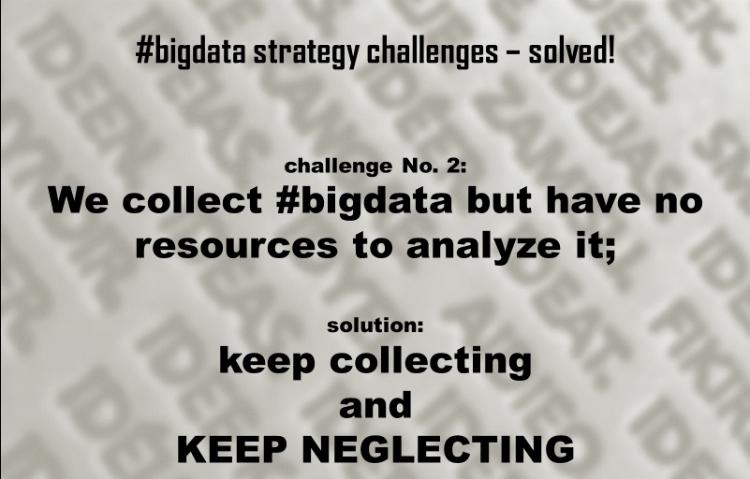

Current Status: Collect to Neglect
Apparently a big data discussion is driven by the challenge of utilization. Despite few industries which are already in, the majority of corporations still struggle with the question what for?. This is typical pioneer challenge and natural phase of the innovation life-cycle. Currently there are a lot of successful cases of collecting data. There is also a lot of affordable ways to store this data and several interesting analytical tools to dive in and visualize results. What lacks is a systemic approach to already collected data and clear criteria when data are useless enough to be neglected and, finally, erased. Practically, it means that data are collected to be actually neglected. Because it is much more natural to gather new data, watch them once or twice and start the cycle again. Exactly the same story with smartphone video. One makes it, watches it once or twice, and then forgets about it never minds watching again. It is quite frustrating indeed.